We know those late night walks to the bathroom or kitchen can make your heart race a little, especially if you care for someone who is unsteady on their feet. The house feels different in the dark, shadows play tricks on the eyes, and one small misstep can lead to a fall that changes everything for a family.
The gentle answer is that smart lighting can make those night trips much safer by giving clear, automatic light where and when it is needed, without harsh glare or confusing shadows. For most homes, a mix of motion-sensing night lights, softly lit pathways, and easy controls near the bed and bathroom can reduce falls at night in a real, practical way, while still keeping the bedroom restful.
Smart lighting for fall prevention is not about fancy gadgets. It is about calm, predictable light that comes on by itself, in the right place, at the right time, so no one has to fumble in the dark.
We will walk through the options step by step, so you can choose what fits your home, your budget, and the person you care about, whether they are aging in place, living with vision changes, or recovering after surgery.
How Nighttime Lighting Affects Fall Risk
Nighttime falls often do not happen because someone is reckless. They happen because the body and the home do not work well together in the dark.
Why Getting Up At Night Is Risky
Several things come together to make those few steps from bed to bathroom or hallway more dangerous than daytime walking:
- Sleepiness and grogginess: When we first wake up, our balance and attention are not at their best.
- Medication effects: Many evening or nighttime medicines increase dizziness, slow reaction time, or cause blurred vision.
- Low blood pressure when standing: Some people feel lightheaded when they get out of bed, especially older adults or those on blood pressure medicines.
- Reduced night vision: Aging eyes need more light and are slower to adjust to darkness or sudden brightness.
- Clutter and uneven surfaces: Rugs, cords, pet beds, and thresholds are harder to see at night.
Without good lighting, a safe room during the day can become a maze at 2 a.m.
A simple rule of thumb: if you would not walk that path with your eyes half-closed during the day, it probably needs more help at night.
How Light Helps Our Brains And Bodies Navigate
Good nighttime lighting supports both sight and balance:
| Lighting feature | How it helps prevent falls |
|---|---|
| Even, gentle illumination | Reduces shadows that can hide steps, cords, or clutter. |
| Light on floors and paths | Makes the walking route and any trip hazards easier to see. |
| No need to reach for switches | Prevents losing balance while stretching or turning. |
| No sudden glare | Protects night vision and avoids disorientation and squinting. |
| Consistent routine | Helps the person feel secure and remember where things are. |
This is where smart lighting comes in. It is not magic. It is a set of tools that help you create predictable, kind light that matches your loved one’s habits.
What “Smart” Lighting Really Means In A Caregiving Home
When we hear “smart home,” it can sound overwhelming or like a luxury. For caregiving and fall prevention, smart lighting usually means three practical things:
- Automation: Lights turn on and off by themselves, based on motion, time of day, or sensors.
- Control: Lights can be controlled from multiple places: wall switches, phones, remotes, or voice.
- Adjustment: You can easily change brightness, color warmth, or timing for comfort and safety.
For many families, “smart lighting” starts with one motion night light and grows slowly from there. You do not have to change the whole house at once.
Some caregivers like phone apps and routines. Others prefer devices that simply plug in and work. The good news is that both options exist.
Common Types Of Smart Lighting For Fall Prevention
Here are the types you are most likely to use in a home where fall safety matters:
| Type | What it is | Best use at night |
|---|---|---|
| Plug-in motion night lights | Small lights with built-in sensors that turn on when they detect movement or darkness. | Hallways, bathroom entrances, bedroom walls near the floor. |
| Smart bulbs | Light bulbs with wireless control that fit existing lamps or fixtures. | Bedroom lamps, bathroom ceiling lights, bedside fixtures. |
| Smart switches or dimmers | Wall switches that control regular lights, often with timers and remote control. | Hallway ceiling lights, bathroom lights, main bedroom lights. |
| LED strip or toe-kick lights | Thin LED strips placed under beds, along baseboards, below cabinets. | Under-bed glow, bathroom floor lighting, kitchen toe-kick lighting. |
| Smart bedside lamps | Lamps with touch controls, dimming, and sometimes motion or schedule features. | Gentle wake-up lighting, reading before sleep, safe transfer out of bed. |
| Voice-controlled lights | Lights that respond to simple voice commands through a smart speaker. | “Lights on” from bed, chair, or bathroom when hands are busy or unsteady. |
Each of these pieces can play a part in creating a safe path through the home at night.
Designing A Safe Nighttime Path: Room By Room
We can think about smart lighting as building a gentle “runway” from the bed to the bathroom, and to any other place the person goes during the night.
Step 1: Map The Usual Nighttime Routes
Before buying anything, it helps to quietly observe or ask:
- How many times does the person usually get up at night?
- Where do they go: bathroom, kitchen, living room, medication area?
- Do they use a walker, cane, or wheelchair?
- Which hand do they use to steady themselves on walls or furniture?
- Where have near-misses or falls already happened?
You can sketch a simple floor plan and mark the paths in pen or pencil. This gives you a clear picture of where light is truly needed.
Smart lighting works best when it follows the person, not the furniture. Lighting should support their actual movement, not what we wish their habits were.
Bedroom Lighting Strategy
The goal in the bedroom is to help the person transition from sleep to standing without startling them or fully waking them if not needed.
Helpful bedroom lighting ideas:
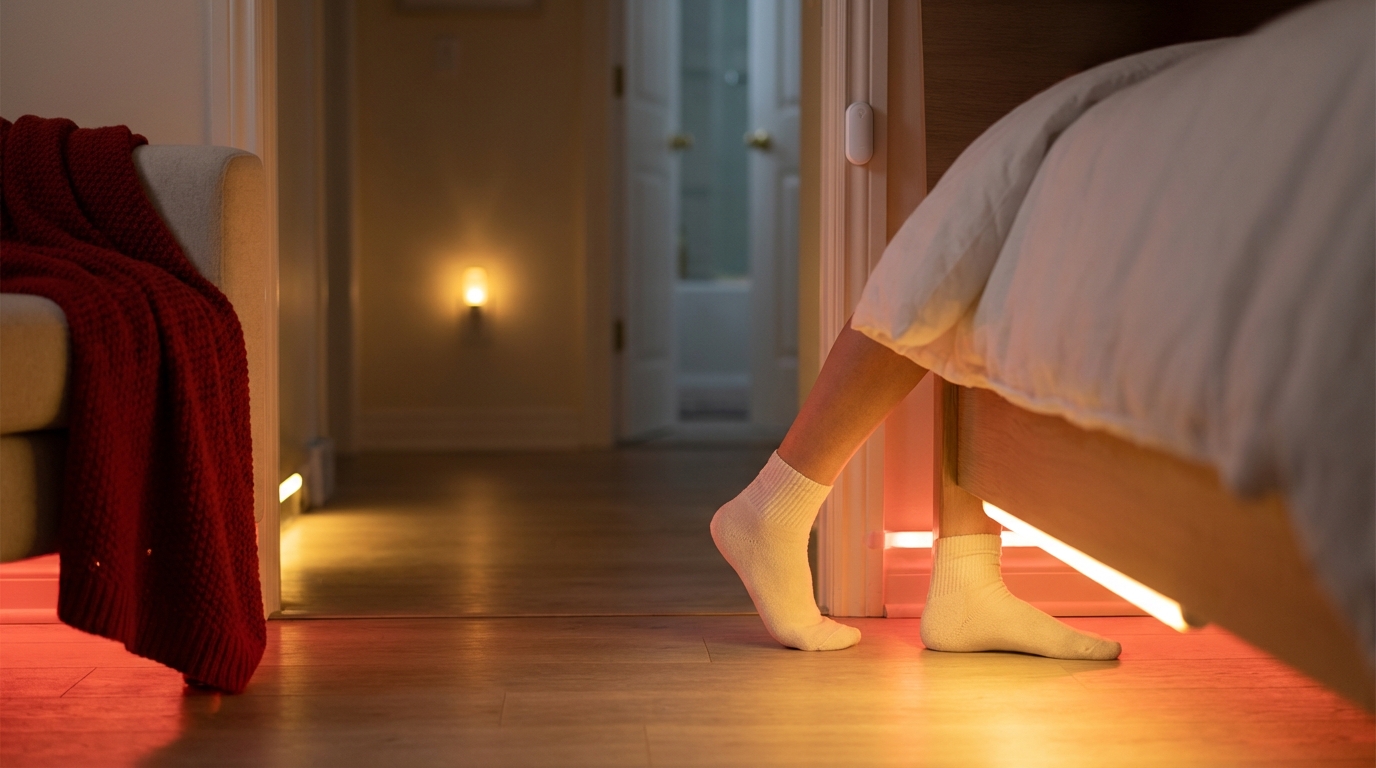
- Low-level under-bed lights: Motion-activated strips under the bed that cast a soft glow onto the floor when feet touch down.
- Gentle bedside lamp: A lamp with a large, easy button or touch base that turns on at a low brightness rather than full blast.
- Smart bulbs in the ceiling: Pre-set to a low, warm setting during night hours, so if they are turned on, they are not blinding.
- No dark “gap” between bed and hallway: Plug-in night lights along the baseboards to remove shadowy spots.
If the person often forgets to turn lights off, smart bulbs or switches can fade them out slowly after a set time, which also helps the sleep cycle.
Hallways And Transition Areas
Hallways are where many nighttime trips and stumbles happen, especially if there is a change in flooring or narrow space.
You might focus on:
- Continuous path lighting: Plug-in motion night lights spaced every 6 to 10 feet along the hallway, all at the same color and brightness.
- Lighting near thresholds: Extra light where carpet meets tile, or where there is a step down or up.
- Clear wall space: Avoid putting light fixtures or controls where someone might reach across themselves and lose balance.
- Night mode for overhead lights: A smart switch that turns hallway lights on at 10 to 30 percent brightness after bedtime.
If someone uses a walker, movement sensors should trigger before they reach the darkest section, not right in the middle of it. Choosing lights with a wide detection range can help.
Bathroom Safety Lighting
The bathroom is one of the most dangerous rooms at night. Wet floors, tight spaces, and low alertness make a risky mix.
Good bathroom lighting at night usually includes:
- A dedicated night light inside the bathroom: Near the floor, away from direct line of sight when seated on the toilet, to avoid glare.
- Smart switch or motion sensor: That brings the main light to a soft level at night, with full brightness reserved for daytime.
- Light around the toilet and grab bars: So the person can see what to hold and where to sit without guesswork.
- Non-glaring mirror lighting: Over-mirror lights can be harsh at night. Either dim them or keep them off while the lower lights handle guidance.
For people with dementia or confusion, it can also help to have the bathroom door slightly open with a consistent, warm glow that “invites” them and shows clearly where the toilet is.
Kitchen And Living Area Night Lighting
Not everyone only goes to the bathroom at night. Some wake to drink water, check blood sugar, feed a baby, or calm agitation.
Possible approaches:
- Toe-kick or under-cabinet strips: In the kitchen, these gently light the floor and counters without shining into the eyes.
- Smart bulbs in a few key fixtures: Pre-set “night walk” scenes that turn on just enough light to see from bedroom to kitchen and back.
- Chair or recliner lighting: A nearby lamp with a smart bulb, controlled by voice or remote, so someone can sit safely without walking in the dark.
- Medication corner lighting: A small, focused light where medications are kept, to avoid mixing drugs in the dark early morning hours.
You want the home to feel familiar and welcoming, not theatrical. Gentle, repeated patterns of light help the brain relax and trust the surroundings.
Choosing Light Color, Brightness, And Placement
Not all light is equal, especially at night. The right color and strength make a big difference in both safety and sleep quality.
Brightness: Enough To See, Not So Much To Shock
For nighttime fall prevention:
- Night lights: Often 5 to 40 lumens is enough for hallways and bathroom floors.
- Under-bed or strip lights: Generally lower brightness, spread out in a line, rather than one intense point.
- Ceiling fixtures on dimmers: Aim for 10 to 30 percent output during night hours.
- Task lights (for reading labels, medications): Can be brighter, but used briefly and directed away from the eyes.
Too much light can cause squinting, eye watering, and an urge to look away, which raises risk of missteps. Many caregivers find that starting dim and slowly increasing brightness over a few seconds gives the eyes time to adjust.
Color Temperature: Warm vs Cool Light At Night
Light color is measured in Kelvins (K):
| Color temperature | Looks like | Good use at night? |
|---|---|---|
| 2700K to 3000K | Warm white, soft and yellowish | Yes, calming and gentle on sleepy eyes. |
| 3500K to 4000K | Neutral white | Possibly, for task areas if needed, but can feel more “awake.” |
| 5000K and above | Cool white or daylight, bluish tone | Better for daytime, often too stimulating at night. |
For fall prevention during sleep hours, warm white light is usually kinder. It allows enough contrast to see obstacles but does not signal “wake up” as strongly to the brain.
Warm, low-level light is like a soft voice in the night. It says, “You are safe, take your time,” instead of “Wake up now.”
Reducing Glare And Harsh Shadows
People with cataracts, macular degeneration, or other eye conditions are often very sensitive to glare. Some ideas that can help:
- Choose night lights with frosted covers or diffusers, not naked bright diodes.
- Aim under-cabinet and strip lights toward the floor or backsplash, not directly into the room.
- Place lights lower on the wall when possible, so they illuminate the floor instead of shining at eye level.
- Use shades or covers on bulbs in direct sight lines, especially near beds and toilets.
Soft, shadow-free light along the floor shows tripping risks like pets, shoes, or oxygen tubing more clearly.
Simple, Low-Tech Smart Lighting Options
Not every family wants to handle apps or networks. There are still many “smart enough” solutions that work out of the box.
Plug-In Motion And Dusk-To-Dawn Night Lights
These are some of the easiest fall-prevention tools to put in place.
Common features:
- Automatic on when the room is dark, off when it is bright.
- Motion sensing within a certain distance.
- Adjustable brightness knobs.
- Warm white or amber versions for night use.
Good spots for these:
- Near the bedroom doorway.
- Along the hallway at ankle or knee height.
- Just outside and inside the bathroom door.
- Near stair tops and bottoms if stairs are present.
You might test a few brands before installing everywhere, since sensor sensitivity and color can vary.
Battery-Powered Stick-On Lights
For outlets that are in the wrong place, or areas without outlets:
- Use battery-operated, motion-activated puck lights or strips.
- Stick them under beds, under handrails, near closet doors, or inside cabinets.
- Choose versions with long battery life and easy-to-open covers.
These are very helpful in rentals or older homes where wiring is limited. Just remember to mark a calendar for regular battery checks.
Timer-Based Lamps
Some caregivers simply want a lamp that turns on at a set time each evening and off in the morning:
- Use plug-in timers for lamps in hallways and bathrooms.
- Set them for when your loved one usually prepares for bed or wakes.
- Combine them with low-wattage, warm bulbs so they do not disturb sleep.
This is not as responsive as motion sensing, but it still reduces the risk of walking into a dark room.
More Advanced Smart Lighting For Those Who Want It
If you are comfortable with basic technology, you might create a more tailored smart lighting system.
Smart Bulbs And Scenes
Smart bulbs screw into existing fixtures and connect to your home Wi-Fi or a hub. Once set up, you can:
- Dim lights and change color from a phone or tablet.
- Create “scenes” like “Night bathroom” at 20 percent warm light, or “Morning routine” at brighter levels.
- Schedule lights to go into night mode automatically at a certain time.
- Control lights remotely if you are caring from a distance.
Scenarios that can help fall prevention:
- A “Path to bathroom” scene that turns on a string of hallway and bathroom lights at low levels with one tap.
- A “Care visit” scene that brightens key areas when nurses or helpers arrive early or late.
- “All off except night lights” scenes at bedtime to avoid forgotten lights that create glare.
If your loved one is uncomfortable with phone controls, you can still set the scenes and let them use the switches as usual.
Smart Switches, Dimmers, And Motion Sensors
For people who strongly prefer using wall switches, smart switches can be a good middle ground.
They allow:
- Normal on/off use at the wall.
- Remote control and scheduling through an app.
- Integration with motion sensors and door sensors.
- Preset night brightness so that switches never blast full light in sleep hours.
Examples of helpful automations:
- When motion is detected in the bedroom between 10 p.m. and 6 a.m., hallway and bathroom lights turn on at low brightness for 5 to 10 minutes.
- When a bathroom door opens at night, floor-level lights stay on for a short time to cover handwashing and return to bed.
- If there has been no movement for several hours during usual waking time, a hallway light turns on as a gentle safety check.
If you use motion and door sensors, discuss privacy and consent with the person who lives there. The goal is support, not surveillance.
Voice-Controlled Lighting
For some people with limited mobility or hand strength, voice control can be very freeing.
Practical uses:
- Saying “Bedroom low lights on” when waking at night, instead of reaching for switches.
- Turning all lights off after getting settled in bed.
- Asking for brighter light if they drop something or feel unsteady.
This may not suit everyone. People with hearing loss, speech difficulties, or distrust of smart speakers may prefer touch controls. It is fine to skip this layer if it does not bring comfort.
Special Considerations For Dementia, Low Vision, And Mobility Limits
Different health conditions call for different lighting choices. It helps to adjust for the person, not just age in general.
For People Living With Dementia Or Cognitive Changes
Unfamiliar or startling lighting can increase confusion or wandering. Some helpful ideas:
- Keep lighting patterns very consistent from night to night.
- Avoid sudden strong changes in brightness; use gradual fades.
- Use warm, calm colors rather than bright blues or greens.
- Keep the bathroom lighted enough that the toilet is easy to recognize.
- Use lighting to gently “guide” away from stairways or outdoor doors at night, not to attract attention to them.
Motion lights in the bedroom can be unsettling for some people with dementia, who may not understand why lights “turn on by themselves.” In that case, a soft, always-on night light may be better than motion detection.
For People With Low Vision
When vision is reduced, contrast and glare matter more than brightness alone.
You might:
- Strengthen contrast by using light to clearly outline doorframes, handrails, and grab bars.
- Place extra light near steps, uneven floors, and thresholds.
- Choose matte finishes for floors and walls to reduce reflection.
- Avoid very dark rugs or mats that can look like holes.
- Add tactile cues (like non-slip strips) where lighting changes are not enough.
Consulting with a low-vision specialist can be helpful. They often have practical suggestions about where light will help the most and where it may hinder.
For People Using Walkers, Canes, Or Wheelchairs
Mobility aids change how light hits the floor and where shadows fall.
Helpful adaptations:
- Place lights so that the front of the walker or wheelchair does not cast a big shadow over the next step.
- Consider small, clip-on lights for walkers or canes that point downward, if the home lighting is limited.
- Ensure that pathways are wide and free of cords, pet bowls, or low tables that may hide in shadows.
- Keep handrails and grab bars well lit, as reaching for these is a key safety move.
A brief walk-through with the person, at night with all lights set as planned, can show you where new shadows remain and where to add lights.
Balancing Safety, Sleep Quality, And Privacy
It can be tempting to just make everything bright, all night, and feel that you have “solved” the fall problem. Yet constant bright light can disrupt sleep, cause agitation, and remove the sense of nighttime rest.
Protecting Sleep While Preventing Falls
To keep night lighting gentle on sleep:
- Use warm color temperatures for all automatic night lights.
- Keep light levels as low as safely possible for walking and toileting.
- Turn off or dim screens and bright task lights 1 to 2 hours before bedtime.
- Use blackout curtains or shades if streetlights glare into the room.
- Reserve bright white or blue-toned lights for daytime activities only.
Safety matters, but so does rest. A well-planned lighting setup respects both, so the person is less likely to be drowsy and unsteady the next day.
Respecting Dignity And Independence
Many older adults feel that “safety measures” mean loss of control. The way we introduce smart lighting can either calm or heighten those feelings.
You might:
- Involve the person in choosing fixtures, colors, and where lights go.
- Explain that lights are there to support their independence, not to monitor them.
- Offer options: “Would you like the hallway brighter at night, or more light in the bathroom?”
- Adjust based on their feedback rather than assuming what they need.
If cameras are part of your smart home, keep them separate from lighting controls when possible, and always be clear about what exists where.
Practical Steps To Get Started In Your Home
It can feel like a lot to take in. Small, steady changes usually work better for everyone than a big overhaul.
Step 1: Do A Night Walk-Through
Choose a calm evening and, together if possible, walk the actual night routes with the lights set as they usually are:
- Start in bed, stand up as the person normally would, and notice where shadows fall.
- Walk to the bathroom, to the kitchen, or to wherever they go at night.
- Pay attention to points where you feel uncertain about your footing.
- Note any glare from windows, mirrors, or unshielded bulbs.
Write down 3 to 5 spots that feel the least safe. These are your first lighting projects.
Step 2: Begin With The Highest-Risk Area
Most caregivers start either with the path to the bathroom or with the bathroom itself.
A basic starter kit might include:
- 2 to 4 plug-in motion night lights.
- 1 or 2 under-bed or strip lights.
- 1 smart bulb or dimmable bulb in the bathroom.
- Non-slip bath mat and clearly visible grab bars to go with the light.
Place them, then test another night walk. Adjust angles and brightness until the route feels calm and clear.
Step 3: Add Control That Fits Your Situation
Once your basic path is lit, you can decide how much control you want:
- If you want “set it and forget it,” rely mostly on motion and dusk sensors.
- If you want tailored routines, add smart bulbs or switches and create time-based scenes.
- If you want remote check-ins, choose devices that you can monitor and adjust from your phone.
If you care for someone long-distance, smart lighting can be a way to still support their safety, alongside regular local checks.
Step 4: Review After A Few Weeks
After a little time with the new lighting:
- Ask the person how they feel about the changes: too bright, too dim, comforting, annoying.
- Watch for any new tripping areas created by moving furniture, cords, or rugs around lights.
- Adjust timers and brightness based on real experience, not just guesses.
Fall prevention is an ongoing process, not a one-time project. As health changes, lighting needs may also shift.
We cannot remove every risk, but we can soften the home so that night does not feel like an obstacle course. Gentle, thoughtful lighting is one of the kindest tools we have for that work.