It is not easy to look at your front steps and feel like they are a wall between your home and the person you love. Many of us reach a point where we stand at the door, wheelchair or walker nearby, and think, “How are we going to keep doing this safely?” If you are weighing ramps vs. lifts for outdoor access, you are not alone, and you are not late. You are simply at the next step of caring.
The short answer is that ramps tend to be better for shorter heights, tight budgets, and people who can manage some distance, while outdoor lifts are often better for higher porches, limited yard space, harsh weather, and situations where pushing a wheelchair up a long ramp feels unsafe or exhausting. Both can be safe and dignified when they match the person’s mobility, your home’s layout, and your budget. The most helpful choice comes from looking calmly at day-to-day life, not just the sales brochure.
Starting with feelings, not hardware
Before we compare ramps and lifts, it helps to pause and name what many caregivers feel in this moment: worry about falls, guilt about money, frustration with stairs, and sometimes grief as independence changes. That mix is heavy.
You are not failing if the stairs have become too hard. It simply means the home needs to change, not the person.
When we talk about ramps vs. lifts, we are really talking about:
– How to make coming and going calm instead of stressful.
– How to protect backs, knees, shoulders, and hearts.
– How to stretch money in a way that feels responsible.
– How to preserve dignity for the person using the mobility aid.
Once we hold that in mind, the technical details start to make more sense and feel less overwhelming.
Ramps vs. lifts at a glance
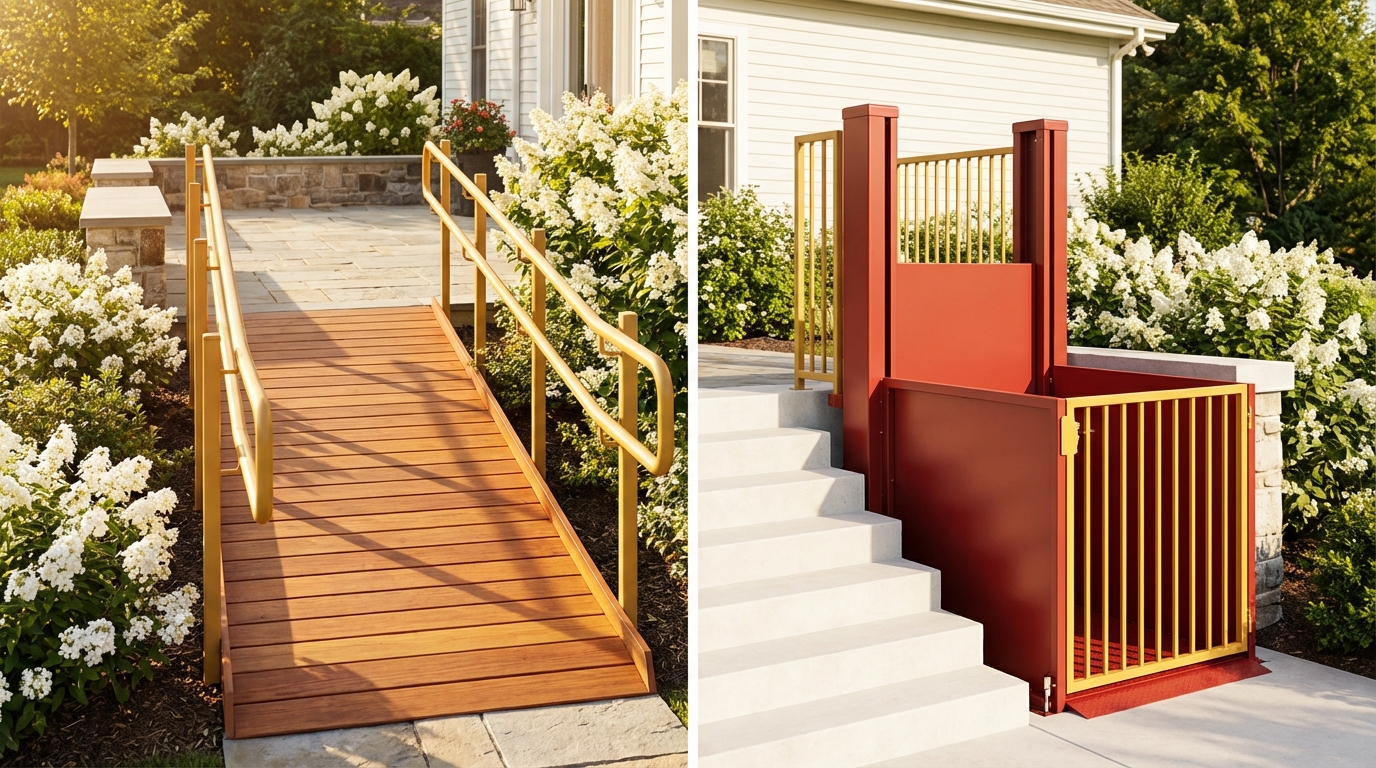
- Ramps work well for small to moderate height changes (often up to about 24 inches) when there is enough yard or driveway space for a gentle slope.
- Outdoor lifts (often called vertical platform lifts or porch lifts) work well for higher porches or decks, small yards, or very limited caregiver strength.
- Ramps usually cost less upfront but take more space and can be harder to clear of snow, ice, or leaves.
- Lifts cost more upfront and need electricity and maintenance but handle bad weather and higher rises more easily.
- The safest choice is the one that the person can use comfortably, day after day, without strain for them or for you.
What is an outdoor ramp?
Ramps are sloped paths that replace or bypass stairs so that wheelchairs, walkers, scooters, and people with unsteady balance can move more safely.
Common types of outdoor ramps
- Temporary or portable ramps
Usually aluminum, smaller, and movable. They sit on top of steps or thresholds and can be folded and stored. - Modular metal ramps
Pre-fabricated sections in aluminum or steel, assembled on-site. They can be reconfigured, extended, or removed later. - Permanent wood ramps
Built by carpenters, tied into decks or porches. They can look more like part of the house but need ongoing care. - Concrete or masonry ramps
Poured concrete or block with a finished surface. Very sturdy, long-lasting, but harder to change later.
For long-term, daily wheelchair use, a modular metal or well-built permanent ramp with railings usually gives the safest, most predictable surface.
What is an outdoor lift?
An outdoor lift for wheelchairs is usually a vertical platform lift (VPL). It is like a small open elevator. The person rolls or walks onto a flat platform at ground level, closes a gate or safety rail, presses a button, and the platform rises straight up to porch or deck height.
Key parts:
– Platform with non-slip surface.
– Small ramp or lip at the entry edge.
– Side panels or guards to prevent roll-off.
– Top and bottom safety gates or doors.
– Controls with constant-pressure buttons (you must keep pressing).
– Electric motor with backup safety systems.
Some homes use inclined platform lifts on stairways, but for outdoor access from yard to porch, a vertical platform lift is more common.
Safety and comfort: what matters day to day
Before cost or style, safety and comfort need our full attention. Many caregivers discover that what looks “cheaper” can become more costly in injuries, strain, or fear.
Key safety questions for ramps vs. lifts
| Safety factor | Ramps | Lifts |
|---|---|---|
| Risk of falls | Higher if slope is too steep, surface is wet/icy, or there are no railings. | Low when used correctly, but risk exists with missteps or rolling at platform edges. |
| Caregiver strain | Can be high if pushing a wheelchair up a long ramp or controlling it downhill. | Lower physical strain; the motor does the lifting. |
| User independence | Good if the person can self-propel on slopes and turn safely. | Good if the person can manage buttons, gates, and turning on the platform. |
| Weather impact | Snow, ice, rain, and leaves can make ramps slippery and hard to maintain. | Platforms still need to be kept clear, but lifts may be easier to treat with mats and covers. |
| Emergency reliability | Always “on,” no power needed, unless snow or damage blocks the surface. | Needs power; many units have battery backup, but long outages can be a concern. |
If you or another caregiver must lean your whole body weight into a wheelchair to get up the ramp, the setup is not safe enough, no matter what the code says.
Thinking about the person’s abilities
Ask yourself and, if possible, the person who will use the ramp or lift:
– Can they push their own wheelchair up a gentle slope, or do they tire quickly?
– Can they control speed on the way down?
– How is their vision, especially in low light or bad weather?
– How steady are their hands for operating buttons, latches, or gates?
– Do they feel anxious about heights or moving platforms?
Sometimes, we try to “build independence” by choosing a ramp that is technically usable, but very tiring. If the person will end up asking for help every time, a different solution might support independence more kindly.
Space, slope, and building code basics
One of the most common surprises with ramps is how long they must be to be truly safe. A small-looking porch can require a very long ramp.
How long does a ramp need to be?
A common guideline from accessibility standards is:
– For every 1 inch of rise, you need about 12 inches (1 foot) of ramp length.
– That is often written as a 1:12 slope.
So:
– 6 inch rise needs about 6 feet of ramp.
– 12 inch rise needs about 12 feet of ramp.
– 24 inch rise needs about 24 feet of ramp.
– 36 inch rise needs about 36 feet of ramp.
Many local codes follow something close to this, especially for public spaces. Homes sometimes are allowed steeper ramps, but steeper than 1:12 quickly becomes hard to push and riskier to walk.
If the rise is over 24 inches, it is very common for long ramps to become hard to manage in real life, even if they meet the letter of the code.
Space planning for ramps
Ramps for wheelchairs also need:
– Flat landings at the top and bottom, usually 5 feet by 5 feet.
– Turn platforms if the ramp changes direction.
– Clear width, often at least 36 inches between handrails, sometimes more.
This means a ramp for a 30 inch porch might need:
– Around 30 feet of ramp.
– A few 5 foot long flat areas for resting or turning.
– Railings along exposed sides.
– Space away from property lines or sidewalks, depending on local rules.
If your yard is small or slopes away quickly, that much ramp may not fit safely.
When yard space is limited
If you find yourself sketching a zig-zag ramp that circles half the yard, it might be time to look more seriously at a lift. There is no prize for squeezing in a ramp that barely fits.
On the other hand, if you have a long, straight driveway or a side yard with room for a gentle run of ramp, a ramp might be peaceful and straightforward.
Cost comparison: ramp vs. lift
Money is often the hardest topic in these decisions. Many caregivers feel torn between “doing everything possible” and “not draining savings.” It helps to look at typical ranges instead of guessing.
Approximate cost ranges
These are very general ranges in US dollars. Local prices can vary.
| Solution | Typical upfront cost | Ongoing costs |
|---|---|---|
| Portable threshold or short ramp | $100 to $800 | Minimal; occasional replacement or adjustments. |
| Modular aluminum ramp (longer) | $1,500 to $6,000 (sometimes more for complex layouts) | Little maintenance; some cleaning, anti-slip treatments. |
| Permanent wood ramp | $2,000 to $8,000+ | Staining, sealing, repairs for rot or warping. |
| Concrete ramp | $3,000 to $10,000+ | Minor cracks, surface treatments, de-icing. |
| Vertical platform lift (VPL) | $5,000 to $15,000+ (lift and install) | Electricity, annual service, repairs, battery replacements. |
When comparing costs, consider not only money but also the “cost” of back injuries, falls, and avoided outings.
Hidden and long-term costs
Some questions to ask yourself:
– Will I need to shovel, salt, or sweep this every time we go out?
– Could this design cause strain that leads to physical therapy or missed work?
– How much will maintenance visits or wood sealing add over 5 years?
– If we sell the home later, will this be easy to remove or reuse?
It is very common to underestimate the physical effort and time that a long outdoor ramp can require, especially in snowy or leafy regions.
Weather, climate, and outdoor conditions
Your local climate shapes what “safe and low stress” looks like far more than most brochures suggest.
Ramps in wet, snowy, or icy climates
On ramps, moisture combines with slope. That can be risky. Points to think through:
– Rain can make wood and metal slick without proper non-slip surfaces.
– Snow and ice can cover ramp markings and edges.
– Slush and wet leaves can create a layer that feels like soap under wheels or feet.
– Salt can corrode metal if not managed.
For ramps in these areas, you might look for:
- Textured surfaces or non-slip treads, not smooth boards or sheet metal.
- Handrails on both sides at a comfortable height.
- Good drainage so water does not pool and freeze.
- Shade or covers where possible, to limit snow buildup.
Lifts in harsh weather
Outdoor lifts must be rated for exterior use. Points to consider:
– Many lifts run in cold temperatures but may need special lubricants.
– Snow and ice must be cleared from the platform and entry/exit zones.
– Some units have covers or small roof structures to protect the equipment.
– Coastal or very humid regions may need extra rust protection.
Here, a properly installed lift with a small covered area can be easier to manage than a 30 foot snow-covered ramp, but you will still need a plan for clearing and for power outages.
Independence vs. assistance
This is where many families struggle. We want loved ones to do as much for themselves as they safely can, but not so much that every trip out the door drains their energy.
When ramps support independence well
Ramps tend to work best for independence when:
– The person has moderate arm strength and endurance.
– Their wheelchair or scooter handles slopes well.
– The rise is modest (for example, 12 to 18 inches).
– The surface has good traction, and the route is straightforward.
– There is a level area at the top and bottom where they can pause.
A person who enjoys rolling themselves and has reasonable stamina may feel free and confident on a gentle ramp.
When lifts support independence well
Lifts often suit independence better when:
– The person has very limited strength for slopes but can press buttons.
– The rise is large, such as a tall porch or second-level deck.
– Space for ramps is limited, which would force steep or twisting runs.
– Caregivers cannot safely push a wheelchair up or down a ramp.
Some users with visual or cognitive changes may feel uneasy on a lift, so it helps to do a trial if possible, at a medical facility or showroom, before you decide.
Caregiver safety and strain
Many caregivers try to be brave about their own pain. They push hard, twist, lift, and brace because they love the person in the chair. This is generous, but not sustainable.
If you injure yourself, both of you lose independence. Your safety is part of their safety plan.
Risk factors with ramps
Ramps can be hazardous for caregivers when:
– The slope is more than 1:12 and the person is in a manual wheelchair.
– The caregiver is significantly lighter or weaker than the person they are pushing.
– Weather makes controlling the chair difficult on the way down.
– The route requires sharp turns that risk tipping.
Warning signs:
– You feel dread every time you approach the ramp.
– You find yourself leaning with all your weight into the handles.
– Your feet often slip while pushing, especially in rain or snow.
– You already have back, shoulder, or knee pain.
In those cases, a shorter, safer ramp combined with a lift, or a lift alone, may protect everyone better.
Risk factors with lifts
With lifts, caregiver strain tends to be more emotional and cognitive than physical:
– Remembering the sequence of gates, locks, and buttons.
– Helping someone with dementia who may step or roll at the wrong time.
– Worry about power outages or mechanical failures.
Training, clear instructions, and practice runs can ease these worries. Battery backups and manual lowering systems are important to ask about when choosing a lift.
Installation: what to expect for ramps vs. lifts
Both ramps and lifts change the look and function of your entry. Planning ahead can save both money and stress.
Ramp installation overview
For modular aluminum ramps:
– A technician or team visits, measures height and space, and designs a layout.
– The ramp sections arrive, often pre-fabricated.
– Installation can take a few hours to a day, with minimal disruption.
– Few permanent structural changes to the house, though there may be some anchoring.
For wood or concrete ramps:
– A contractor designs and may need drawings and permits.
– Digging, post setting, form building, and concrete curing can take multiple days.
– The ramp is more permanent, and changes later can be costly.
Permits and code checks differ by place, so calling your city or county office before starting can prevent unpleasant surprises.
Lift installation overview
For a vertical platform lift:
– An evaluator measures height, checks available space and paths, and confirms electrical supply.
– In many areas, you need a permit and an inspection for safety.
– A concrete pad or strong base is often poured or confirmed.
– The lift is anchored, wired, and tested.
– Safety features, gates, and controls are checked.
This can take longer than a modular ramp, especially if you need electrical and concrete work. However, once installed, the physical footprint is often smaller than a long ramp.
A closer comparison: when a ramp makes sense
There are clear cases where a ramp is usually the kinder and more straightforward choice.
Good fit situations for ramps
Consider a ramp when:
- The porch or step height is small (for example, 1 to 2 standard steps).
- You have enough space for a gentle 1:12 slope and level landings.
- The person using it can self-propel or walk with a walker safely.
- You prefer a passive system that does not rely on electricity or motors.
- Your budget is limited, and you need an accessible solution quickly.
Short, well-built ramps can be nearly invisible in day-to-day stress levels. They become simply “the way we go in.”
When a ramp might be the wrong choice
You might want to question a ramp-centered plan if:
– The porch is more than about 24 to 30 inches high.
– Yard space is steep or very limited.
– Your climate brings long winters, heavy snow, or frequent ice.
– Caregivers are already coping with injuries or limited strength.
– The person in the wheelchair is large, and those pushing are smaller.
In these settings, forcing a ramp to work can create daily struggles that no one deserves.
A closer comparison: when a lift makes sense
Lifts tend to shine where space or height make ramps impractical or unsafe.
Good fit situations for lifts
A vertical platform lift might be well suited when:
- The porch or deck is several feet high, and a ramp would need many feet of length.
- The yard is small, hilly, or there is no clear path for a long ramp.
- The person using it has limited strength for slopes or depends on powered mobility.
- Caregivers have physical limitations or there is often only one person helping.
- There is a strong desire to keep the yard more open or maintain certain landscaping.
Some families also value that a lift can feel more “neutral” than a large ramp visually, although this is quite personal.
When a lift might be the wrong choice
You might rethink a lift if:
– You cannot secure reliable power or backup power.
– There is no place to pour a suitable concrete pad.
– The person using it has severe agitation, fear of moving platforms, or may try to exit while the lift is moving.
– Ongoing maintenance costs are not realistic in your budget.
In those settings, a carefully designed ramp, sometimes at a different entry to the home, may be more practical.
Maintenance and reliability over time
Once the installers leave, you live with the choice. Thinking about care and repairs from the start can protect your peace of mind.
Ramp maintenance needs
For metal ramps:
– Periodic checks for loose bolts, shifting, or corrosion.
– Cleaning to remove dirt, algae, or leaf buildup.
– Fresh anti-slip tape or treatments when worn.
For wood ramps:
– Regular sealing or staining to resist moisture.
– Checking for rot, splinters, heaving, or loose boards.
– Extra care at railings and joints where water can enter.
For concrete ramps:
– Watching for cracks or uneven settling.
– Resealing top surfaces if needed.
– Ensuring de-icing agents do not break down the surface too quickly.
Lift maintenance needs
For outdoor lifts:
– Annual or semi-annual professional service checks.
– Keeping tracks, platforms, and controls clear and dry.
– Testing backup systems as recommended.
– Responding quickly to any unusual noises, jerks, or error messages.
Many installers offer service contracts. You may want to ask about response time, available parts, and costs before you buy.
Emotional and social aspects
Accessibility changes more than how we move. It can shift how we feel about home, pride, privacy, and community.
Stigma and visibility
Some people worry that a large ramp in front of the house “announces” disability. Others feel that a lift looks like a machine or a medical device.
There is no single right view. What matters is how the person who lives there feels. It can help to:
– Involve them in choosing style and placement.
– Look at photos of different designs together.
– Ask gently: “What feels more like home to you?”
Social connection
Better access can:
– Make it easier to attend appointments and favorite activities.
– Help neighbors and friends visit without awkward lifting at the door.
– Reduce isolation, especially for someone who already feels cut off.
Every safe, low-stress trip out the door is a small return of freedom, both for the person you care for and for you.
Making the decision step by step
With all this information, you might still feel torn. That is normal. A simple process can help.
1. Measure and sketch
– Measure the height from ground to the top of the porch floor.
– Measure how much flat space you have in different directions.
– Sketch the house front, driveway, and yard roughly on paper.
2. List medical and physical realities
Write down:
– The person’s diagnosis and how their mobility might change over the next 2 to 5 years.
– Their weight and the weight of chair or scooter.
– Caregivers’ physical limits and any past injuries.
– Local weather challenges for most of the year.
Try to be honest rather than hopeful here. This protects everyone.
3. Set a realistic budget range
Include:
– What you can pay now without harming other critical needs.
– Whether you can handle some monthly payments if needed.
– If you have access to grants, veteran benefits, or state programs.
Sometimes a smaller, safer solution now plus a plan for later is kinder than waiting years for a “perfect” setup.
4. Talk to at least two qualified providers
Reach out to:
– A reputable ramp provider or contractor.
– A reputable lift provider or dealer.
Ask each to:
– Explain why they think their solution fits your situation.
– Show you similar jobs they have done.
– Walk you through maintenance and total 5 year cost, not just install price.
If one of them pushes you to sign quickly or dismisses your safety concerns, that is a warning sign.
5. Bring in a neutral professional if possible
If you can, involve:
– An occupational therapist with home modification experience.
– A social worker or case manager familiar with local housing programs.
They can see risk areas and daily living challenges that salespeople might miss.
Common scenarios and which option often fits
The following are simplified examples, not strict rules, but they can give a useful sense of direction.
| Scenario | Ramp or lift tends to fit better | Why |
|---|---|---|
| Single step at front door, mild mobility issues, walker use | Short ramp | Small rise, low cost, more stable walking surface. |
| Two to three steps, large front yard, manual wheelchair, mild climate | Modular ramp | Enough space for gentle slope, independent self-propelling may be possible. |
| High porch (4+ steps), small or sloped yard, caregiver has back pain | Lift more often | Ramp would be long and hard to push on; lift reduces strain. |
| Very snowy region, 3 steps, person uses power wheelchair | Lift or short, covered ramp | Snow on long ramps is hard to manage; power chair works well on lift. |
| Rapidly changing condition, rental housing, uncertain future plans | Portable or modular ramp | Lower commitment, removable, can move with you. |
Questions to ask any installer or vendor
Having a short list of questions can help you feel less at the mercy of sales talk.
For ramp providers
- What slope are you planning, and how does that compare to 1:12?
- How wide will the ramp be, and will railings be included?
- How will you make the surface non-slip in wet or icy weather?
- Where will the landings be, and is there space for turning a wheelchair?
- How long do you expect this ramp material to last outdoors?
- What permits or inspections are required, and who handles that?
For lift providers
- Is this model rated for outdoor use in my climate and temperature range?
- What safety features are built in (gates, sensors, emergency lowering)?
- What happens in a power outage, and how long does backup power last?
- What is the weight limit, including the chair or scooter and any caregiver riding along?
- How often should it be serviced, and what does that cost?
- How quickly can repairs usually be done if there is a breakdown?
Clear, respectful answers from a provider are just as important as the equipment itself.
When neither option feels “perfect”
Sometimes, no choice feels fully right. Maybe the porch is high, the yard is small, the budget is thin, and there are several health issues at once. In those hardest cases, it can help to think in layers:
– Can we move the main entry to a different door with a lower rise?
– Can we adapt a garage entry to avoid outdoor stairs?
– Can we combine a small ramp with a fewer-step interior lift?
– Would short-term help with transportation ease the pressure while we plan?
This is where honest conversations with medical providers, social workers, and sometimes housing specialists can open paths that were not visible at first.
Bringing it back to daily life
At the end of the day, the question is simple, even if the path is not:
“How can we make getting in and out of home feel safe, calm, and as independent as possible for both of us?”
Ramps give a steady slope that asks more of muscles and weather care. Lifts give a stable platform that asks more of wiring, motors, and maintenance. Both can be wise. Both can be unwise if they ignore your real space, climate, bodies, and budget.
You do not need to decide in one night. You do not need to carry this alone. Gather measurements, talk with neutral professionals, listen to your own body and to the person who will ride the ramp or lift. Then choose the solution that lets you both stand at the doorway, take a breath, and feel that home is still reachable.