It is not easy to relax at home when you are always watching every step, worried that a small bump in the floor or a raised threshold might cause a fall. Many of us only start noticing those tiny changes between rooms after a loved one stumbles, or after a new walker, cane, or wheelchair catches on a strip of flooring that never seemed like a problem before.
If you just want the short answer: the safest way to reduce trip hazards where one room’s flooring meets another is to keep height differences as small and smooth as possible, use gentle transition ramps or strips that are securely installed, improve lighting and contrast so edges are easy to see, and avoid loose rugs or sudden level changes at doorways and between flooring types. Most homes benefit from a mix of simple fixes (tape, trim, removing bumps) and a few more permanent changes (low-profile thresholds, transition ramps, and sometimes leveling the floor) chosen to match the person’s mobility needs.
Why Transitions Between Room Flooring Matter So Much
Those little changes in floor height that many of us step over without a thought can be a serious hazard for:
– Older adults
– People using walkers, rollators, or canes
– Wheelchair users
– People with neuropathy, Parkinson’s, stroke, low vision, or balance problems
– Kids and adults who are simply tired or distracted
When legs do not lift as high as they used to, or when balance is fragile, even a 1/2 inch rise can feel like climbing a curb. Wheels can snag, canes can slip, and toes can catch.
A safer home often starts with the small things that break our stride: the lip into the bathroom, the raised edge into the kitchen, the thick rug at a doorway.
These transitions matter for reasons beyond safety too. Smoother flooring changes can:
– Make it easier to push a wheelchair or walker
– Reduce fatigue for caregivers who are helping someone walk
– Help a person feel more independent at home
– Lower anxiety about moving from room to room
Once we see those spots as real barriers, not just quirks of an older house, it becomes easier to plan changes that help everyone move more comfortably.
Common Trip Hazards Where Floors Meet
Before we change anything, it helps to notice how many different kinds of transitions we may have under one roof. Each one can bring its own risks, especially for someone with mobility or vision challenges.
- Raised thresholds at doorways (metal, wood, or stone strips)
- Height differences where one room’s floor is slightly higher than the next
- Transition strips that are loose, curled, or poorly fitted
- Thick or frayed carpet edges where carpet meets tile, vinyl, or wood
- Loose rugs or runners laid across doorways to “cover” a change in flooring
- Broken tiles, cracked grout, or uneven boards at the border of two rooms
- High saddles into bathrooms or entryways, especially in older homes
- Floor vents or access panels close to doorways that create extra edges
Many of these hazards develop slowly. A strip loosens over time, or the carpet backing wears. An aging loved one might start shuffling their feet more, which turns a small rise into a big risk. The good news is that many of these problems have fairly simple, low-stress fixes once we know what we are looking for.
How Big a Height Difference Is a Problem?
Building codes vary, but as a general safety guide:
| Height difference | Risk level | Common approach |
|---|---|---|
| Under 1/4 inch | Lower risk | Often safe if edges are well bonded and visible |
| 1/4 to 1/2 inch | Moderate risk | Needs a beveled, sloped transition and clear visibility |
| Over 1/2 inch | High risk | Often needs a ramp, threshold reducer, or floor leveling |
For someone with a walker, shuffling gait, or poor vision, even small rises in the “moderate” range can feel quite dangerous. Many caregivers find that if they treat anything over 1/4 inch as something to soften or slope, falls are less likely.
Step 1: Walk the House With “Safety Eyes”
Before spending money or starting any projects, it helps to take a quiet, slow walk through the home and gently look at it through the eyes of the person who is most at risk.
One of the most powerful tools we have is simply slowing down, walking where our loved one walks, and noticing what interrupts the flow of their steps.
Here is a simple way to do that:
Walk the Path of Daily Life
Walk through:
- From bedroom to bathroom (especially at night)
- From bedroom to kitchen or living room
- From main entrance or garage into the main living area
- From bed or favorite chair to outside patio or porch
If possible, walk those paths:
– With the same device the person uses (cane, walker, wheelchair)
– At the same speed they usually walk
– With the same lighting they have at that time of day, including nighttime trips
Pay attention to where your feet or wheels hesitate, bump, or stop. Those are likely transition trouble spots.
Use Simple Tools to Check Height and Movement
You do not need special equipment. A few basic items help:
- A small ruler or tape measure to check height differences
- Painter’s tape to mark problem spots during your walk
- A flashlight to see edges and shadows along baseboards and thresholds
Note or mark:
– Any change in level over 1/4 inch
– Any loose, shifting, or frayed edges
– Any rugs or mats that slide or curl up
– Any thresholds that catch the wheels of a walker or chair
By the end, you will likely have identified several places that deserve attention, even if no one has fallen there yet.
Types of Transitions Between Room Flooring
Different flooring combinations need different solutions. It can feel a bit confusing at first, so it may help to look at common situations one by one.
Carpet to Carpet
Carpet to carpet is often safer than hard surface to hard surface, but it can still create problems when:
– One carpet is much thicker or more cushioned than the other
– The seam between them is not tight
– There is a metal strip that sticks up
Safer options:
- Use low-pile carpet in pathways where mobility is limited.
- Install a flat, low-profile seam or “seam tape” rather than raised metal bars.
- Check seams regularly for lifting or fraying and repair before they worsen.
If your loved one drags their feet or uses a walker, thick or plush carpets can be tiring and increase the risk of stumbling, even if the transition itself is smooth.
Carpet to Hard Flooring (Wood, Vinyl, Tile)
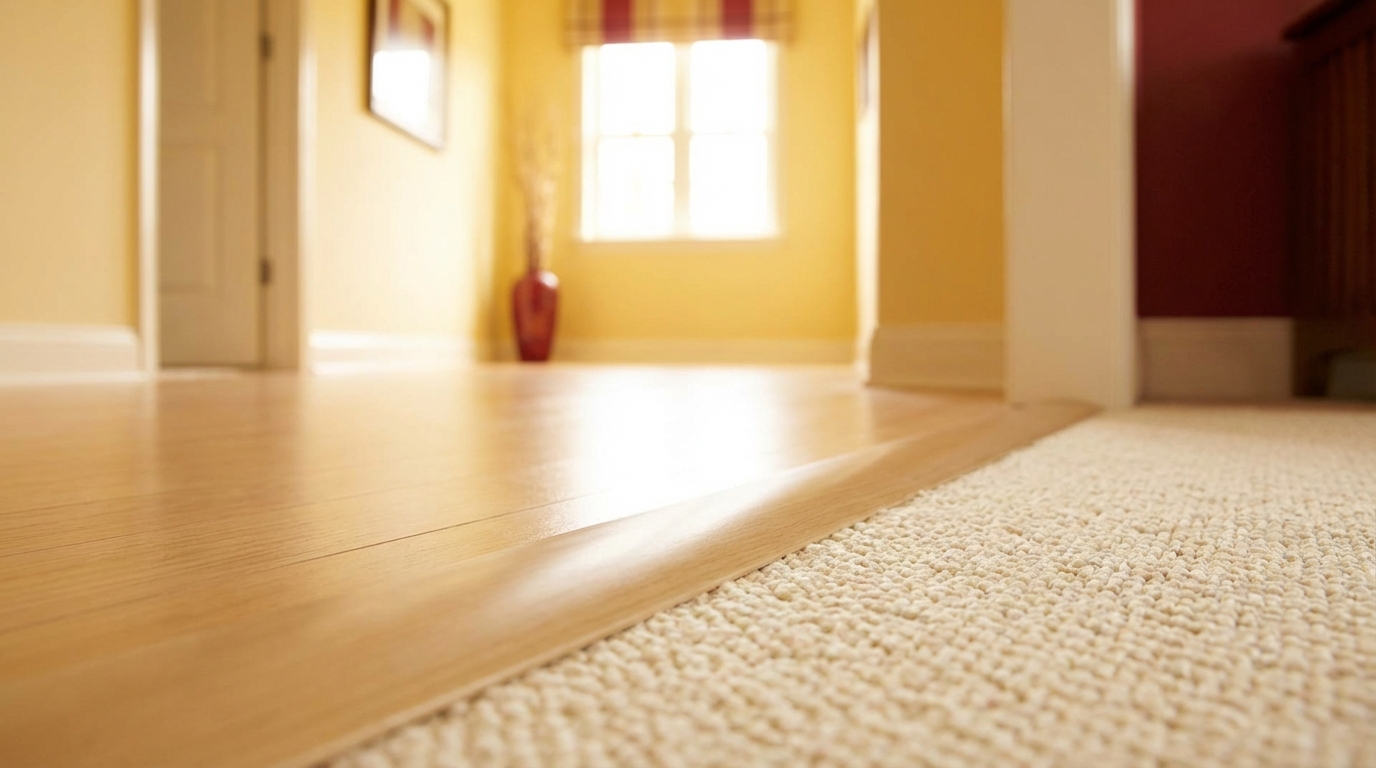
This is one of the most common and risky transitions. Often the carpet sits higher than the hard surface, which creates a small step down. The edge can curl or fray, and shoes or walkers can catch there.
Safer options include:
- Reducer strips that slope gently from the higher carpet to the lower hard floor.
- T-molding or similar trim that sits over the joint so there is no exposed edge.
- Using low-pile carpet so the height difference is smaller.
- Firmly securing the carpet edge to a tack strip or track below the trim.
If someone uses a wheelchair, you will want as smooth a slope as possible and plenty of clearance under any metal or wood trim so wheels do not bump.
Hard Floor to Hard Floor (Wood, Vinyl, Laminate, Tile)
Here, the main issues are:
– Slight height differences between rooms
– Slippery changes in texture
– Narrow or raised threshold strips that stick up
Options:
- Flat metal or wood strips that sit nearly flush with both surfaces.
- Reducer transitions that create a small ramp between levels.
- Flexible transition strips for uneven junctions or curved spaces.
If floors differ significantly in height, a gradual ramp may be safer than trying to “hide” the difference with a narrow strip.
Transitions at Bathroom and Exterior Doorways
These spots are often the trickiest. We might see:
– High saddles to protect against water
– Tile that sits higher than hallway flooring
– Door thresholds raised to block drafts or rain
These are also areas where someone might be barefoot, in socks, or using a walker in tight quarters.
Bathroom and entry door thresholds deserve special attention, because falls in these areas are common and often more serious.
Safer choices:
- Replace high saddles with lower, beveled ones that still manage water but are easier to step over.
- Use non-slip flooring on both sides of the doorway.
- Install a low-profile threshold ramp for wheelchair or walker users, especially at exterior doors.
Sometimes building codes limit how low an exterior threshold can be because of weather concerns. In these cases, a sturdy, secure small ramp (inside, outside, or both) can create the needed smooth transition.
Practical Solutions To Soften Transitions
Many families worry that safer flooring changes will be complex or expensive. While that can happen in some homes, many hazards can be eased with relatively small, careful projects.
Transition Strips and Reducers
These pieces bridge the gap between two flooring types:
| Type | Best used for | Key safety points |
|---|---|---|
| T-molding | Floors of similar height | Keep as flat as possible, secure firmly, avoid sharp edges |
| Reducer strip | Higher floor to lower floor | Choose a gentle slope, non-slip surface, and correct height |
| End cap | Flooring ending at a doorway or edge | Use where no second floor continues, keep edges low |
| Flexible threshold | Uneven or curved junctions | Can adapt to irregular surfaces, still needs secure fixing |
When you shop or speak with an installer, you might find it helpful to:
– Take measurements of the height difference between rooms
– Bring photos of the doorway or transition area
– Ask for products with non-slip surfaces and low profiles
For someone with limited mobility, the best transition strip is one that almost disappears underfoot: solid, low, and gently sloped.
Threshold Ramps
Threshold ramps are small ramps used where there is a noticeable step, often at:
– Exterior doors
– Sliding glass doors
– Garages
– Older interior doorways with significant level changes
They come in materials like:
– Rubber
– Aluminum
– Composite or wood
Key points:
- Choose the right height. The ramp top should be level with the higher floor, not below it.
- Slope matters. A longer, gentler ramp is easier to manage than a very short, steep one.
- Secure placement. Many ramps can be screwed down or have strong grippy undersides. Avoid loose, wobbly ramps.
- Weather resistance. Outdoor ramps should drain well and resist ice buildup as much as possible.
For wheelchair or power chair users, local building or accessibility guidelines about slopes can help you select safe products. If you are unsure, a home access specialist or therapist can advise.
Leveling or Feathering Floors
In some cases, the safest approach is to gently “feather” or level a floor near a doorway so the step down or up is smaller. This is more common when:
– You are already replacing or repairing flooring
– The height difference is too large for a simple strip
– There are multiple hazards in the same area
This type of work usually needs a professional installer or contractor, especially for tile or hardwood. While it can cost more, it often creates a safer, cleaner look that is easier for everyone to navigate.
The Role of Lighting and Contrast
Even a perfect transition can be risky if no one can see it clearly. Many falls occur because people did not notice where one flooring stops and another begins.
Make Edges Easy To See
Some people, especially those with low vision, Parkinson’s, or dementia, benefit from stronger visual cues.
Our feet often follow our eyes, so when edges are clear and well lit, movements tend to be steadier and more confident.
Ideas that can help:
- Good lighting above or near transitions, especially in hallways and at the top of stairs.
- Night lights between bed and bathroom so thresholds do not disappear in shadow.
- Contrast strips (for example, a darker or lighter strip along the edge of a step or saddle).
- Avoiding busy patterns right at the transition that make it hard to see where the floor changes.
For dementia or cognitive changes, a high-contrast strip can sometimes be interpreted as a gap or barrier. If you care for someone in this situation, it can help to test small changes first and watch how they respond.
Dealing With Rugs and Mats at Transitions
Rugs and mats are common in doorways and near room borders. They can protect floors and trap dirt, but they can also slide, fold, or catch toes and wheels.
When Rugs Become Hazards
Risk increases when rugs:
– Are thick or high-pile near doorways
– Have turned-up corners
– Slide easily on hard floors
– Layer over a threshold or transition strip
– Are placed where someone must turn a walker or wheelchair
Many fall-prevention experts recommend removing throw rugs altogether in homes with high fall risk. That advice can feel harsh or unwelcome, especially when rugs have sentimental value or help with warmth.
Here, care and compromise often help.
Safer Rug Options
If rugs must stay:
- Choose low-profile, non-slip rugs with a firm backing.
- Secure all edges with rug tape or non-slip underlay rated for the flooring type.
- Avoid putting rugs directly over thresholds or where two floors meet.
- Check rugs often for curling or bunching and replace if they cannot lay flat.
Sometimes, replacing several small throw rugs with one larger, firmly anchored rug can reduce the number of edges someone has to cross.
Special Considerations for Walkers, Canes, and Wheelchairs
Every mobility device interacts with flooring a bit differently. What feels safe for one person may be hard for another, so real-world testing is very helpful.
Walkers and Rollators
Walkers and rollators can:
– Catch front wheels on small rises
– Tip slightly when one side hits a bump first
– Become harder to push on soft or thick flooring
To support walker users:
- Keep transitions low and beveled, not abrupt.
- Avoid thick rugs or mats where a walker must turn.
- Make sure doorways are wide enough so the walker can go straight through, not at an angle.
- Check that transition strips are smooth and do not have ridges where narrow wheels might get stuck.
After installing any new transition, have the person try it several times, turning and walking at their usual speed, while you stand nearby for safety.
Cane Users
A cane adds a third point of contact, but it can also:
– Slip on smooth metal or plastic thresholds
– Land unevenly on edges
– Catch in gaps or cracks
For cane users:
- Prefer non-slip surfaces at transitions, not shiny metal.
- Keep gaps between floors or strips as narrow as possible.
- Encourage the person to place the cane on the new surface first when stepping through a doorway, if they can remember that pattern.
Sometimes a physical therapist can review the home and offer tips on how to step through specific doorways more safely with the cane.
Wheelchairs and Power Chairs
For wheelchairs, level changes are barriers more than trip hazards, but they can still cause falls if a chair tips or gets stuck.
Key needs:
- Transitions that are wide enough for the whole chair, not just one wheel.
- Low, smooth thresholds that do not snag front casters.
- Ramps that meet both floor levels cleanly, with no gaps or sudden changes.
You might test transitions by:
– Slowly pushing the chair forward and backward across each threshold
– Turning slightly to see if front casters catch or hang up
– Checking that the person can self-propel across without straining
For power chairs, sudden jolts at thresholds can be uncomfortable or even painful, so smoother slopes are especially calming.
Working With Professionals
Sometimes projects go beyond what feels comfortable for a family to handle alone. There is no shame in asking for help, and outside eyes can spot things we miss.
Who Can Help
You might look to:
- Occupational therapists (OTs) with home safety experience.
- Physical therapists who know the person’s gait and balance issues.
- Certified aging-in-place specialists or home access contractors.
- Local home modification programs through senior centers or disability organizations.
These professionals can:
– Prioritize which transitions matter most
– Suggest products that match your flooring and budget
– Coordinate with flooring installers or contractors
– Teach safer ways to step or roll through tricky spots
Sometimes the most reassuring step is having a trained eye walk the house with you and confirm that your concerns are real and worth addressing.
Questions To Ask Before Any Work Begins
To keep the focus on safety:
- “How will this transition feel for someone who shuffles their feet or uses a walker?”
- “Will this make it easier or harder to push a wheelchair?”
- “Is there a way to keep this threshold as low and smooth as possible while still meeting building and water-resistance needs?”
- “What can we do to keep this area non-slip and easy to see?”
Asking these questions out loud can guide everyone involved toward solutions that work not just for the house, but for the people who live in it.
Balancing Safety, Comfort, and Appearance
Many caregivers feel torn between safety and how the home looks or feels. It can help to remember that:
– Changes can be gentle and gradual.
– Many modern transition strips and thresholds are subtle and attractive.
– The peace of mind that comes with fewer falls often outweighs concerns about small visual changes.
You do not have to fix everything at once. Many families start with:
1. The most traveled paths (bedroom to bathroom, front door to living space).
2. The largest level changes.
3. Any place where a fall has already happened.
From there, other transitions can be addressed over time, as budgets and energy allow.
Simple Step-By-Step Plan To Reduce Trip Hazards at Transitions
To bring all of this together into something practical, you might follow a gentle sequence like this:
1. Notice and List Problem Spots
– Walk the house with “safety eyes” and a measuring tape.
– Mark or note every transition where there is:
– A height change over 1/4 inch
– A loose or frayed edge
– A rug or mat that moves
– A history of stumbles or falls
2. Tackle Quick, Low-Cost Fixes First
These may include:
- Removing or securing loose throw rugs.
- Adding non-slip underlays or tape under mats that must stay.
- Improving lighting and adding night lights near transitions.
- Trimming and reattaching any loose carpet edges.
These smaller changes can already lower risk while you plan larger projects.
3. Add or Replace Transition Strips and Thresholds
For each transition with a height difference:
- Choose low-profile, beveled strips suited to the flooring types involved.
- Confirm they are firmly attached with no wobble or flex.
- Check the slope by walking, using a walker, or rolling a wheelchair across.
If a current threshold is high, sharp-edged, or slippery, replacing it often brings a noticeable improvement in day-to-day safety.
4. Use Threshold Ramps Where Needed
At doors with more significant steps:
– Select ramps that reach the full width of the doorway.
– Make sure the top meets the higher floor cleanly.
– Secure them so they cannot move.
Test with the actual devices used in the home.
5. Revisit and Adjust Over Time
As a person’s mobility changes, flooring that felt safe one year may feel challenging the next. It can help to:
– Re-walk the home every few months or after any fall.
– Ask your loved one where they feel most worried about tripping.
– Adjust rugs, add lighting, or rethink certain transitions as new needs arise.
Home is not a fixed object, it is a living space that can gently adapt as the needs of the people inside it change.
By seeing each flooring transition as a small bridge rather than just a line in the floor, we give ourselves permission to improve it. Those small bridges add up to a home that feels kinder to tired legs, steadying to unsure feet, and more welcoming to everyone who moves through it.