
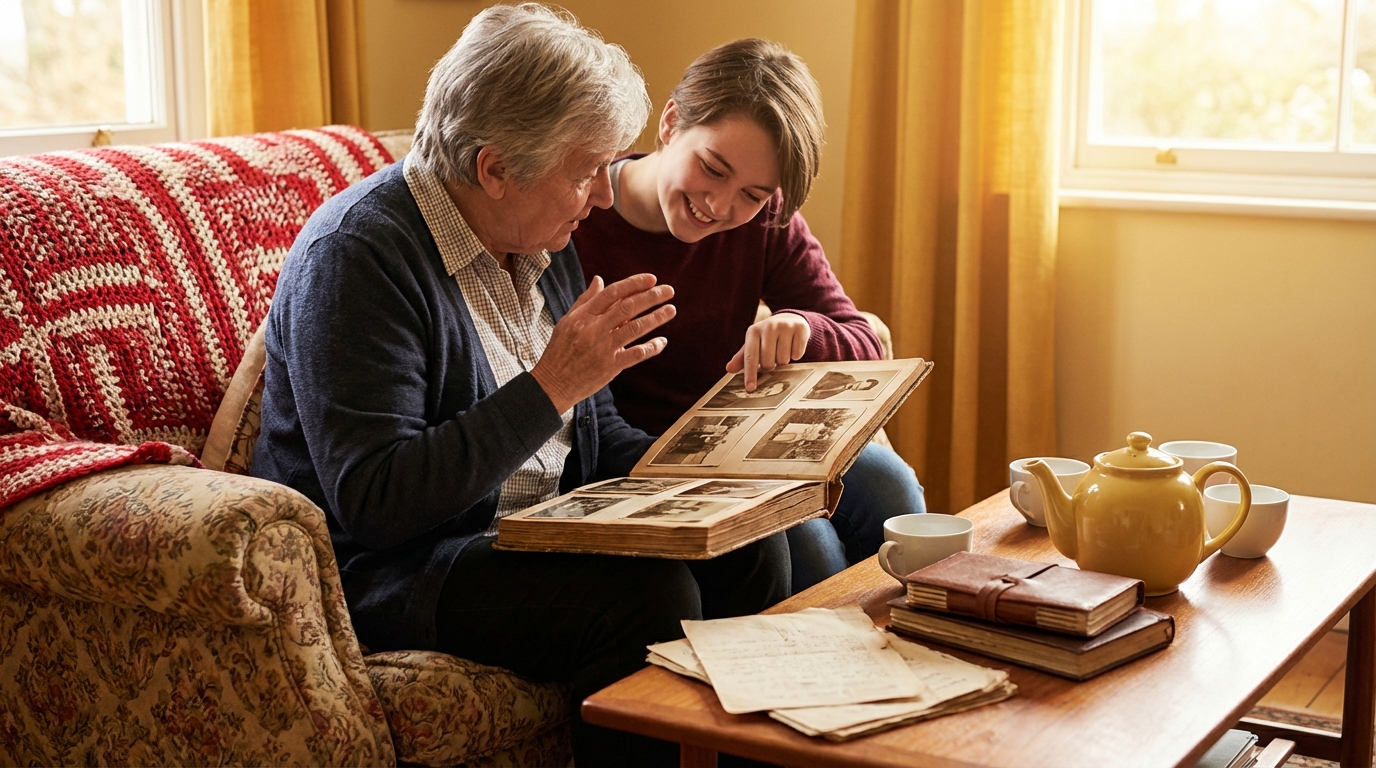
It is not easy to watch time move across our family. The elders who once told long stories at the table begin to forget details, grow tired more quickly, or are no longer here to speak for themselves. Many of us feel a quiet pressure: “If I do not gather these stories now, they might disappear.” That feeling can be heavy, but it can also be a gentle invitation. We are being asked to become keepers of memory for the people we love.
The simple truth is this: preserving family history through storytelling does not have to be perfect or polished to matter. A few recorded conversations, a handwritten page of memories, or a simple photo with names and dates can already protect years of family experience from fading. The goal is not to create a museum. The goal is to keep our people, their voices, and their lessons close, so that children and grandchildren will still feel connected long after we are gone.
Why family storytelling matters so deeply
Before we talk about how to preserve stories, it helps to slow down and sit with why this work touches us so much. When we are caregiving, trying to keep a household running, or helping an aging parent, storytelling can feel like “extra.” In truth, it often becomes the emotional backbone that holds everyone together.
- It gives elders a sense of dignity and meaning. Sharing memories helps older adults feel that their lives still matter, that they are more than medical charts and appointments.
- It helps younger family members feel rooted, not alone. Hearing what grandparents survived or enjoyed can give comfort during their own struggles.
- It can ease grief before and after loss. When we know our loved ones’ stories, the goodbye can feel less like a sharp break and more like a handoff of wisdom.
- It builds bridges in families that have had conflict. Storytelling can open small windows of understanding, even when the past holds hurt.
Family stories do not erase pain, but they often explain it, soften it, and give it a place in a larger, more generous picture.
For caregivers, these stories can change how we see the person we are helping. The parent with memory loss becomes the young worker who crossed a border or learned a trade. The partner with limited mobility becomes the athlete, the teacher, or the gentle friend they once were. Storytelling lets us hold both versions at the same time.
The emotional side: why it feels hard to start
Many of us carry a quiet resistance to family history work, even when we care deeply about it. You might notice one or more of these feelings:
- “I am too busy keeping everyone safe and cared for to sit and record stories.”
- “If I ask about the past, I might stir up old hurts or make someone sad.”
- “My writing is not good, and I do not know how to do interviews the right way.”
- “My family did not have big adventures. Who would care about these stories?”
These worries are very common. Many caregivers feel that if they cannot do something “properly,” then maybe it is better not to start. In this case, that belief gets in the way of something gentle and healing.
Family storytelling is not a performance; it is an act of care. Small, imperfect steps still protect what might otherwise disappear.
It can help to remind ourselves that we are not writing a book review or a history exam. We are simply giving our elders a chance to be heard and giving our younger ones a path back to them, even years later.
Types of stories that help preserve family history
Family history is not only about dates and major events. The most powerful stories are often the small, very human moments. When we think broadly about what “counts” as history, the task feels lighter and more natural.
1. Origin stories: where we came from
These are the stories many of us think of first. They include:
- Migration stories: who moved where, and why.
- Work and survival stories: how the family made a living.
- Stories of war, crisis, or natural disaster and how people coped.
- Religious or cultural traditions that shaped the family.
These stories often explain family values: why education is so stressed, why money is saved cautiously, or why certain holidays carry so much meaning.
2. Everyday life stories
Children and grandchildren rarely ask for exact birth dates. They want to know what breakfast smelled like in their grandmother’s house, or what games a grandfather played in the street. Helpful examples include:
- What a typical school day looked like for each generation.
- First jobs: how much they earned, how they got hired.
- Chores and responsibilities as children.
- Favorite songs, movies, or radio shows.
- What the neighborhood or village looked and sounded like.
These details bring history to life. They move it from “long ago” to “I can almost see it.”
3. Relationship stories
Families are built on relationships: marriages, friendships, rivalries, reconciliations. Some safe, helpful areas to explore:
- How couples met, what the early days of their marriage or partnership were like.
- Close friendships that shaped someone’s life.
- Mentors or teachers who opened new doors.
- Moments when the family came together to help one of their own.
When topics like divorce, estrangement, or abuse arise, you can tread gently and let the elder choose how much they wish to share. The story does not need every detail to carry meaning.
4. Stories about challenges and resilience
Many caregivers discover that the seniors they help carry powerful stories of hardship and courage that nobody has heard in full. These can cover:
- Illness and recovery, including mental health journeys.
- Periods of financial struggle or job loss.
- Times they felt different, excluded, or targeted.
- What helped them carry on, even when they were afraid.
These stories can give younger generations tools to handle their own crises. They can also help caregivers see their loved ones as more than patients or dependents.
5. Stories of joy, play, and beauty
Not every story needs to focus on survival. Light, uplifting stories balance the hard ones. These may include:
- Favorite celebrations or parties.
- Hobbies that brought deep happiness.
- Journeys or trips that changed how someone saw the world.
- Moments of laughter that the family still remembers.
These stories bring warmth back into the room, especially if the elder is dealing with chronic illness, disability, or grief.
Simple ways to start preserving stories (without feeling overwhelmed)
Many people never begin because the task feels too large. We picture boxes of photos, hours of audio, or long family trees. It can feel more manageable to pick one small doorway and walk through it, slowly.
Here are gentle, practical starting points that work well for busy caregivers and families.
1. Begin with “one memory today”
You might give yourself and your loved one a very small goal: one memory each day or each week. This can be spoken or written.
You could ask:
- “Can you tell me about a meal from your childhood that you still remember?”
- “Who made you feel safe when you were a child?”
- “What did you like to do on a Sunday afternoon?”
Write their answers in a simple notebook, or record them on your phone. A few lines each day grow into a treasure over a year.
A single page of honest memories can hold more love than a perfect, polished family history that never gets started.
2. Use gentle prompts instead of big questions
Questions like “Tell me about your life” are often too large and tiring, especially for someone who is ill or has memory loss. Short, specific prompts feel safer and easier. For example:
- “Tell me about the house you grew up in. What did it smell like?”
- “What was your favorite toy or object as a child?”
- “Who was the strict one in your family? Who was playful?”
- “Was there a time you got in trouble, but now it makes you laugh?”
It helps to pause often, allow silence, and respect if someone says, “I do not remember” or “I prefer not to tell that story.”
3. Pair stories with photos and objects
Many elders find that a physical object helps memories come back. You might gently bring:
- Old photographs or photo albums.
- A piece of jewelry or a watch.
- A recipe card, a tool, or an item from their work life.
- A piece of fabric, medal, or keepsake from a special event.
You can ask:
- “What is happening in this photo?”
- “Who are these people, and what were they like?”
- “Where did you get this object? What does it mean to you?”
Recording these explanations, either in writing or by audio, turns silent photos and items into speaking witnesses.
4. Use simple technology that you already have
You do not need special equipment. For most families, the easiest tools are:
| Tool | How it helps | What to watch for |
|---|---|---|
| Smartphone voice recorder | Captures tone, laughter, and pauses in real time. | Check battery life; ask permission before recording. |
| Notebook and pen | Simple, portable, no setup time. | Leave space for names, dates, and follow-up questions. |
| Video recording | Preserves facial expressions and gestures. | Some elders feel shy; keep sessions short and relaxed. |
| Simple scanner or phone camera | Saves photos, letters, recipe cards. | Label files with names, years, and locations while you remember. |
What matters most is that you back up what you gather, even if that only means emailing files to yourself or saving them in two different places.
5. Create small, safe routines
Story work goes best when it becomes a gentle part of ordinary life. Some ideas:
- “Tea and stories” once a week, where you sit with an elder for 20 minutes.
- Asking one memory question during car rides to appointments.
- Recording stories while sorting photographs together.
- Having younger children ask elders prepared questions, which is often very heartwarming.
Routine reduces pressure. It reminds everyone that this is not an interrogation; it is time to connect.
Storytelling in caregiving: making it part of daily care
Caregivers often feel that they have no extra time. Still, storytelling can weave gently into tasks you are already doing. It can also improve the emotional quality of the care you give.
Storytelling during personal care
Bathing, dressing, or helping with meals can sometimes feel clinical or rushed. Small story prompts can soften that feeling.
For example:
- While brushing hair: “Who used to cut your hair when you were young?”
- While preparing food: “What did your mother or father cook on a special day?”
- While helping with mobility: “Did you walk to school, or take a bus? What was that like?”
These questions remind both of you that your relationship is deeper than the tasks. They also help the person feel valued for their memories, not only their needs.
Supporting people living with dementia
Storytelling with someone who has dementia or other memory issues requires patience and respect. Some gentle guidelines:
- Focus on older memories, which often remain clearer than recent ones.
- Avoid arguing about incorrect details; the feeling of the story matters more than perfect accuracy.
- Use photos, music, or smells to awaken remembered times.
- Keep questions simple and concrete, such as “Who is this?” instead of “What was happening that year?”
For someone with memory loss, being listened to kindly in this moment is as precious as the truth of the past they are trying to share.
You can still record these stories, while noting that some details may not be precise. The love and personality are still very real.
Using stories to support medical care
Doctors and nurses often see only a narrow slice of a person’s life. You might find it helpful to share brief, respectful stories with care teams, for example:
- “He was a carpenter for 40 years, and his hands were very strong and skilled.”
- “She raised six children largely on her own and cared for her own parents, too.”
- “He is a singer; music is very important to him.”
These small pieces of history can change how professionals speak to and about your loved one. They remind everyone that this is a whole person with a long, rich past.
Honoring culture, language, and sensitive histories
Family history often touches sensitive topics: migration, poverty, discrimination, violence, or long-standing family conflict. It also lives inside particular languages, religions, and cultures. Handling this with care protects both the storytellers and the stories.
Respecting what does not want to be said
Some elders have faced events they never wish to relive aloud. You might gently invite, but never push.
If someone says:
- “I do not want to talk about that,”
- “That time was very painful,”
- “Maybe another day,”
you can respond with calm acceptance, such as:
- “Thank you for telling me how you feel. We can talk about something lighter.”
- “Your comfort matters more than any story. We can stay where you feel safe.”
This kind of trust-building sometimes leads to deeper sharing later. Even if it does not, you are honoring their right to hold some things privately.
Preserving heritage languages
If your elders prefer a language that younger generations do not speak well, you still have options. You might:
- Record their stories in their language first, without rushing to translate.
- Ask a relative or community member who is bilingual to help with summaries later.
- Keep key phrases, songs, or prayers in the original language, even in written form.
Hearing a grandparent speak their heart language on a recording, long after they are gone, can be one of the deepest gifts you leave to future children.
You can also photograph written materials such as letters, documents, or books, and store them for later translation.
Balancing painful truth with kindness
Many families have skeletons in the closet. There may be stories of addiction, violence, affairs, or criminal behavior. The question often arises: “Do we record this or protect the family image?”
There is no single correct answer, but here are some guiding thoughts:
- Separate judgment from description. “He drank heavily and missed work” is different from “He was a bad person.”
- Focus on impact and learning. “This was very hard on the children, who felt unsafe. Over time, some of them chose to avoid alcohol entirely.”
- Consider confidentiality for living people who might be harmed by exposure.
- Remember that many descendants feel relief when the family stops pretending that everything was perfect.
You can choose to store some stories privately for a time, sharing them only when younger generations can handle them with maturity and compassion.
Practical methods for recording and organizing family history
A gentle plan can help you avoid feeling buried under a pile of half-finished projects. Think in terms of three steps: gather, name, and share.
Step 1: Gather
You might start by gathering items and stories into one place, without trying to sort everything perfectly.
Helpful categories:
- Audio and video: interviews, voice messages, voicemail backups, old tapes.
- Written materials: letters, diaries, recipe cards, school records, certificates.
- Photos: individual portraits, group photos, wedding albums, school pictures.
- Objects: medals, tools, clothing pieces, religious items, craftwork.
You do not need to decide right away what to do with each thing. Just protect them from damage and loss.
Step 2: Name
The greatest enemy of family history is the unlabeled photo or recording. While your elders are still able to help, make it a joint project to “name” as much as you can.
Some simple practices:
- Write names, places, and approximate dates on the back of printed photos in pencil.
- Save digital files with clear names: “Maria_aged_20_in_Madrid_1962.jpg”.
- Add short descriptions: “First day at factory,” “Family garden behind house,” etc.
- Keep a small notebook or digital document where you explain who key people are and how they are related.
You can involve children in this work by turning it into a “Who is this?” guessing game, followed by confirmation from the elder.
Step 3: Share
Once you have gathered and named some materials, it helps to share them in a way that feels natural for your family. Not all families want a big, formal project. Some gentle sharing ideas:
| Sharing Method | What it looks like | When it helps most |
|---|---|---|
| Monthly story email or group message | One photo and one short story sent to relatives. | Families spread across cities or countries. |
| Printed “story packets” | Papers with 3 or 4 stories, photos included. | Elders who prefer something they can hold and reread. |
| Story night | Family gathers in person or online, one person tells a memory. | Holidays, birthdays, anniversaries. |
| Small photo books | Print-on-demand books with captions and short stories. | Gifts for grandchildren, memorial items after a death. |
You can set gentle boundaries so that sharing does not become another heavy task for the primary caregiver.
Involving children and teens in preserving family stories
Younger family members often surprise us with their interest once they have a clear role. They may not respond to long lectures, but they do respond to specific, simple tasks.
Giving children “story jobs”
Even small children can help:
- Drawing a picture of a story they just heard from a grandparent.
- Helping to label photos with simple notes such as “Grandpa with dog.”
- Choosing which story to ask for next: “Tell us about your school” or “Tell us about your first friend.”
Teens can take on more technical roles:
- Recording and editing audio on a phone or computer.
- Scanning photos and organizing them into folders.
- Creating simple family trees or timelines.
Many adolescents who feel distant from older relatives become more engaged when they are trusted with this kind of meaningful work.
Helping younger generations connect emotionally
The distance between a teenager and a very old grandparent can feel large. Storytelling can narrow that gap. It helps to ask elders questions that link directly to modern life, such as:
- “When you were my age, what were you most worried about?”
- “Did you ever break a rule? What happened?”
- “Who did you have a crush on when you were in school?”
You can then gently point out similarities, such as shared feelings of anxiety, hope, or desire for independence. This reminds everyone that human hearts change less over time than the outside world does.
Using storytelling to support grief and memory after loss
When a loved one dies, many of us long for their voice. If we already have recordings and written stories, they can bring comfort. If we do not, we might feel regret. Both experiences are very common.
If your loved one is still here
If you still have some time with your elder, you might choose one or two of these gentle steps:
- Record a simple “message for the future” where they speak to younger family members.
- Ask them to tell the story of their name, or the names they chose for their children.
- Invite them to share what they hope their family will remember about them.
These are tender conversations. It can help to remind them that this is not about death; it is about letting their love travel forward.
If your loved one has already died
If you do not have many recordings or stories from a person who has died, it can feel painful. Still, collective storytelling after a loss can support healing.
You might:
- Gather family members and ask each person to share one clear, specific memory.
- Write those memories in a shared notebook, online document, or memory box.
- Create a small ritual on birthdays or anniversaries where one new story is told.
Preserving family history after a loss is not only about the person who died. It is also a way for those who remain to carry their grief together, not alone.
In some cases, it also gives children who were too young to remember a path to know who this person was beyond photos and dates.
Protecting and passing on your collected stories
Once you have gathered stories, it is natural to worry about losing them. Again, your plan does not need to be complex. It just needs to exist.
Think in pairs: two places, two people
A simple rule can guide you: every important story, photo, or recording lives in at least two different places, and at least two different people know how to reach it.
Some options:
- Keep physical copies in a safe box at home and a copy at a trusted relative’s house.
- Store digital files on your computer and in a cloud storage service.
- Give one child a printed story packet and email the same to another relative.
Make sure you share any passwords or instructions needed to access digital material.
Leave a clear “map”
Your descendants will be grateful if you leave a simple guide. This does not have to be formal. A few pages can help future family members understand what they are looking at.
You could include:
- A simple family tree with names, birth years, and relationships.
- A list of what you have stored and where (photos, recordings, documents).
- A short note about why you did this work and what you hope it will bring.
This map can sit with your other important papers, such as wills or health care directives. That way, it will not disappear in a box.
Letting go of perfection: what “enough” looks like
Many caregivers hold themselves to very high standards. You may feel that if you cannot capture every story, you have failed. That belief can stop you from doing the simple, loving things that are well within reach.
Here are some gentle reminders to keep nearby:
- You are one person, living in real time, with real limits.
- A few well-told stories, recorded with care, are worth more than a long list of plans.
- You are allowed to choose which projects fit your energy and your family’s needs.
- The next generation can continue the work; you do not have to finish it alone.
Preserving family history is not about creating a perfect archive. It is about giving your people a way to remember and be remembered with kindness.
If all you manage this year is to record one conversation with an elder, label a small stack of photos, or write down your own story in a few pages, that already matters. You have taken a living thread from the past and tied it gently to the hands of those who will come after you.
They may not thank you today, but one day, when they listen to a grandparent’s laugh or read about a long-ago kitchen filled with steam and music, they will feel less alone. That sense of belonging and continuity is the quiet power of storytelling, and each of us can help preserve it, one small memory at a time.