
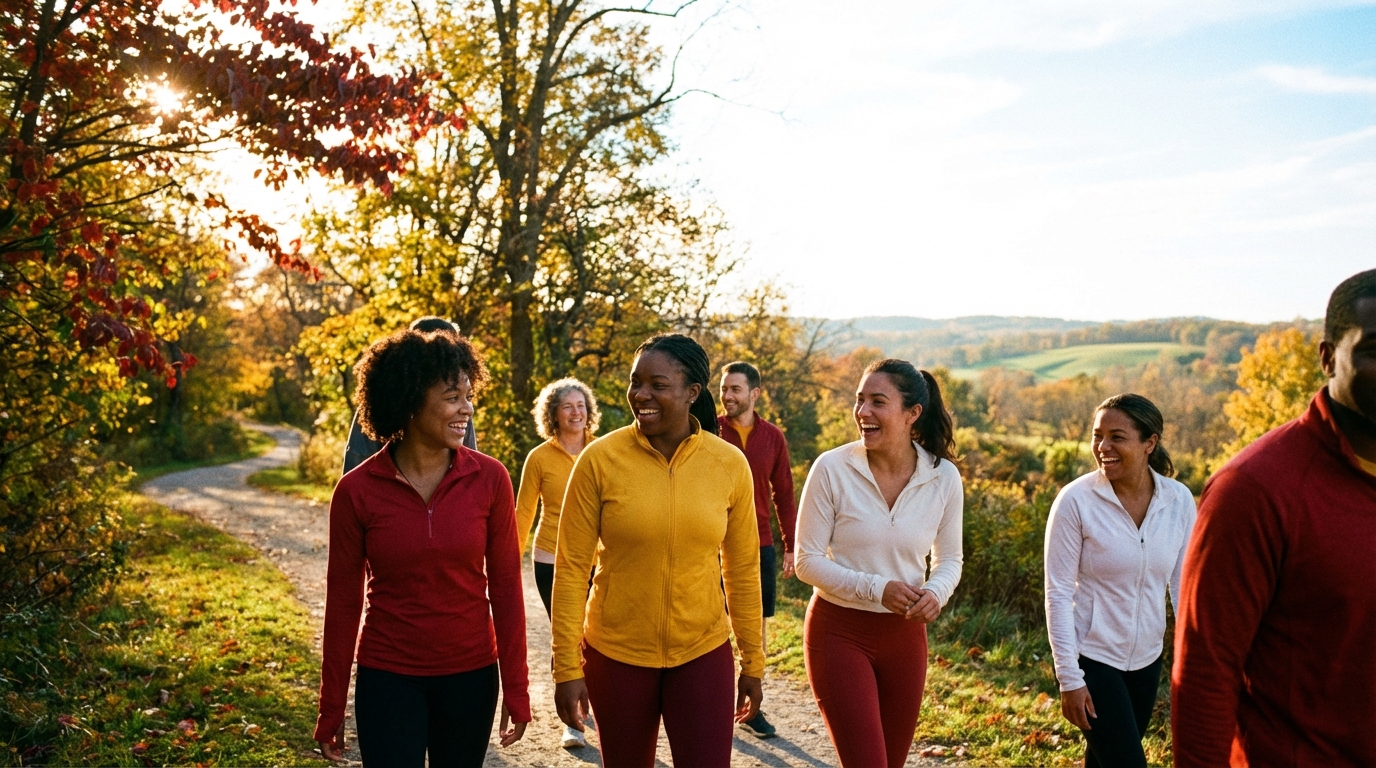
Sometimes it is hard to admit how lonely and stiff we can start to feel. Our body wants to move, our heart wants company, and at the end of the day we are tired in every way, not just physically. For many caregivers, older adults, and people living with health challenges, it can feel like there is never a simple way to care for both our bodies and our need for connection at the same time.
The gentle truth is that a simple walking group can help with both. Walking with others gives light exercise, friendly faces, and a reason to step outside, all in one small habit. You do not have to become an athlete, and you do not have to be the life of the party. A slow, steady walk with kind company is often enough.
Why walking groups feel so helpful
When we talk about walking groups, we are not talking about fast power walkers racing down the sidewalk. We are talking about small groups of people who agree to walk together, at a pace that works for everyone, on a regular schedule. The focus is connection and gentle movement, not performance.
- Body: Walking supports heart health, joint flexibility, and balance without asking for special skills.
- Mind: Being with others can ease worry, reduce feelings of isolation, and give our day structure.
- Spirit: Feeling part of a group, even a small one, reminds us that we still belong and still matter.
For many of us, the real benefit of a walking group is not the miles walked, but the feeling that we do not have to walk through life alone.
Emotional benefits: why companionship matters as much as exercise
For caregivers, older adults, and people living with disabilities or chronic conditions, loneliness can sneak in quietly. A partner might be ill, driving might feel harder, or energy levels may change. Friendships can slip away when it takes more planning to leave the house.
Walking groups can gently push back against that isolation.
Breaking the cycle of staying inside
Many of us know this pattern: the more time we spend at home, the harder it feels to go out. The world can start to seem distant, even unsafe. A walking group offers:
- A simple reason to go out: “I promised I would meet them at 10 a.m.”
- A safe, familiar route: The same park path or neighborhood loop, walked together.
- Predictable faces: People who notice if you are not there and are glad to see you when you are.
Just knowing that someone will notice your absence can be a quiet source of comfort and motivation.
Emotional support in small doses
Walking side by side often feels safer than talking across a table. We do not need constant eye contact, and the rhythm of walking allows natural pauses in conversation. This can make it easier to share:
- Caregiving stress and burnout
- Fears about falling or getting weaker
- Sadness after loss
- Worries about memory changes or health issues
No one needs to be a counselor. Gentle listening, light humor, and “me too” moments can be healing in their own quiet way.
Rebuilding confidence and identity
Serious health changes, disability, or caregiving roles can make us feel like we have lost parts of ourselves. We might feel like “just a caregiver,” “just a patient,” or “just someone who needs help.”
A walking group can remind us:
- We are still neighbors, friends, and community members.
- We can still keep a commitment and contribute.
- We are not only the person who needs care or provides care.
Being greeted by name, being missed when absent, and being thanked for showing up all help rebuild a fragile sense of worth.
Physical and cognitive benefits of group walking
Of course, movement matters for the body as well. For many of us, walking is the most realistic exercise we can manage. It requires no special equipment, can be adjusted to different ability levels, and usually fits into daily life.
Gentle benefits for the body
Here are some of the ways a regular walking group can support health:
| Body System | How walking can help |
|---|---|
| Heart and circulation | Supports blood flow, helps with blood pressure control, supports heart strength. |
| Joints and muscles | Keeps joints moving, can reduce stiffness, supports muscle strength used for daily tasks. |
| Balance | Helps the body practice steady movement, which can lower fall risk when done safely. |
| Blood sugar | Regular movement can help manage blood sugar levels for people with diabetes or prediabetes. |
| Sleep | Daytime activity can improve sleep quality for many people. |
Walking in a group can also make it easier to stick with movement. When we walk alone, it is easy to talk ourselves out of it. When we know a small group is expecting us, we tend to show up more often.
Cognitive and brain health
Walking and talking at the same time gives the brain a gentle workout. For older adults and people at risk of memory changes, this can be especially supportive.
Some benefits can include:
- Improved mood and lower stress, which can protect brain health over time.
- Light cognitive challenge from conversation, remembering names, and following the route.
- Fresh sensory input from being outdoors, which can help with alertness and orientation.
For people with early memory loss or mild dementia, a simple, repeated walking route with familiar companions can feel grounding. A caregiver might walk alongside and still get the sense of being part of a group, not alone in the role.
Movement and conversation together often feel more natural than formal “brain games” or exercise routines.
Different types of walking groups
Not every walking group looks the same. You can adjust structure, pace, and goals to suit the people involved.
Social walking groups
These groups focus on companionship first and exercise second. They are usually:
- Short to moderate in distance.
- Flexible with pace and rest breaks.
- Open to a wide range of ages and abilities.
They might meet at a:
- Community center
- Senior center
- Faith community building
- Public park or trailhead
Conversation is casual. People might discuss family, recipes, local news, or caregiving tips without any set topic.
Health-focused groups (for specific conditions)
Some groups are built around people who share a health condition. The mood is usually friendly, but there may be more structure.
Examples:
- A diabetes walking group that walks at a set pace for a set time.
- A cardiac rehab group that meets under nurse or therapist guidance.
- A “Better Balance” group led by a physical therapist or trainer familiar with fall prevention.
- A “Walk with a Doc” program where a clinician walks with the group and answers health questions.
These groups can be helpful for people who want clear goals and feel reassured by some professional presence.
Caregiver and care partner walking groups
Caregivers often have little time for themselves. Some walking groups welcome both the caregiver and the person they support, so no one is left out. Others give caregivers a break by pairing the person receiving care with volunteers.
Common formats:
- Caregivers and their loved ones walk together in a slow, supported group.
- Caregivers walk as one group while trained volunteers walk with care partners in another group nearby.
- A combined group where everyone walks together and no one is labeled by their role.
These walks can naturally lead to sharing resources, tips, and stories, but they can also simply be a time to chat about pleasant, ordinary things.
Accessible walking groups (for mobility aids and varying speeds)
Walking groups do not need to exclude people who use walkers, canes, wheelchairs, or scooters. Some thoughtful planning can make them more inclusive:
- Routes with smooth, wide paths and curb cuts.
- Shorter loops with several “turnaround points” so people can shorten the walk.
- Bench or seating areas at regular intervals.
- Clear communication that devices are welcome and pace will be adjusted.
When a group is clear that mobility aids are welcome, more people feel safe enough to join, rather than staying home to avoid slowing others down.
Planning a safe and welcoming walking group
If you are thinking about starting or improving a walking group, a bit of planning can create a calmer experience for everyone.
Checking with health providers first
Before joining or starting a group, it is wise for each person to check with their doctor or clinician, especially if they have:
- Serious heart or lung disease
- Uncontrolled high blood pressure
- Severe arthritis or balance problems
- Recent surgery or hospitalization
- Frequent dizziness or fainting
You might encourage group members to ask questions like:
- “Is it safe for me to join a walking group?”
- “How far or how long should I aim for at first?”
- “Are there signs that tell me I should stop walking and rest or seek help?”
Choosing a route with accessibility in mind
Here are some points that can make a route feel safe and welcoming:
| Feature | Things to look for |
|---|---|
| Surface | Even pavement, few cracks, no steep curbs, minimal gravel or loose dirt. |
| Grade | Gentle slopes, no long steep hills, especially for people with heart or breathing issues. |
| Rest areas | Benches or low walls every 5 to 10 minutes of walking, shade where possible. |
| Bathrooms | Access to restrooms before or after, and ideally along the route for longer walks. |
| Parking & transit | Accessible parking spots, safe drop-off area, nearby bus or train stops if possible. |
| Safety | Good lighting, enough people around to feel safe, clear of heavy traffic. |
If some participants use wheelchairs or walkers, you might test the route in advance with that in mind, or ask someone who uses a device to help you assess it.
Setting a schedule that people can trust
People feel safer and more committed when they know the group is predictable. Consider:
- Choosing clear days and times, such as “Mondays and Thursdays at 9:30 a.m.”
- Starting on time, but allowing a few gentle minutes for late arrivals.
- Deciding ahead how long each walk will last, for example 20, 30, or 45 minutes.
- Sharing what happens when weather is poor (cancel, move indoors, or shorten the route).
Some groups find it helpful to create a simple phone tree, email list, or message group so they can share updates about weather changes or special events.
Making space for different abilities and energies
One of the greatest gifts of a walking group is that it can include people with mixed abilities, if planned with care.
Creating pace groups
If your group has people who walk at very different speeds, you might gently suggest “pace groups.” No one is ranked or judged; it is simply a way to let everyone walk comfortably.
Example:
- Easy pace group: Short distance, frequent breaks, focus on safety and socializing.
- Moderate pace group: Slightly longer distance, fewer stops, still able to talk in full sentences.
- Faster group: For those who wish to walk quickly, while still staying aware of older or more fragile members.
You might have a volunteer or leader in each group so that no one is left walking alone.
Respecting health limits without pressure
Many people push themselves too hard because they do not want to “hold others back.” Others may be anxious and stop more often than they need to. A kind group culture can help with both.
Some helpful group norms:
- Encourage people to listen to their bodies and slow down or stop when needed.
- Affirm that cutting the walk short is allowed and respected.
- Remind people that showing up matters more than finishing a set distance.
- Offer a “bench buddy” system so no one sits and rests alone if they do not want to.
A healthy walking group celebrates any amount of movement, not just the longest distance or fastest pace.
Including people who cannot walk far
Some people may want to join socially but cannot walk much at all. You might:
- Invite them to walk just to the first bench, then rest and chat with others who reach that point.
- Pair them with a volunteer who can walk their slower pace.
- Encourage them to sit at a gathering spot (such as outside a community center) so they can visit before and after the walk.
- Include wheelchair users or scooter users and adjust language from “walking” to “movement group” if that feels more inclusive.
Social and community building within the group
Beyond exercise, walking groups can become small communities. This does not happen overnight, but you can gently support it.
Simple rituals that build connection
Rituals do not have to be fancy. Small repeated habits help people feel grounded.
Ideas:
- A brief welcome before each walk, with names for any new participants.
- A quick “how is everyone feeling today?” check-in.
- A group stretch before or after walking, guided by someone with experience if possible.
- A shared phrase, such as “We start together and we end together,” to remind people of group values.
Safe conversation spaces
Caregivers and older adults often carry heavy emotions. At the same time, not everyone wants the walk to be about illness and stress every time. You can set a gentle balance.
Guidelines that many groups find helpful:
- Health and caregiving topics are welcome, but no one is required to share.
- Private details about others (even family) should stay within the group.
- Group members try to listen more than they give advice, unless advice is clearly asked for.
- Light topics and humor are encouraged when they bring comfort.
Sometimes the most healing part of a walk is simply laughing together about ordinary things after a long week.
Respecting boundaries and differences
People in a walking group may differ in age, culture, beliefs, and life stories. Good ground rules help everyone feel safe.
Possible shared agreements:
- We allow different opinions without arguing.
- We avoid harsh language and personal attacks.
- We do not push religious or political views on others during the walk.
- We respect any “no” or “I would rather not share” without pressure.
These points can be explained in a caring, not strict, way. The goal is kindness, not control.
Practical tips for caregivers joining or leading walking groups
Caregivers often ask, “How can I possibly add one more thing to my week?” That question is honest. A walking group does not need to feel like another burden. Small steps can still help.
Fitting walking into a caregiving schedule
You might explore:
- Joining a group that meets during a time when you already have respite support.
- Bringing your care partner if safe, with a shorter route or rest points planned.
- Asking another family member, neighbor, or volunteer to stay with your loved one while you attend.
- Starting with once a week instead of several times, and increasing only if it feels helpful.
Even two walks a month, if they feel restorative, can be worthwhile.
Safety steps when walking with a care partner
If you walk with a person you support, some preparation can reduce stress:
| Area | What might help |
|---|---|
| Mobility | Check that shoes fit well, devices (cane, walker) are in good repair, and pace is gentle. |
| Medical needs | Carry needed medications, water, and a small snack if blood sugar can drop. |
| Safety info | Have an ID bracelet or card with name, medical conditions, and emergency contact. |
| Cognition | Use familiar routes, stay near the group leader, and keep transitions calm. |
If wandering is a concern for a person with dementia, clear visual cues (bright scarf, hat) and staying within arm’s reach can help. You might also tell the group leader quietly that this is a concern.
Protecting your own needs as a caregiver
Some caregivers feel guilty taking any time for themselves. This is a hard pattern to break. Joining a walking group can be one small act of self-preservation, which supports both you and the person you care for.
You might gently remind yourself:
- Your body also needs movement to stay strong enough for caregiving tasks.
- Your heart needs moments of being “just you,” not only “the caregiver.”
- Your mood affects the home environment, and shared laughter and movement can lift that mood.
Caring for your own body and heart is not selfish; it is part of long-term caregiving.
Getting started: joining or forming a walking group
If you feel drawn to the idea of a walking group, you can start very small. It does not have to be a large, formal program.
Finding an existing group
You might begin by checking:
- Local senior centers or aging services offices
- Community centers or YMCAs
- Faith communities or congregations
- Hospitals or clinics with community outreach programs
- Online community boards or neighborhood groups
Questions to ask when you contact them:
- “Is the group open to beginners or people who walk slowly?”
- “Are mobility aids welcome?”
- “Do you have members who are caregivers or people with chronic conditions?”
- “Is there a fee, or is it free?”
If the first group you try does not feel like a good fit, you are allowed to keep looking.
Starting small with a friend or neighbor
If there are no groups nearby, you might invite one or two people you know to start one with you. You can begin with something as simple as:
- Choosing one day each week and a time that works for both of you.
- Picking a very short, flat route at first.
- Agreeing that talking about life, not just health, is welcomed.
- Letting others gradually join as they show interest.
Over time, this small effort can grow into a steady community.
Working with community organizations
If you feel ready to create a more formal group, you might partner with:
- A local aging services agency that can help with outreach.
- A parks department that can suggest safe routes and possibly reserve spaces.
- A health clinic that might send a nurse, physical therapist, or health educator to join walks.
- Faith leaders who can invite congregation members and offer indoor backup space.
You do not need to do everything alone. Many organizations are glad to support low-cost, low-risk activities that benefit local residents.
Indoor and seasonal options for walking groups
Weather and seasons can make outdoor walking difficult, especially for people who are frail, heat-sensitive, or at risk of slipping on ice.
Indoor walking locations
To keep the group going year-round, you might explore:
- Community centers with indoor tracks or long hallways.
- Shopping malls that allow walkers during early hours.
- Large faith community buildings with safe corridors.
- School gyms or auditoriums during off-hours, if the school is open to partnerships.
Indoor walking often feels safer for people using mobility aids, since surfaces are more predictable and weather is controlled.
Seasonal adjustments
You can adjust length and timing with the seasons:
- In hot weather: walk earlier in the morning or indoors, shorten walks, encourage hats and water.
- In cold weather: choose later morning or early afternoon, suggest warm layers, and use indoor backup routes.
- During allergy seasons: have tissues and support those who may need masks or medications.
The message to the group can be simple: we adapt, we do not disappear.
Simple tools and supports that can help
Walking groups do not require complex gear, but a few items can increase safety and comfort, especially for older adults and people with health concerns.
Basic items for participants
You might gently suggest:
- Comfortable walking shoes with good grip and support.
- Clothing that suits the weather, including layers for changing temperatures.
- A small water bottle, especially in warm climates or for longer walks.
- A light snack if blood sugar can drop, such as for people with diabetes.
- Sunscreen, a hat, and sunglasses for sunny days.
Some people may feel embarrassed by specialized footwear or braces. A welcoming group helps normalize these supports as practical, not shameful.
Helpful items for group leaders or organizers
Group leaders might carry:
| Item | Purpose |
|---|---|
| Basic first aid kit | Bandages, antiseptic wipes, and other simple items for small scrapes. |
| List of emergency contacts | Contact numbers for each participant, carried confidentially. |
| Cell phone | To call for help if needed and to reach late participants. |
| Printed route map | Helps newcomers understand the path and rest stops. |
| Weather plan | Clear guidelines for heat, cold, rain, or poor air quality days. |
These tools do not remove all risk, but they can reduce anxiety for both leader and participants.
Checking in with yourself: is a walking group right for you right now?
It is honest to say that a walking group is not right for everyone at every stage. There are times when rest, one-on-one support, or medical care need to come first.
You might pause and ask yourself a few gentle questions:
- Do I feel more lonely than I would like to admit?
- Do I miss being outside or moving my body, even for short periods?
- Would I feel better knowing that someone will notice if I do not show up some days?
- Am I willing to start slowly, with very short walks, if that is all my body allows?
If the answer to some of these is yes, a walking group may be worth trying. If the idea feels overwhelming, it may help to start with one trusted friend, or simply sitting outside together before walking is even part of the picture.
We do not have to walk far or fast. What matters most is that, for a little while, we walk together.