
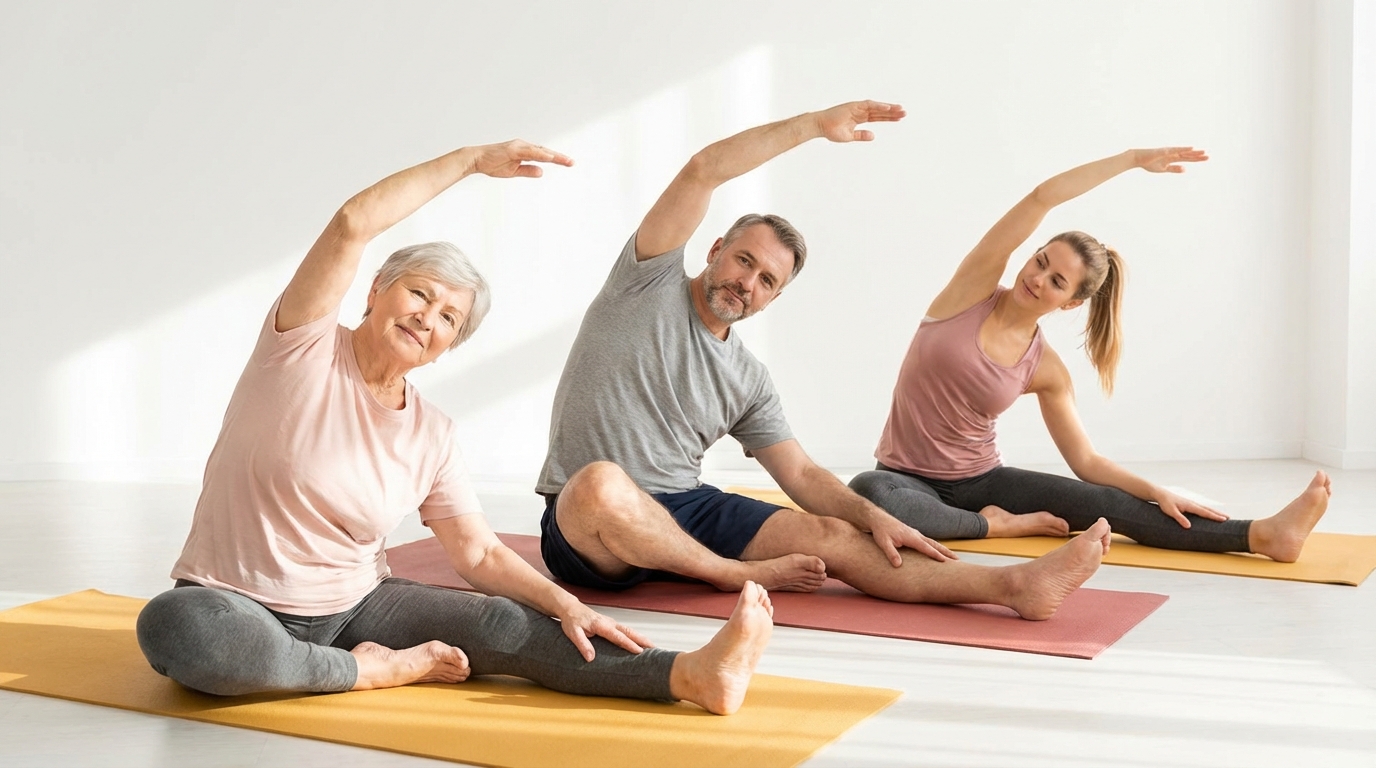
It is not easy to feel your body slowing down, or to watch someone you care about move with more stiffness or fear than they used to. Many of us carry quiet worries about falling, joint pain, or losing our independence, and those worries can make us feel older than our years.
If you take nothing else from this article, let it be this: gentle yoga can help almost any body move with a bit more comfort and confidence, at almost any age, when it is adapted kindly and practiced with patience. We can start very small, even in a chair, and still support balance, flexibility, and a sense of calm in the nervous system.
The goal is not to twist into shapes. The goal is to feel a little safer and more at home in your own body, one slow breath at a time.
How gentle yoga supports mobility at every age
Many families arrive at yoga after a scare: a parent falls, a partner has surgery, or a doctor quietly suggests “you need to move more.” Before we talk about specific exercises, it helps to understand why this kind of slow, kind movement can make daily life easier.
- Less stiffness: Slow stretching and simple poses help muscles relax and joints move more freely.
- Better balance: Gentle standing poses and weight shifts train the body to notice where it is in space and react more quickly.
- Stronger support muscles: Yoga often works the small stabilizing muscles in the hips, feet, and core that protect us when we trip or slip.
- Calmer nervous system: Paired breathing and movement help ease anxiety, which often shows up as tightness, shallow breathing, or trouble sleeping.
- Less fear of movement: When movement is kind and supported, the brain starts to trust the body again, which makes it easier to stay active.
We are not trying to force the body back to what it once could do. We are helping the body gently remember what it still can do, then building from there.
Safety first: when yoga for mobility is helpful, and when to be careful
Before starting any new movement routine, especially for someone with health concerns, it is wise to talk with a doctor, physical therapist, or nurse. They know the history that the rest of us cannot see on the surface.
Here are some common situations where gentle yoga can be a good partner to medical care:
| Situation | How gentle yoga can help |
|---|---|
| Arthritis in knees, hips, or hands | Slow range-of-motion work, gentle strengthening around joints, stress relief that can ease pain perception. |
| After a fall (with medical clearance) | Builds confidence, trains balance and stepping reactions in a safe, controlled way. |
| Parkinson’s or other movement disorders | Supports posture, flexibility, and focused, intentional movement, often combined with therapy. |
| Recovery from surgery | Light, cleared movements keep circulation going and prevent some stiffness once the surgeon allows it. |
| Chronic pain or fibromyalgia | Very gentle movement and breathing can calm the nervous system and may reduce pain flares. |
| Caregiver stress and burnout | Provides a short, structured time to breathe, stretch, and reconnect with your own body and emotions. |
Please be cautious or seek clear guidance before starting if there is:
- Recent surgery, joint replacement, or fracture that has not fully healed.
- Unstable blood pressure or heart rhythm concerns.
- Severe osteoporosis, where forward bending and twisting might increase fracture risk.
- Active vertigo, or frequent fainting spells.
- Strong or changing pain that has not been explained by a clinician.
If something feels sharp, electric, or alarming, that is the body asking us to stop and reassess. A gentle pull, a mild ache that eases when you finish, or a warm feeling in the muscles can be normal. Anything that feels scary deserves respect and a pause.
Yoga for mobility should feel like cooperation with your body, not a battle against it.
Simple principles for safe, gentle yoga
Before we lie down on a mat or sit in a chair, it helps to agree on a few simple rules that protect both dignity and safety.
1. Comfort over depth
You might find it helpful to think of each pose as having “levels” of depth. We stop at the level where:
- The breath still feels smooth and easy.
- The face, jaw, and shoulders can soften.
- Pain stays at zero, or at most a very mild stretch sensation.
If the breath feels trapped, or if the body tenses to “push through,” that is a sign to ease back.
2. Slow transitions
Many injuries for older adults happen not in the pose itself, but in the act of getting up or down. Moving at half the speed you think you “should” is often safer.
You might pause for a full breath:
- Before standing up from a chair.
- After moving from lying to sitting.
- Before turning the head or stepping sideways.
This pause gives the heart and blood pressure time to adjust, which can prevent lightheadedness.
3. Stable support nearby
Have one or more of these within easy reach:
- A sturdy chair, preferably one without wheels.
- A wall or heavy table.
- Yoga blocks or a firm stack of books.
- A folded blanket or towel for knees or under the head.
There is no prize for doing a pose without support. The real prize is staying safe enough to practice again tomorrow.
4. Gentle, steady breathing
Breath is the quiet partner of mobility work. It calms the nervous system and helps us sense when we are doing too much.
A simple rhythm:
- Inhale gently through the nose for a count of 3 or 4.
- Exhale softly through the nose or mouth for a count of 4 or 5.
You do not need to force or hold the breath. If counting makes you tense, let go of the numbers and just notice the cool air in, and the warmer air out.
Chair yoga for mobility: gentle exercises for all ages
Chair yoga can be a kind starting place for many people: older adults, people recovering from illness, those with joint pain, or anyone who spends many hours sitting as a caregiver. These movements can be done in ordinary clothes and do not require a mat.
Setting up the chair safely
Choose:
- A stable chair with a firm seat, without wheels.
- Feet flat on the floor. If they do not reach, place a folded blanket or sturdy books under them.
- Sit toward the front half of the seat, with room to move your arms and legs.
1. Seated grounding and breathing
This helps the nervous system settle before movement.
1. Sit with feet hip-width apart, hands resting on thighs.
2. Lengthen the spine gently, as if a string were lifting the crown of the head toward the ceiling.
3. Feel the weight of the feet on the floor and the sitting bones on the chair.
4. Take 5 to 10 slow breaths, noticing the rise and fall of the chest or belly.
You can quietly say to yourself on the inhale, “I am here,” and on the exhale, “I can soften.”
2. Neck mobility: gentle half circles
For many, the neck holds a lot of tension, especially caregivers who bend forward often.
1. Sit tall, gaze forward.
2. Exhale and let the chin lower toward the chest, only as far as is comfortable.
3. Inhale and slowly roll the head to look over the right shoulder, stopping before any pinching.
4. Exhale back through center, then inhale to look over the left shoulder.
5. Repeat 5 times each side, moving like a slow pendulum.
Avoid rolling the head all the way back, which can compress the neck.
3. Shoulder rolls and arm circles
This helps with dressing, reaching, and circulation in the upper body.
1. Inhale, lift both shoulders up toward the ears.
2. Exhale, roll them slowly back and down, as if they could slide into your back pockets.
3. Repeat 8 to 10 times.
4. Then place fingertips on the shoulders, and slowly draw small circles with the elbows, gradually widening them if it feels good.
5. Reverse the direction after 5 circles.
If raising the arms hurts, make the movements smaller, or move just one side at a time.
4. Seated cat and cow for the spine
This is a classic gentle yoga movement that keeps the spine more fluid.
1. Place hands on thighs.
2. Inhale, gently arch the back, lifting the chest and looking slightly upward. Sit only as tall as feels comfortable.
3. Exhale, draw the belly slightly in, round the upper back, and let the chin move toward the chest.
4. Move slowly between these two positions for 8 to 10 rounds of breath.
If someone has osteoporosis or a history of spinal fractures, keep the rounding very mild or skip that part and focus on gentle lengthening.
5. Seated side bend
Side bending helps with reaching across a table, into a cupboard, or putting on shoes.
1. Place the right hand on the right side of the chair or thigh.
2. Inhale, lift the left arm up toward the ceiling, palm facing inward.
3. Exhale, gently lean to the right, feeling a stretch along the left side of the body, not in the low back.
4. Stay for 3 to 5 smooth breaths, then return to center.
5. Repeat on the other side.
You can also keep the top hand on the hip instead of lifting it high, for less intensity.
6. Seated hip marches
This supports walking, stepping over curbs, and getting in and out of a car.
1. Sit tall, holding the sides of the chair lightly for balance.
2. Exhale, then on an inhale, lift the right foot a few inches, bending at the hip and knee, as if marching.
3. Exhale, lower the foot.
4. Repeat with the left leg.
5. Continue marching slowly for 20 to 30 steps, or less if fatigue sets in.
If the leg is heavy, a caregiver can gently support under the thigh, letting the person lead the movement.
7. Ankle circles and point-flex
Ankle mobility helps with balance and reduces the feeling of “heavy feet.”
1. Extend the right leg slightly forward, heel on the ground.
2. Point the toes away from you, then flex them back toward the face. Repeat 10 times.
3. Then lift the heel an inch off the ground and draw gentle circles with the toes, 5 each direction.
4. Repeat on the left side.
Those with swelling or neuropathy in the feet may find this especially soothing, as long as it does not cause pain.
If all you manage on a hard day is a few minutes of breathing and ankle circles, that still counts as yoga and still supports your mobility.
Standing yoga for better balance and walking
When standing is safe, simple poses near a wall or chair can gently wake up the balance system. A caregiver can stand close by as a quiet safety net.
Preparing for standing practice
Before starting:
- Wear flat, non-slip shoes or grip socks if barefoot is unsafe.
- Stand near a wall or place the back of a sturdy chair in front of you.
- Test how it feels to shift your weight side to side. If there is strong wobbling, keep two hands on the chair at first.
1. Mountain pose (Tadasana) for posture
This is a simple standing position that teaches awareness of alignment.
1. Stand with feet about hip-width apart.
2. Distribute weight evenly between the heels and the balls of the feet.
3. Let the arms rest by the sides or lightly hold the chair.
4. Imagine a string gently lengthening the body upward from the crown of the head.
5. Soften the shoulders down and slightly back.
6. Breathe here for 5 to 10 slow breaths.
You might quietly scan from the feet to the head, noticing where you feel steady, and where you feel tense.
2. Heel-to-toe rocking
Helps with walking and reduces shuffling.
1. Stand in Mountain pose, hands on the chair back or wall.
2. Inhale, slowly lift the heels, coming onto the balls of the feet.
3. Exhale, lower the heels and gently lift the toes, rocking toward the heels.
4. Move slowly back and forth 10 to 15 times.
If balance is fragile, lift heels or toes only a tiny amount. The nervous system learns from even very small shifts.
3. Side weight shifts
This teaches the body to adjust when weight moves to one leg, which we need for safe stepping and turning.
1. Stand behind the chair, lightly holding the backrest.
2. Inhale, gently shift weight into the right foot, letting the left foot lighten but stay touching the floor.
3. Exhale, return through center.
4. Inhale, shift weight into the left foot, right foot light.
5. Repeat 10 times per side, as slowly as you can.
If this becomes easy, you can lift the light foot an inch off the floor for a moment, then place it back down with control.
4. Supported chair squats
These help with getting up from toilets, car seats, and sofas.
1. Stand in front of the chair, back of knees lightly touching the seat.
2. Place feet hip-width apart, toes pointing forward.
3. Either cross arms in front of the chest or hold the armrests.
4. Inhale, lengthen the spine.
5. Exhale, send the hips back and bend the knees slightly, as if starting to sit, then press through the feet to stand tall again.
6. Repeat 5 to 10 times.
If strength is low, you can fully sit down each time, then use the hands on the chair or knees to help stand. Over time, try to use the arms a bit less.
5. Gentle supported Warrior stance for hip strength
This supports stride length and hip stability.
1. Stand sideways to the chair, right hand on the back of the chair.
2. Step the left foot back about one comfortable stride, turning the left toes out slightly.
3. Bend the right knee a little, keeping it over the ankle, not past the toes.
4. Keep the back heel down if possible, or shorten the stance.
5. Place the left hand on the left hip or let it rest by the side.
6. Breathe here for 5 slow breaths, feeling both feet anchored.
7. Step in and repeat the other side.
Keep the stance short enough that there is no strain in the knees or low back.
6. Tree pose with support
Tree pose is a classic balance exercise and can be very gentle when adapted.
1. Stand facing the back of the chair, holding with both hands.
2. Shift weight carefully into the left foot.
3. Turn the right knee out slightly, and place the right toes on the ground with the heel resting lightly against the left ankle.
4. Stay here, or slide the right foot a few inches up the inner calf, keeping toes on the ground.
5. Soften gaze on a steady point.
6. Breathe for 5 slow breaths, then switch sides.
Avoid pressing the foot against the knee joint. Keeping the toes on the floor is already very helpful for balance.
It is better to practice a small, safe version of a balance pose every day than to attempt a bigger version once and end up on the floor.
Floor-based gentle yoga for those who can get down safely
For some, practicing on the floor offers a feeling of grounding and relief from gravity. For others, getting down and back up feels frightening or unsafe. There is no obligation to work on the floor. If someone chooses to, it helps to plan the path down and up carefully.
Getting down to the floor safely
If there is any doubt about safety, have another adult present.
1. Stand next to a stable chair.
2. Place both hands on the chair seat.
3. Step one foot back, then the other, bending the knees to lower into a supported kneeling position on a folded blanket.
4. Bring one hand to the floor, then the other.
5. Shift weight gently and lower the hips to the side, coming into a seated position.
6. From there, you can turn and lie down as needed.
If knees do not tolerate kneeling, floor work might not be suitable without physical therapy guidance.
1. Reclined breathing and body scan
This is helpful for anxiety, chronic pain, or trouble falling asleep.
1. Lie on your back with knees bent and feet on the floor, hip-width apart.
2. Place one hand on the belly and one on the chest.
3. Notice the natural breath for a minute or two.
4. Gently invite the breath to swell into the belly on the inhale, letting it soften on the exhale.
5. Mentally scan from the toes to the head, softening any area that feels tight.
Stay 5 to 10 minutes if comfortable, or less if the low back complains.
2. Knee-to-chest variations
These help with low back comfort and hip mobility.
1. From the reclined position, draw the right knee toward the chest.
2. Hold behind the thigh or on top of the shin, whichever feels easier.
3. Keep the left foot on the floor, or extend the left leg long if the low back is comfortable.
4. Breathe for 5 to 8 slow breaths, then switch sides.
If bringing the leg close feels too strong, move only a small amount and stay there.
3. Gentle reclined twist
Twists, when done softly, can ease tension along the spine.
1. From knees-bent position, let both knees fall gently to the right.
2. Arms can rest out to the sides like a letter T, or hands can rest on the belly.
3. Turn the head slightly to the left only if the neck is happy.
4. Breathe into the side ribs for 5 to 10 breaths.
5. Return to center and repeat to the other side.
Anyone with spinal fractures, recent back surgery, or certain fusions should speak with a clinician before doing twists.
4. Bridge pose for hip strength
This helps with standing, walking, and climbing stairs.
1. Lie on the back with knees bent, feet hip-width, heels close enough that fingertips can brush them.
2. Arms by the sides, palms down.
3. Inhale, press the feet gently into the floor, and lift the hips a few inches.
4. Exhale, lower slowly.
5. Repeat 8 to 10 times.
The lift does not need to be high. You are simply asking the glute muscles to wake up and help support the pelvis.
5. All-fours cat and cow
If wrists and knees can handle some weight, this deepens spinal mobility more than the seated version.
1. Come to hands and knees, wrists under shoulders, knees under hips, padding under knees.
2. Inhale, gently arch the back and lift the chest, looking slightly forward.
3. Exhale, round the spine and let the head relax toward the floor.
4. Move with the breath for 8 to 10 rounds.
To reduce wrist strain, place hands slightly forward or on fists, or lower to forearms.
Returning to standing safely
1. Roll to one side.
2. Use the hands to help push up to sitting.
3. Come onto hands and knees facing the chair.
4. Place both hands on the seat, bring one foot forward, then the other, so you are in a supported squat or lunge.
5. Press into the feet and hands to slowly rise to standing.
There is no shame in taking your time or asking for a steady hand during this move.
Gentle yoga sequences for different needs
To make this practical, it helps to group some of these movements into short routines. These can fit into real life, even on busy or tiring days.
10-minute morning loosen-up (chair based)
This can be a kind start to the day for older adults, caregivers, or anyone who wakes up stiff.
- Seated grounding and breathing (1-2 minutes).
- Neck half circles (1 minute).
- Shoulder rolls and arm circles (2 minutes).
- Seated cat and cow (2 minutes).
- Seated side bends (2 minutes).
- Ankle circles and point-flex (1-2 minutes).
Balance and walking support (standing with chair, 10-15 minutes)
For those who have medical clearance to stand and want to reduce fall risk.
- Mountain pose breathing (2 minutes).
- Heel-to-toe rocking (2 minutes).
- Side weight shifts (3 minutes).
- Supported chair squats (3-4 minutes, with rests).
- Tree pose with support (2-3 minutes).
Evening wind-down for pain and stress (mixed chair and floor, 15-20 minutes)
If floor work is not possible, this can be done fully in a chair by choosing the closest versions.
- Seated or reclined breathing and body scan (5 minutes).
- Gentle seated or reclined knee-to-chest (3-4 minutes).
- Seated twist or reclined twist (4 minutes).
- Bridge pose or seated cat and cow (4-5 minutes).
- Finish with quiet breathing, perhaps with hands on the heart or belly (3-5 minutes).
Short, kind sessions practiced often do more for mobility than long, intense sessions done rarely.
Adapting yoga for different ages and conditions
We often imagine yoga as one-size-fits-all, but real bodies are unique. What feels soothing for one person might feel frightening or painful for another. Adapting is not “cheating.” It is wise.
For children and younger adults
Younger bodies may not worry about stiffness yet, but many sit for long hours, use screens, and feel stress.
You might focus on:
- More playful balance poses like Tree or a gentle Warrior stance.
- Cat and cow, downward-facing dog with bent knees if comfortable, and simple hip stretches.
- Breathing games, such as “smell the flower, blow the candle,” to make breath work less serious.
For children with physical or developmental differences, it is wise to work with therapists who know their specific needs.
For adults in midlife
Many in their 40s, 50s, and 60s start to notice stiffness in the morning, tight hips from sitting, or early arthritis.
Helpful focus areas:
- Hip mobility: seated marches, supported lunges, and gentle figure-four stretches.
- Back care: cat and cow, bridge, and careful hamstring stretches.
- Stress relief: longer exhalations in breathing, or simple guided relaxations.
For those in caregiving roles, it can help to add:
- Shoulder and back release after lifting or transferring loved ones.
- Short, 5-minute “resets” between tasks.
For older adults and those with frailty
With age, falls, fractures, and fear of movement become central concerns. The nervous system sometimes starts to overprotect the body, tightening muscles against every new motion.
Gentle priorities:
- Confidence: Simple movements that feel very safe, repeated often.
- Balance training: Standing near support, practicing small, slow weight shifts.
- Joint comfort: Tiny range-of-motion exercises for ankles, knees, hips, shoulders, and fingers.
- Breath and calm: Managing worry that can freeze the body.
For some, just sitting tall, moving the arms, and lifting the heels can be enough at first.
For people with limited mobility or using wheelchairs
Yoga can still offer comfort and mobility for those who spend most of their day seated or in bed.
Helpful ideas:
- Gentle neck and shoulder movements, side bends, and twists within the chair.
- Arm circles, wrist stretches, and hand opening and closing.
- Imagined movement: visualizing moving the legs or standing, which can still help brain-body connection.
- Breathing practices and guided relaxation to ease stress.
Caregivers can assist with passive range-of-motion exercises if trained and if a therapist has guided them.
Emotional benefits: yoga as a friend during hard seasons
Mobility work is not just about joints and muscles. Reduced mobility can stir up grief, anger, or shame. Many people feel that their body has “let them down,” or they feel guilty for needing help. Caregivers often carry their own quiet pain, feeling stuck between compassion and exhaustion.
Gentle yoga invites a different kind of relationship with the body.
Making space for feelings
During a pose, especially a quiet one like a seated forward fold or reclined breathing, emotions can surface. Tears may come without a clear reason. This is not failure. It is often a sign that the nervous system feels safe enough to soften.
You might:
- Let the feelings be there, without rushing to fix them.
- Keep the breath slow and kind.
- Place a hand on the heart or cheek as a simple self-comfort.
Building a sense of agency
For a person who relies on others for many tasks, choosing to do 5 minutes of gentle yoga can restore a small but powerful sense of control.
They can say:
- “I can choose when to move and when to rest.”
- “I can stop a pose that hurts.”
- “I can notice what feels better today than yesterday.”
Over time, these small choices add up to a stronger sense that life still holds options.
Yoga as shared time for caregivers and loved ones
Practicing together, even for a few minutes, can ease tension in a relationship that has become mostly about tasks and schedules.
Ideas:
- Sit side by side and do the same simple chair sequence.
- Take turns choosing the next movement or stretch.
- End with a shared moment of gratitude, perhaps naming one thing the body did well that day.
Mobility work is not only about walking across the room. It is also about feeling that life can still move in meaningful ways.
Practical tips for starting and staying consistent
Knowing what to do is one part of the puzzle. Making it part of daily life is another. Many of us have good intentions that fade by the end of a long week.
Start smaller than you think you should
Instead of a 30-minute routine, start with 5 minutes. Perhaps:
- Three chair movements after brushing your teeth.
- Five slow breaths before standing up from the bed.
- Two balance holds at the kitchen counter while waiting for the kettle.
If a day feels very hard, the “practice” can be just one minute of gentle breathing.
Pair yoga with daily habits
Routine sticks better when it is tied to something that already happens.
Examples:
| Existing habit | Gentle yoga add-on |
|---|---|
| Morning coffee or tea | Seated cat and cow, ankle circles. |
| TV watching | Commercial break stretches: neck rolls, shoulder circles, seated marches. |
| Bedtime prep | 3 minutes of breathing in bed, simple knee-to-chest. |
Listen, adjust, and forgive
Some days the body will feel more open. Other days it will feel like moving through mud.
You might keep a simple note:
- “Today: 5 minutes chair yoga, felt more open in shoulders.”
- “Today: only breathing, very tired.”
Rather than judging, treat this as information, like checking the weather before going out.
If several days go by without practice, you have not failed. You are human. You can restart with one breath, one stretch.
When to seek more guidance
There are times when home practice is not enough, or when a skilled guide could prevent harm.
You might look for a yoga teacher, therapist, or class that has:
- Experience with older adults, chronic illness, or disability.
- Small class sizes, so the teacher can see and support each person.
- A clear policy that students can rest or skip poses without shame.
- Good communication with medical providers when needed.
Ask questions such as:
- “How do you adapt poses for people with arthritis or balance issues?”
- “Is it welcome if my caregiver attends with me?”
- “Can I stay in a chair for the whole class if the floor is not safe for me?”
If the answer does not feel respectful or safe, it is acceptable to look for another option.
For some, one or two private sessions can set up a home routine that feels realistic and safe, especially after surgery or during complex illnesses.
Yoga for mobility is not about perfection, youth, or flexibility. It is about gentle, repeated kindness to a body that has carried you through many seasons of life.