
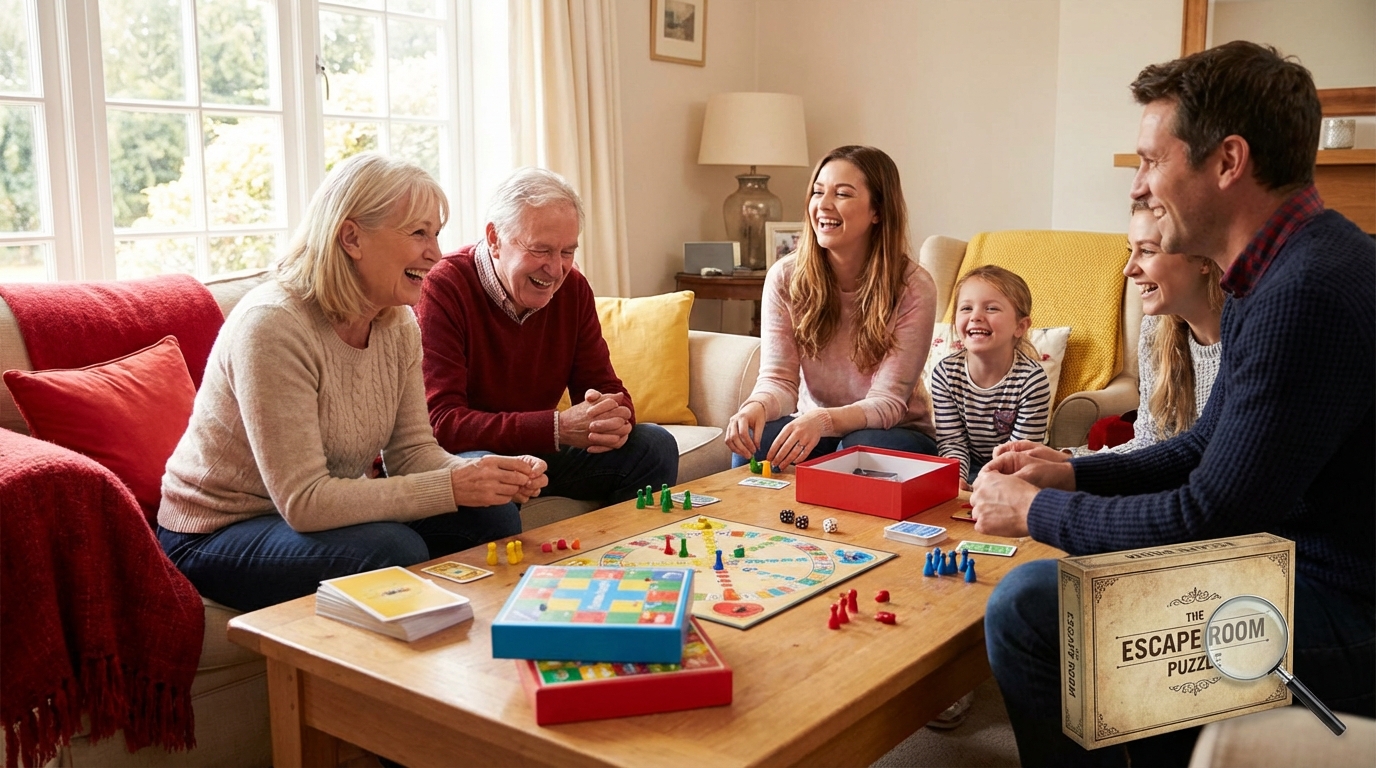
It is not easy to get everyone in the family to slow down, put their phones away, and sit around the same table. Many of us look around our homes and see people we love, all close by, but still a little disconnected. If you feel that, you are not alone, and there is nothing wrong with you or your family. Life is busy, and real connection often takes gentle, intentional effort.
The short answer is that board games can be one of the kindest, most practical tools we have for bringing a family back into the same shared moment. They give us a reason to sit together, laugh, think, and even work through disagreements in a safe way. For some families, traditional board games are enough. For others, adding a simple “escape room at home” style game can create a deeper sense of adventure and teamwork. You do not have to be a “gamer” or spend a lot of money. With a few thoughtful choices, board games can become a regular family ritual that supports connection, communication, and even caregiving.
Why board games can feel like a safe place for families
There is something very grounding about a game that sits on the table in front of us. We can see the pieces, touch the cards, move the pawns. For family members who feel overwhelmed by screens or fast conversations, this slower, tactile experience can feel calmer and more manageable.
Board games give us a shared focus, so the family is not staring at each other, but facing the same gentle challenge together.
For caregivers, this can be a relief. You might worry about how to include a parent living with memory loss, a partner with limited mobility, or a child who has trouble sitting still. A well-chosen board game can make inclusion easier because everyone has a clear role and the expectations are lighter.
Here are a few emotional needs that board games can meet:
- Belonging: Everyone at the table has a place and a turn.
- Predictability: The rules stay the same, which can comfort anxious or confused family members.
- Shared joy: Laughter over a silly mistake or surprise draw helps ease tension.
- Low-pressure interaction: You do not have to maintain constant conversation. The game itself helps fill the space.
For many caregiving households, evenings can feel strained. There may be exhaustion, stress about medical issues, or worry about bills. A simple game can create a pocket of time when the main goal is not to fix anything, but just to be together.
How board games support caregivers and care receivers
Caregiving changes the way a home feels. Tasks multiply. Roles shift. A spouse becomes a nurse. An adult child becomes a helper for a parent. Both sides may grieve the old, easier days of “just” being family.
Board games cannot remove those realities, but they can soften them.
Connection without heavy conversation
Many caregivers tell me that they want to connect more deeply with their loved one, but long, serious talks are hard. Maybe the person tires easily, or memory loss gets in the way, or old conflicts resurface.
Games allow connection without forcing big conversations. You can show care by:
- Explaining a rule gently, without rushing.
- Helping move pieces for someone with shaky hands.
- Encouraging a nervous player when they are unsure what to do.
- Sharing small comments and smiles between turns.
In a game, care often looks like patience: waiting a little longer for someone to decide, reminding them of a rule without criticism, or praising a clever move.
This kind of patience builds trust over time. It can spill over into harder parts of caregiving, such as bathing, medication, or medical appointments.
Support for cognitive and emotional health
Many board games quietly exercise the brain. Matching, planning, recalling simple rules, counting spaces on a board, or recognizing patterns all give the mind gentle work to do.
For older adults, or anyone living with mild cognitive decline, these small challenges can help maintain:
- Short-term attention
- Word finding and naming objects
- Decision making in low-risk situations
- Emotional resilience when things do not go their way
For children or teens in a caregiving household, games can offer:
- A sense of normal family life, even during illness.
- Practice handling frustration without outbursts.
- A safe chance to succeed at something small.
None of this has to feel like therapy. It can simply feel like “game night,” but with meaningful effects on mood and thinking.
Choosing the right kind of board game for your family
Not every game suits every family, especially when caregiving, disability, or health issues are part of daily life. The goal is not to pick the most complex or impressive game. The goal is to pick a game that fits your people.
Questions to ask before choosing
You might find it helpful to sit for a moment and ask:
- How long can our family comfortably focus on one activity?
- Does anyone have trouble reading small print or seeing colors?
- Is anyone living with memory loss or confusion?
- Do we have family members who dislike competition or feel bad when they lose?
- How much physical movement can people manage around the table?
Once you have a sense of your family’s abilities and comfort levels, you can look at game types more clearly.
Types of games and when they help
| Game Type | Good for | Possible challenges |
|---|---|---|
| Classic roll-and-move games | Younger children, casual play, low reading skills | May bore older teens or adults over time |
| Cooperative games | Families who dislike conflict, anxious players, dementia care | Some players may miss the feeling of competition |
| Light strategy games | Teens, adults, families who like planning | Rules may feel complex for someone with memory issues |
| Party and word games | Larger groups, laughter, social bonding | Can be stressful for people with language or hearing difficulties |
| Escape room / puzzle games | Teamwork, problem solving, older kids and adults | Can frustrate players who struggle with puzzles or reading |
Cooperative games and home escape room style games often work especially well in caregiving homes, because they replace “me versus you” with “all of us together versus the puzzle.”
Games that work well across ages and abilities
You might look for games with:
- Simple rules that can be explained in a few sentences.
- Short turns so no one feels forgotten or restless.
- Bright, clear pieces that are easy to see and grasp.
- Flexible difficulty, where you can adjust the challenge.
- Cooperative play, so younger or more fragile family members feel supported.
If you care for someone with moderate or advanced memory loss, very simple games like matching tiles, large-print bingo, or color sorting can feel safer. The key is to respect the person, never to “baby” them, and to invite them to join at their own comfort level.
Creating a calm, welcoming game-night routine
For families living with illness, disability, or stress, the routine around a game can matter even more than the game itself. A predictable pattern can help everyone relax.
Setting up the space for comfort and accessibility
Before you even open the box, it helps to think about:
- Lighting: Soft but bright enough for reading cards and seeing pieces. Avoid glare on shiny boards.
- Seating: Chairs with arms can help older adults stand up safely. Wheelchairs or walkers need enough room to move.
- Noise level: Turn off the television and limit background noise to reduce confusion or agitation.
- Table height: Make sure everyone can reach the board, including someone using a wheelchair or with limited arm strength.
- Breaks: Place water, tea, or simple snacks nearby to reduce the need to get up often.
You might keep a small basket or drawer near the table with:
- Reading glasses
- Large-print instructions you have copied from the game manual
- Card holders for people with shaky hands or arthritis
- Extra dice or simple counters
When the physical space feels gentle and prepared, family members are more likely to relax and join in, especially if they live with pain, fatigue, or confusion.
Soft rules for emotional safety
Game rules on paper are one thing. Emotional rules at the table are just as important.
Many families find it helpful to agree on gentle guidelines such as:
- No teasing about mistakes or forgetfulness.
- No raised voices, even when someone is excited or frustrated.
- Anyone can step away if they feel tired or overwhelmed.
- We focus on enjoying the time together, not only on winning.
If a loved one lives with memory loss or brain injury, you might also agree that:
- Other players can quietly remind them of a rule without drawing attention.
- Changing the rules mid-game for their comfort is allowed and respected.
- No one corrects them sharply for forgetting whose turn it is.
Sometimes it helps to say this out loud before you start: “Our goal is to have a peaceful time together. If anyone feels stressed, we can pause.”
Using board games to support communication
Many caregivers feel that communication in the family has become strained. Maybe there are frequent arguments about chores, medications, or school work. Maybe people just go silent.
Board games can gently encourage better communication habits.
Listening and turn-taking practice
Game play naturally involves:
- Waiting for your turn.
- Watching other people’s choices.
- Accepting that you cannot control everything.
These skills carry into daily life. When a child learns not to grab the dice out of turn, they are also practicing waiting when a sibling talks. When a spouse listens quietly while their partner explains a move, they are also practicing patience that might later help during stressful medical discussions.
You can quietly support this by:
- Praising patient behavior: “I saw you waited so calmly for Grandma’s turn. That was kind.”
- Gently pointing out good listening: “I like how we all listened to the rule again without interrupting.”
- Modeling calm yourself, taking a breath if you feel irritated.
Creating openings for small conversations
While the game gives structure, it also creates natural pauses where you can ask gentle questions or share short stories.
For example:
- While shuffling cards: “How did your appointment feel today?”
- While moving pieces: “What was your favorite game as a child?”
- While solving a puzzle: “This reminds me of the time we got lost on that trip.”
Sometimes the best conversations happen when no one is staring directly at each other, but at the shared cards, dice, or clues on the table.
If someone in your family finds direct eye contact or deep talk hard, the game can be a gentle shield that makes sharing feel safer.
Board games as a bridge to escape room style fun
For some families, especially with older children or teens, traditional board games can begin to feel repetitive. They might roll their eyes at yet another round of the same simple game. This is where “escape room at home” style games can bring new energy and togetherness.
What is a home escape room style game?
An escape room style game is usually a boxed game or printable kit that gives you a small story, a series of puzzles, and a goal, such as “unlock the vault” or “find the missing heirloom.” Instead of each person playing only for themselves, the whole family works as one team to “escape” or solve the final mystery within a certain time.
These games might include:
- Printed clues and codes
- Puzzle cards or envelopes
- Maps or simple props
- A website or app that checks your answers or provides hints
You can buy boxed escape room games or download printable ones that you cut and set up at home. Some websites even offer family-friendly kits that are designed for mixed ages or for people who need simpler puzzles.
Why escape room games can be powerful for families
Escape room style games encourage:
- Teamwork: There is no “loser” in the room. You all win or lose together.
- Shared focus: Everyone looks at the same clue, map, or riddle, which reduces side conflicts.
- Variety of skills: One person might be good at word puzzles, another at spotting visual patterns, another at organizing clues.
- Story-based play: A simple story about a haunted library or missing treasure can capture imaginations, especially for kids who love drama and adventure.
When a family solves a tough puzzle together, the feeling of “We did it” can be very healing, especially for households that spend a lot of time facing hard problems they cannot easily solve.
For caregivers, this sense of joint success can be especially meaningful. Much of caregiving involves situations where there is no perfect fix. A contained puzzle that truly ends, where you can solve it as a team, gives a rare and satisfying sense of completion.
Adapting escape room play for caregiving households
Escape room games can be quite challenging. Some families in caregiving situations might find them overwhelming without small adjustments.
You might find it helpful to:
- Choose beginner or family editions: Look for games labeled as easy or family level.
- Ignore or relax the timer: If a time limit creates stress, either extend it generously or skip it completely.
- Allow hints freely: Use hint cards or hint websites early and often, framing them as part of the fun, not as failure.
- Break it into sessions: Solve a few puzzles one evening, then pause and continue the next day if someone tires easily.
- Give roles: Someone might be the “clue reader,” another the “writer,” another the “piece organizer.”
If you care for someone with dementia or significant cognitive challenges, they might still enjoy being present at the table, touching props, listening to the story, or helping find symbols or pictures that match. You can let them take part in small ways that feel dignified and safe, without any pressure to handle complex steps.
Blending traditional board games with escape room elements
You do not have to jump straight from simple board games to a full escape room kit. Many families enjoy a middle path, mixing gentle board play with a small puzzle or mystery theme.
Ideas for simple “escape” touches at home
Here are a few accessible ways to add a sense of adventure without overwhelming anyone:
- Treasure clue trail: Hide 3 or 4 simple picture clues around the living room that lead to the board game box itself, turning “game start” into a tiny hunt.
- Mystery tokens: During a regular board game, add a few special tokens. When someone lands on or draws them, you all pause and solve a tiny riddle together.
- Story starter card: Before the game, read a short, gentle story aloud about why you are “gathered at the table” today (for example, “We are protecting the village from a storm, and this game helps us plan”).
- Family-created puzzle: Ask older kids to design a short, simple puzzle that the rest of the family has to solve to “unlock” dessert or the next game round.
These do not have to be clever or perfect. The point is the shared experience, not the puzzle quality.
When to keep it simple
It is possible to go too far with story and puzzles, especially if someone in the home:
- Is easily confused by pretend stories versus reality.
- Feels anxious with time pressure or complex challenges.
- Is already overwhelmed by medical decisions or paperwork during the day.
In those cases, a gentle, familiar board game with only a light touch of story may be best. You can always add more puzzle elements later if everyone seems to enjoy it.
Supporting different abilities at the same table
One of the most beautiful parts of board games is the way they can bring together grandparents, parents, children, friends, and neighbors. Still, when abilities differ widely, you might worry that someone will feel left out.
Physical accessibility
For someone with arthritis, tremors, weakness, or limited reach, small pieces and tight boards can be a barrier. You can ease this by:
- Using card holders so players do not have to grip a fan of cards.
- Choosing games with larger pieces, tiles, or pawns.
- Offering to move a piece for them only after asking permission.
- Placing frequently used items near them on the table.
If you care for someone who uses a wheelchair or needs frequent position changes, you might:
- Play at a table with open space underneath for legroom.
- Use a lap tray or pillow to support the board if needed.
- Agree that the game can pause at any time for comfort.
Cognitive and sensory differences
For family members with dementia, brain injury, autism, ADHD, or sensory sensitivities, you might adapt the game by:
- Shortening the game: playing to fewer points or ending after a set time.
- Reducing rules: skipping complex scoring or bonuses that add confusion.
- Using visual aids: drawing simple icons to show turn order or available actions.
- Providing quiet space: allowing someone to step back if the group energy feels too intense.
When we adjust the game to fit the person, rather than forcing the person to fit the game, we show deep respect and care.
You can say openly, “We changed the rules a bit so that everyone can play together,” so that adaptations feel normal, not shameful.
Supporting the caregiver through play
It is easy to focus only on the person receiving care and forget that the caregiver’s heart and body are also under strain. Board games and escape room style puzzles can offer the caregiver specific kinds of relief.
Shared responsibility instead of constant leadership
In daily life, caregivers often carry most of the planning and decision making. A game can shift that balance for a short time. The game rules, the board, and the cards give structure, so the caregiver does not have to invent every activity or conversation.
This can feel like a small rest. You can sit, follow the steps, laugh, and let someone else draw the next card or read the next clue.
A gentle way to ask for help from others
Family members who live far away or who are not involved in daily caregiving sometimes feel nervous about visiting. They may not know how to interact with a loved one who has changed. Suggesting a simple game or a family escape room evening can give them a clear activity.
You might say:
- “When you visit, could you bring a favorite game to share with Dad?”
- “Would you be willing to host an escape room puzzle night so that Mom has something fun to look forward to?”
This turns “visit” into “shared activity,” which many people find less intimidating. It also gives you, the caregiver, a bit of emotional breathing room as other relatives step into the circle of care, even for an hour or two.
Affordable ways to bring more games into your home
Money can be tight in caregiving homes. Medical bills, adaptive equipment, and lost work hours add up quickly. The good news is that you do not need a large collection of new games to benefit from family play.
Low-cost and free options
You might find:
- Public libraries: Many libraries now lend board games and puzzles along with books.
- Community centers and senior centers: Some offer game afternoons that you can copy at home.
- Printable games online: There are simple board games, bingo sheets, and escape room kits that you can print for the cost of paper and ink.
- Thrift stores and swaps: Used games are often very affordable. Just check that all the main pieces are present.
For escape room style play, you can:
- Search for free or low-cost printable puzzle kits.
- Create your own basic riddles, such as “Look for the book with a blue cover” leading to the next clue.
- Use objects you already own as “locks,” such as a shoebox tied with string that must be “unlocked” by solving a simple code.
Rotating a small collection
You do not need a shelf full of options. Many families do well with:
- One very simple game for tired days or for a loved one with more advanced support needs.
- One mid-range game that most people like and find easy to remember.
- One cooperative or escape room style game for days when you have more energy.
You can rotate these depending on the mood, time of day, and health of the people involved. Over the years, you can add or trade games as needs shift.
Gently introducing games to a reluctant family
Not every family member will love the idea of “game night,” especially if there have been tensions or if someone feels self-conscious about their abilities.
Starting very small
Instead of announcing a formal event, you might:
- Set up a very simple game on the coffee table and invite whoever walks by: “I am going to play a quick round. Want to join me?”
- Invite one person at a time rather than the whole family at once.
- Choose a game that ends in 10 to 15 minutes so no one feels trapped.
Over time, as people notice that these moments feel calm and kind, they may become more open to longer or slightly more complex games.
Respecting boundaries while still offering connection
If someone strongly resists, it helps to respect their boundary while leaving the door open. You might say:
- “That is alright, you do not have to play. You are welcome to sit with us or watch if you like.”
- “We will start with just a few rounds and see how it feels.”
For some family members, just sitting nearby during a game, listening to the laughter and conversation, can still bring a sense of belonging.
The goal is not to force every person into the same activity, but to offer gentle, regular chances for shared joy and connection.
When board games or escape experiences are not helping
There will be evenings when a game does not go well. Someone may become upset, tired, or confused. A puzzle may prove too hard, or old family conflicts might show up at the table.
This does not mean you failed, or that games are a bad idea for your family.
It can help to:
- Pause the game kindly rather than forcing it to continue.
- Speak calmly and say something like, “It seems like we are all a bit tired. We can put this away and try again another day.”
- Reflect later on what felt hard. Was the game too long? The rules too complex? Was the time of day wrong for the person receiving care?
You might decide to shift to:
- Simpler games for a while.
- Shorter sessions, perhaps one or two rounds only.
- Other shared activities, such as music, gentle stretching, or storytelling, on some days.
Sometimes the kindest choice is to put the box back on the shelf and choose rest instead. Your worth as a caregiver or family leader does not rest on how well game night goes.
Turning small game moments into lasting family memories
Over time, many families find that board games and home escape puzzles become more than just entertainment. They turn into a thread that runs through birthdays, holidays, and quiet evenings.
You might notice:
- Certain jokes that only make sense because of a funny moment from a game.
- Stories that children repeat later, such as “Remember when Grandpa cracked that code before any of us?”
- Photos of the family leaning over a board, showing a rare mix of focus and joy.
For families living with serious illness, disability, or end-of-life care, these gentle memories can be especially precious. They remind everyone that, even in hard seasons, there were shared moments of play, teamwork, and simple happiness.
Board games and escape room style experiences do not erase the hard parts of caregiving, but they can give us small islands of connection in the middle of a demanding sea.
We sit at the same table. We touch the same pieces. We study the same clue. For an hour, we are not only patient and caregiver, not only parent and child, not only healthy and ill. We are teammates, storytellers, puzzle solvers. That shared identity can make the work of caring and being cared for feel a little lighter, and the home feel a little more like a place where everyone truly belongs.