
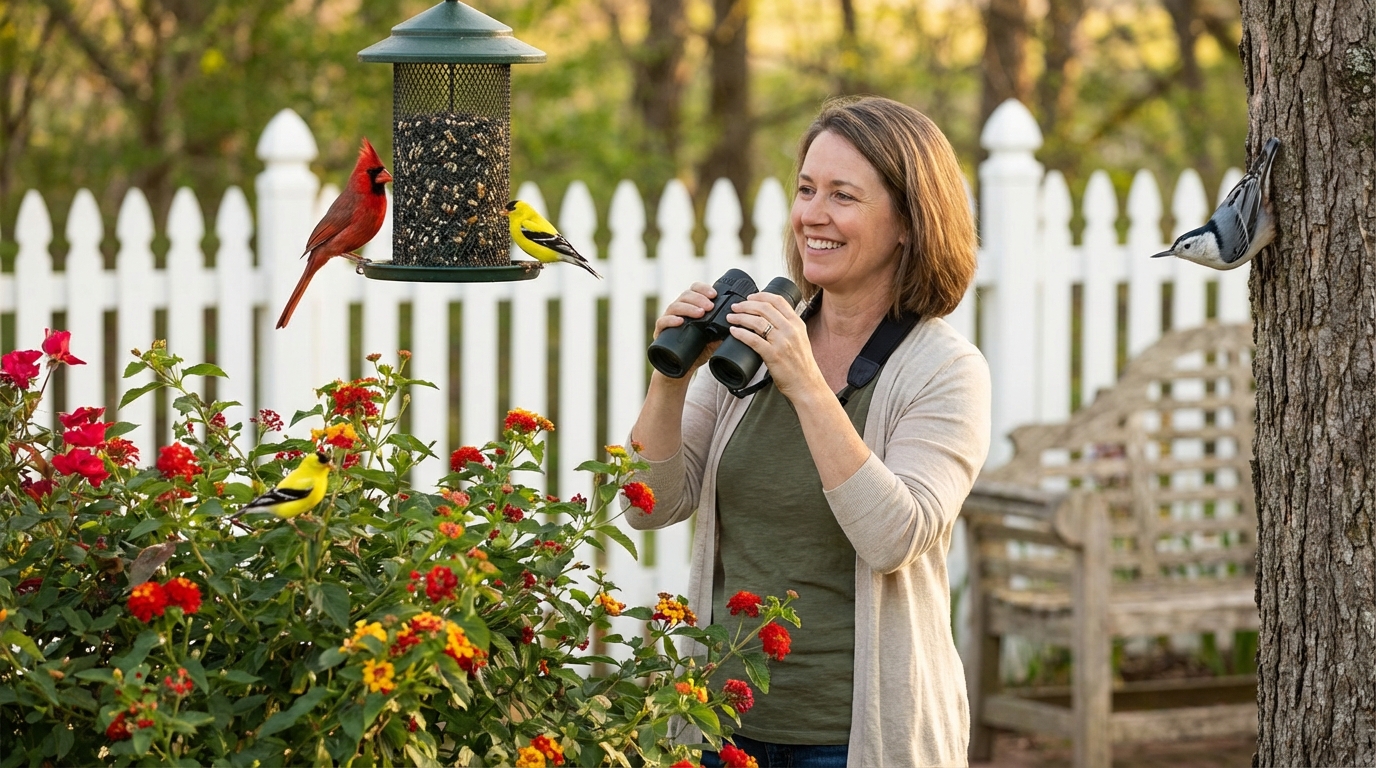
It is not always easy to slow down when life feels full of appointments, medications, and caregiving tasks. Many of us feel like we move from one responsibility to the next, with very little space to breathe or enjoy something gentle and quiet. Bird watching in the backyard can feel like a small doorway back to that quiet, for us and for the people we care for.
The short answer is that backyard bird watching is one of the simplest nature activities we can bring into an accessible home. With a few feeders, some water, and a place to sit near a window or on a patio, we can invite birds to come to us. This can give daily comfort, mental focus, a sense of routine, and a shared activity that works for older adults, children, and people with limited mobility or chronic illness.
Backyard bird watching is less about “doing it right” and more about creating a gentle moment in the day where we stop, look, and listen together.
We will walk through how to set up an easy, accessible bird watching space, how to keep it safe and clean, and how to make this a meaningful part of caregiving or family life, not just a hobby on the side.
Why Bird Watching Matters For Caregivers And Families
Before we look at what feeder to buy or where to put a birdbath, it helps to remember why we are doing this. Many caregivers tell me they feel guilty any time they sit down “just to look at birds.” It can feel like we are wasting time when there is so much to do. In reality, this small practice often gives back more than it takes.
Emotional Benefits For Caregivers And Care Recipients
When we share even a few minutes of quiet observation, something shifts. Breathing slows, shoulders drop, and the mind has a moment away from worry. For a person living with dementia, Parkinson’s, chronic pain, or serious illness, birds can bring interest and color to days that otherwise feel long and repetitive. For the caregiver, those same birds can feel like companions that keep us company when we feel alone.
A simple thing like noticing “our” cardinal or “our” chickadee returning each day can give a surprising sense of continuity and comfort.
Some gentle emotional supports that backyard bird watching often brings:
- Calm and grounding: Repeating sounds like chirping, cooing, and soft movement can help lower stress.
- Hope and anticipation: Waiting to see who visits the feeder each morning can give people something kind to look forward to.
- Connection: Watching together encourages conversation, shared smiles, and small memories.
- Meaning: Caring for birds, even in a small way, can restore a sense of purpose when other roles feel lost.
Benefits For People With Limited Mobility Or Illness
Many of us have loved ones who used to love hiking, gardening, or walking in the park and cannot do those things anymore. When we bring birds closer to the window or porch, we bring a piece of the outside world to them. This can ease the sadness of losing former hobbies.
Bird watching can support:
| Area | How Bird Watching Helps |
|---|---|
| Cognition | Identifying birds, remembering their colors and calls, and tracking visits can gently exercise memory and attention. |
| Vision & focus | Looking out the window and tracking movement helps eye focus and can reduce fixation on screens. |
| Sense of agency | Filling a feeder, choosing where to hang it, or writing in a bird journal can support a sense of control. |
| Routine | Checking the feeder at breakfast or before bed can create comforting daily patterns. |
| Social interaction | Bird visits give easy conversation topics, even for those who struggle to talk about more personal things. |
Benefits For Children And Grandchildren
If children or grandchildren visit, birds give an easy way to connect generations. A child can help fill the feeder or look through binoculars, while a grandparent can share stories or simple facts.
You might notice:
- Children growing more patient as they wait quietly for birds.
- Curiosity about nature and seasons starting from the yard.
- Moments where adults and children focus together on something calm, rather than a screen.
Birds offer something gentle to talk about when words are hard, whether from age, illness, or simply a long day.
Creating An Accessible Bird Watching Space At Home
For caregiving households, the biggest challenge is often not “what bird is that,” but “how do we make this easy and safe given our space, bodies, and time.”
Choosing The Best Viewing Spot
You might find it helpful to start by asking: “Where do we already sit every day?” Then, think about how to bring birds into view from that place.
Some common options:
- Living room window: Good for people who spend much of the day in a recliner, lift chair, or couch.
- Kitchen or dining window: Nice for building a routine of “breakfast with the birds.”
- Bedroom window: Comforting for someone who is bedbound or spends long periods resting.
- Accessible porch or patio: Ideal if wheelchair ramps, grab bars, or stable seating are already there.
Practical tips for choosing a spot:
- Make sure the window is at a comfortable height for the person watching, whether they are seated in a standard chair, a wheelchair, or recliner.
- Check that you can draw curtains or blinds if bright light bothers eyes, or for naps.
- Ensure pathways to the window or door are clear of clutter, cords, and loose rugs, to prevent falls.
- If possible, pick a place where background is trees, shrubs, or sky, which make birds easier to see than a busy street.
Accessibility Considerations For Different Needs
Caregiving homes often need many small adjustments. Bird watching can fit into that pattern gently.
| Need | Helpful Adjustments |
|---|---|
| Wheelchair access | Lower the feeder in view of seated eye level, keep deck/patio free of debris, widen pathways to at least 36 inches. |
| Low vision | Choose bright feeders, place them closer to the window, focus on birds with strong colors like cardinals, jays, or goldfinches. |
| Hearing loss | Focus on colors and movement more than sound, consider labels or photos of frequent visitors. |
| Dementia or memory loss | Keep the setup simple, avoid frequent changes in feeder location, use a routine phrase like “Let us see who is visiting the feeder today.” |
| Fall risk | Mount feeders where the caregiver can reach them safely, avoid step stools, and keep seed storage in easy reach. |
The best bird watching setup is the one that fits your real daily life, even if it looks simple or “imperfect.”
Choosing Feeders, Food, And Water
Once we know where we want birds to appear, we can think about how to invite them in with food and water. It can feel overwhelming at first, with many choices, but we can keep it very simple.
Types Of Feeders And Their Pros And Cons
Here are some common feeder styles and where they fit well in caregiving settings:
-
Tray or platform feeders
These are open, flat surfaces with low edges. Birds can land easily and seeds are visible.Best for: People who enjoy seeing many birds at once and want easy filling.
Considerations: Can get messy with shells and droppings, so position them where cleanup feels manageable. -
Tube feeders
These are clear tubes with small feeding ports. They protect seed from rain.Best for: Smaller birds like finches and chickadees, and for narrow spaces near windows.
Considerations: Need occasional brushing inside to prevent mold. -
Hopper feeders
These look like small houses or barns with a chamber that releases seed slowly.Best for: A variety of birds, good for people who want to fill less often.
Considerations: Heavier when full; make sure the person filling it can lift it or that it can be filled while hanging. -
Suet feeders
Wire cages that hold blocks of suet, a high-fat food that many birds love, especially in cooler weather.Best for: Woodpeckers, nuthatches, and other clinging birds.
Considerations: In hot weather, suet can soften or smell; choose no-melt suet if summers are hot. -
Window feeders
Small feeders that attach with suction cups to the outside of a window.Best for: People who need the birds very close, such as those with low vision or who are bedbound.
Considerations: Need good-quality suction cups and careful cleaning of glass to reduce the risk of feeders falling.
For many caregiving homes, starting with one simple tube or hopper feeder visible from the main sitting area is enough. You can always add more later if you enjoy it.
Choosing Bird Food That Attracts Visitors
Different seeds bring different birds, but we do not need a complex mix to get started.
Some common choices:
- Black oil sunflower seeds: A favorite for many species. The shells can be messy but they are excellent at attracting visitors.
- Sunflower hearts/chips: Hulled seeds that reduce shell waste, helpful for patios and accessible decks, but slightly more expensive.
- Nyjer (thistle) seed: Very small seeds for finches. Requires a special feeder with small holes.
- Mixed seed blends: These can be useful, but try to choose mixes where sunflower is a main ingredient, rather than mostly filler grains like millet and cracked corn.
- Suet cakes: High-energy food, especially valued in cold weather.
For an easy start, many caregivers use only black oil sunflower seeds in a tube or hopper feeder and a suet cake in a small cage. This combination brings a wide range of birds in many regions.
You do not need a dozen feeders or rare seed types. One well-placed feeder with decent seed can bring steady joy.
Offering Water: Birdbaths And Small Ponds
Water is just as important as food. A simple bowl or birdbath can bring birds that never touch your feeder, especially in hot climates or winter when natural sources freeze.
Options for water:
- Classic birdbath: A shallow basin on a pedestal or placed on a table.
- Ground-level basin: A wide, shallow dish on the ground, which many birds prefer as it feels more natural.
- Hanging birdbath: A light basin hung from a tree branch or hook, good for decks and small yards.
Safety and accessibility tips:
- Choose a shallow basin, about 1 to 2 inches deep, or place a flat rock inside deeper baths so birds can stand safely.
- Place the bath where it is easy for the caregiver to reach with a pitcher of water or hose, without lifting heavy buckets.
- Change water every couple of days to prevent mosquitoes and algae. Small baths are easier to lift and dump.
- If someone in the home is at high fall risk, avoid placing birdbaths where water can splash on walking paths or steps.
For some households, a simple heavy plant saucer on a sturdy table outside a window is enough. It can be cleaned and refilled without much bending.
Keeping Birds, People, And The Home Safe
Bird watching is gentlest when it does not create new health or safety problems. A little planning helps protect the birds and the people who live in the home.
Reducing Window Collisions
Birds may not always see glass and can fly into windows with serious injury. We can lower this risk without losing our view.
Ways to help:
- Distance from glass: Place feeders either within about 3 feet of the window (so birds cannot gain speed) or more than about 30 feet away, if you have space.
- Window markings: Apply stickers, stripes, or patterned films to the outside of large clear panes, spaced closely, so birds see the barrier.
- Keep blinds partly lowered: Some caregivers leave blinds or curtains a bit closed when the feeder is not in use, to reduce reflections.
Hygiene And Disease Prevention
Bird feeders and baths can collect droppings and old seed, which sometimes encourage disease. With vulnerable people in the home, including those with weakened immune systems, extra care helps.
Simple hygiene steps:
- Clean feeders about every 2 to 4 weeks with warm soapy water and a scrub brush. For stubborn grime, a weak bleach solution (for example 1 part bleach to 9 parts water) can be used, followed by thorough rinsing and drying.
- Wash birdbaths at least once a week, more often in hot weather.
- Rake up shells and spilled seed under feeders when possible, or place a platform beneath to catch debris.
- If you see several sick or dead birds near your feeder, stop feeding for a couple of weeks and clean everything carefully.
- Caretakers with respiratory issues might wear a simple mask when cleaning feeders, to avoid inhaling dust or droppings.
If the person you care for is at very high infection risk (for example, during chemotherapy), talk with their medical team about any extra precautions before you start backyard feeding.
Managing Pests And Unwanted Visitors
Seed can attract squirrels, rats, raccoons, and sometimes larger animals. That can raise concerns for home safety and cleanliness.
You might find it helpful to:
- Use “baffles,” which are plastic or metal barriers on poles, to slow squirrels climbing up to feeders.
- Feed only as much seed as birds will eat in a day or two, rather than always leaving feeders full.
- Store seed in metal or thick plastic containers with tight lids, not in bags on the floor.
- Bring feeders in at night if raccoons or bears are a concern in your area.
If pests become stressful or hard to control, it may be kinder to shift focus from feeding to watching birds that come naturally to your yard’s trees and shrubs.
Making Bird Watching A Meaningful Daily Ritual
Once everything is set up, the deeper value comes from how we weave bird watching into everyday life. This is where it can truly support caregivers and care recipients emotionally.
Creating Gentle Routines
Routine can feel like a lifesaver, especially in caregiving homes where many things feel unpredictable.
You might like to shape small rituals such as:
- “Morning check-in”: Looking at the feeder together after breakfast, naming who you see, noticing the weather.
- “Evening count”: Before closing curtains, counting how many birds visit at dusk or looking for particular species.
- “Refill days”: Choosing one or two set days each week to refill feeders together, if the person you care for is able to help.
A shared ritual of checking on “our birds” can feel as grounding as watering a favorite plant or making evening tea.
Adapting Bird Watching For Different Abilities
Not everyone will engage with birds in the same way. Adapting the activity can keep it accessible.
For people with dementia:
- Keep things simple. One feeder, one or two common birds to talk about, rather than many details.
- Repeat familiar phrases: “Look, the red bird is back” for a cardinal, for example.
- Avoid challenging quizzes. Gentle questions like “Do you see the bird on the branch?” can encourage attention without pressure.
For people with low vision:
- Move feeders closer to windows, within 5 to 8 feet if safe.
- Choose brightly colored feeders and focus on birds with strong colors.
- Use high-contrast bird photos or flashcards indoors for reference.
For people with limited hand strength:
- Use feeders that open easily with large clips rather than small screws.
- Place seed in small, light containers instead of heavy bags.
- Let them help in ways that do not strain, such as pouring seed from a scoop or pointing to where birds are.
Turning Observation Into Gentle Conversation
Birds give us neutral topics that can lead softly into deeper sharing.
You might ask:
- “Which bird do you feel closest to today?”
- “Did your family ever notice birds when you were young?”
- “If you could be any bird for a day, which would you choose?”
These questions can open doors to memories, hopes, and stories. For loved ones who struggle with speech, sometimes just naming simple things together helps: “Red bird,” “Blue bird,” “Two birds,” “Flying,” “Eating.”
Simple Tools That Can Help (Without Making Things Complicated)
Many bird guides and apps exist, and it can be easy to feel pressured to identify everything exactly. For caregiving homes, it is fine to keep tools very basic and focus on enjoyment first.
Field Guides, Apps, And Aids
Helpful, gentle tools include:
- Local bird guides with pictures: Choose ones with clear, large photos and simple, short text.
- Printable charts: Many nature organizations offer free printable sheets of common backyard birds in each region.
- Audio recordings: Playing bird calls at low volume indoors can support recognition, but keep it limited so birds outside are not confused.
- Simple apps: For tech-friendly families, some apps can help identify birds by photo or sound. Caregivers may enjoy using these while keeping the interaction with the person they care for easy and relaxed.
For someone living with cognitive decline, it may be best not to focus on correct names at all. “Little brown friend” or “our red visitor” is completely fine.
Bird Journals And Memory Books
Keeping a written or visual record of bird visits can be meaningful and soothing.
Some ideas:
- Daily bird log: Write the date and note one or two birds you noticed, or simply whether there were “many,” “few,” or “none.”
- Sticker or stamp chart: Use bird stickers or simple stamps for each day you see certain colors or species.
- Photo album: Take occasional photos from the window and keep them in a small album where your loved one can flip through on harder days.
This kind of record can help someone feel that their days have continuity and content, rather than blending together.
Designing A Backyard That Welcomes Birds
Feeding birds is one part of the picture. The yard or balcony itself can also become more inviting, even with small changes.
Plants That Support Birds
Native plants tend to support more insects and natural food sources for birds. Every region has its own best choices, and local nature groups often have lists.
Broad ideas that tend to help:
- Shrubs and small trees: Provide perches, nesting places, and cover from predators.
- Berry-producing plants: Such as serviceberry, elderberry, or viburnum, which give food in cooler seasons.
- Flowering plants with seeds: Like coneflowers or black-eyed Susans, whose seed heads birds enjoy after the flowers fade.
- Ground cover: Areas of leaves or low plants where birds can forage for insects.
If full gardening feels like too much, you might place just a few potted plants on a balcony: a small shrub in a pot, a hanging basket, or a planter box with flowers that go to seed.
Balcony And Small-Space Bird Watching
Not everyone has a yard. Many caregivers live in apartments or senior housing with only a balcony or small patio. Bird watching can still work in these settings, with some extra care about neighbors and building rules.
Some options:
- Use clamp-on deck feeders that attach to balcony railings.
- Choose no-mess seed blends or sunflower hearts to reduce hulls and waste falling below.
- Place a shallow dish of water on a stable surface, wiping up spills promptly to avoid slippery spots.
- Check any community rules about feeding wildlife, to avoid conflict or fines.
For some buildings, landlords may not allow bird feeders. In that case, you can still watch birds that appear naturally, and add interest with plants, wind chimes (soft ones, so they are not bothersome to neighbors), or small decorations that give conversation points.
Including The Whole Care Team
Caregiving is often shared among family, friends, and paid aides. Bird watching can be a gentle way to build consistency and shared joy among the whole team.
Helping Home Health Aides And Support Staff Join In
You might find it useful to include bird watching in the care plan in small ways, such as:
- Asking aides to open the curtains each morning so your loved one can see outside.
- Encouraging short, simple conversations about birds as a warm-up before more personal care tasks.
- Having aides help refill feeders on designated days, if that fits within their job description and safety rules.
Sharing a quick note in a communication notebook like “Mr. James enjoyed watching the blue jay at 10 a.m. today” helps everyone feel more connected and gives future visitors easy conversation starters.
Group Bird Watching In Care Facilities
For those living in assisted living or nursing homes, bird watching can become a small group activity.
Examples:
- A communal feeder near the dining room window.
- Weekly “bird time” where residents gather near windows to share what they see.
- Simple seasonal crafts, such as making pinecone feeders (if policies allow) or decorating picture frames for bird photos.
Staff can use birds as a gentle focus during group sessions, especially for residents who find large gatherings overwhelming.
Listening To Your Limits As A Caregiver
While bird watching can be healing, it should not become another heavy obligation. If you notice that managing feeders feels stressful, that is a sign to simplify.
You might adjust by:
- Reducing to one feeder that you fill only a few times per week.
- Taking a seasonal break during times of family illness or extra stress.
- Focusing more on listening and watching whatever birds visit naturally, with no feeding at all.
Backyard nature observation should meet you where you are, not ask you to prove anything or measure up to anyone else’s idea of a “perfect” bird garden.
Sometimes, just opening a window for a few minutes to feel fresh air and listen for a distant bird is enough for that day. That is still bird watching, still connection, still worthy of time and care.
By inviting birds into our everyday moments, we are quietly telling ourselves and our loved ones that there is still room for beauty, curiosity, and rest, even in the middle of caregiving. Over time, those small moments of watching a robin hop or a chickadee tilt its head can become part of the thread that holds our days together.