
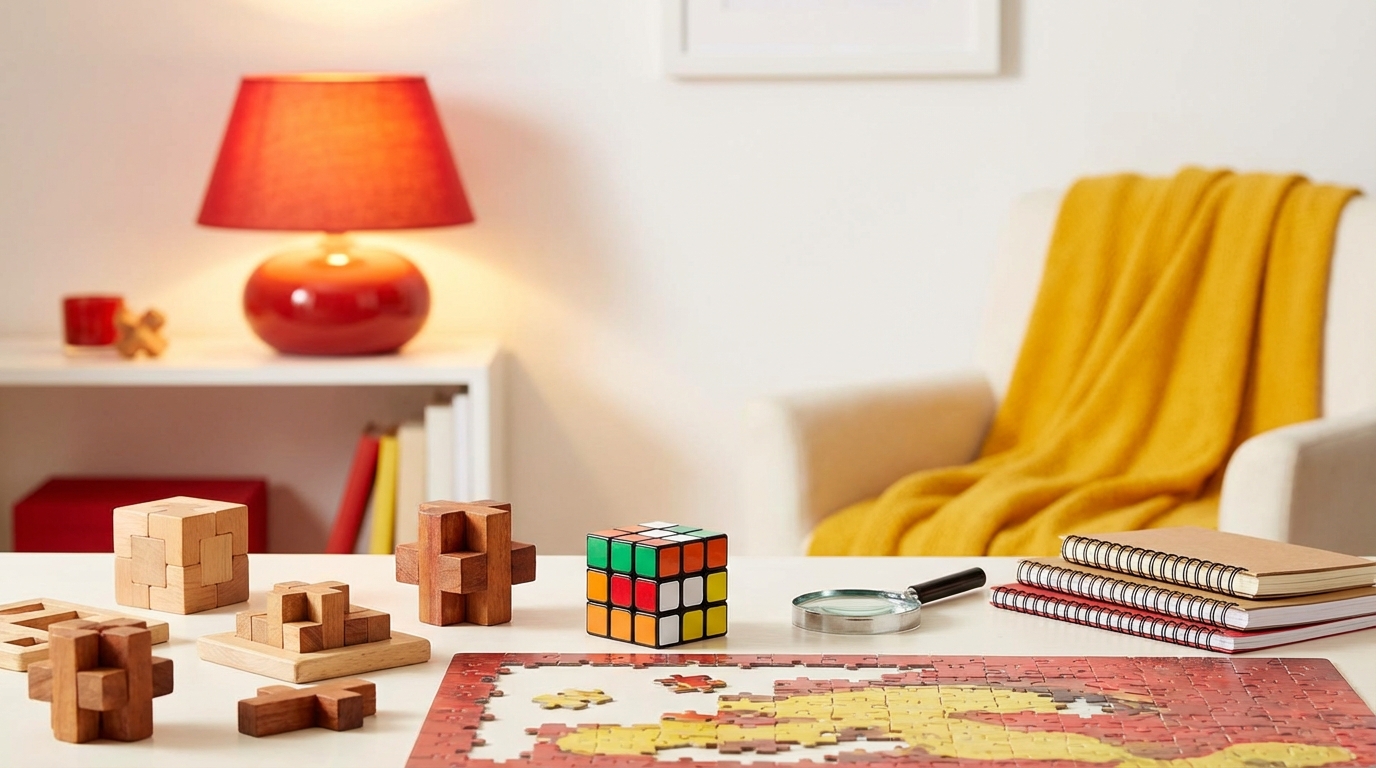
It is not easy to watch a mind you love slow down a little, or to feel your own memory slip on names or details that once came so easily. Many of us quietly wonder if there is anything gentle and realistic we can do to keep our minds steady, curious, and engaged as the years go by.
The short answer is yes: regular mental challenges like puzzles, word games, and even thoughtful escape room experiences can help keep thinking skills sharper for longer. They do not cure dementia or erase aging, but they can support attention, memory, problem solving, and mood, especially when they are fun, social, and matched to the person’s abilities.
Brain games work best when they feel like play, not pressure. A little bit, most days, often helps more than a long, stressful session once in a while.
How Puzzles Support a Healthy, Aging Brain
Before we talk about specific games, it can help to understand why puzzles and mental challenges matter at all. Many caregivers feel so stretched by basic daily tasks that “brain games” can sound like one more burden on the list. Knowing the “why” can make the “how” feel more worthwhile.
The basic science in simple language
Our brains change across our whole lives. Some changes are natural: it can take longer to find a word, to shift between tasks, or to keep track of several things at once. Other changes are harder, such as early dementia, strokes, or head injuries.
Even with these challenges, the brain keeps a certain ability to adapt. It can build new connections between brain cells and strengthen existing ones when we use our skills in a consistent way. Puzzles and games are one of the gentlest tools we have for this.
You might think of it like this: we do not build muscle by staring at our arms, we build muscle by using our arms in ways that feel a bit challenging, over and over, with rest in between. The brain works in a similar way.
Here are some of the main thinking skills that puzzles tend to touch:
- Attention: focusing on one thing and ignoring distractions.
- Short-term memory: holding information in mind long enough to use it.
- Working memory: juggling pieces of information while solving a problem.
- Processing speed: how quickly we can understand and respond to information.
- Executive function: planning, organizing, and choosing strategies.
- Visual-spatial skills: understanding shapes, positions, and patterns.
- Language skills: finding words, reading, and understanding clues.
Different kinds of puzzles touch different parts of this list, which is one reason variety can help.
The goal is not to “beat” aging, but to keep using and enjoying the abilities we still have, for as long and as fully as we can.
The emotional side: why feeling engaged matters
There is another piece that often gets less attention, and that is emotion. Many older adults, and many caregivers, live with quiet worries about decline. There can be a sense of shrinking: fewer outings, fewer new experiences, more television, more isolation.
Gentle brain challenges can help to:
- Bring back a sense of competence (“I can still do things”).
- Support mood by offering small, frequent successes.
- Encourage connection when games are shared with others.
- Break up long days that all feel the same.
For many families, a simple daily puzzle becomes a shared ritual: a crossword at breakfast, a jigsaw in the afternoon, a word game before bed. This rhythm can calm both the person receiving care and the caregiver.
What research really says about brain games
It is easy to run into bold claims about brain training. Many ads say that a certain app or program will “reverse aging” or “prevent dementia.” Current research does not support those big promises.
Here is what studies tend to show more reliably:
| Finding | What it means for us |
|---|---|
| Regular mental activity is linked with better thinking skills in older adults. | People who keep their minds active tend to do better on memory and thinking tests over time. |
| Benefits often match the type of training. | Practicing memory games mainly helps memory; practicing planning tasks mainly helps planning. |
| Social and enjoyable activities seem especially helpful. | Games played with others often bring both cognitive and emotional benefits. |
| No single game can “prevent” dementia. | Games are one piece among many: sleep, movement, blood pressure control, diet, and social life also matter. |
Brain games are not magic, but they can be a kind of gentle physical therapy for the mind, especially when used alongside good medical care, movement, sleep, and social connection.
Types of Brain Games and What They Help With
Now we can look at the kinds of puzzles and games that tend to help, and how each one supports different parts of thinking. You can treat this as a menu, not a to-do list. No one needs all of them.
Word puzzles and language games
Word-based games are familiar to many older adults, which lowers anxiety and makes it easier to start.
Common examples include:
- Crossword puzzles (full-sized or mini)
- Word searches
- Word scramble games (unscrambling letters into words)
- Fill-in-the-blank or “hangman” style guessing games
- Simple story prompts (“Tell me three things that could happen next in this picture”)
These tasks tend to support:
- Word finding: recalling names and everyday words.
- Reading skills: keeping up comfort with written text.
- Spelling and phonics: useful for many stroke survivors.
- Memory: when clues connect to past knowledge.
For a person with mild memory problems, you might gently lower the difficulty by:
- Using larger print.
- Choosing themed puzzles based on familiar topics (music from their era, favorite sports, classic movies).
- Letting them “team up” with you rather than solve alone.
Number puzzles and logic games
Number puzzles are not only for “numbers people.” When kept at a gentle level, they can be less language-heavy and more about patterns.
Examples:
- Very easy Sudoku or 4×4 versions.
- Simple arithmetic puzzles (fill in the missing number).
- Logic grid puzzles at beginner level.
- Dominoes, Rummikub, or simple card games that involve counting.
These can be helpful for:
- Working memory: holding several steps in mind.
- Logical thinking: drawing conclusions from clues.
- Attention to detail: noticing small differences.
Many caregivers learn quickly that not every game is right for every person. If number tasks cause stress or bring back math-related shame from school years, it is fine to skip them and lean on other types.
Jigsaw puzzles and visual-spatial games
Jigsaw puzzles are gentle, tactile, and easy to share at a table. They also allow people to join and leave at any time, which can be helpful in multi-generational homes.
Board and card games that rely on patterns and shapes (like matching games or simple tile games) fall in this group as well.
These help with:
- Visual scanning: searching the table for colors and edges.
- Spatial awareness: turning pieces in the mind.
- Perseverance: sticking with a task long enough to feel success.
To make jigsaw puzzles more accessible:
- Choose fewer, larger pieces (12, 24, or 36 pieces), especially for someone with dementia or visual changes.
- Select clear, simple images rather than busy scenes.
- Use good lighting and a non-glare surface.
- Sort edge pieces with the person to give an early sense of progress.
Memory and matching games
Classic “memory” card games, where you flip over cards and try to find pairs, are a direct workout for short-term memory. The key is to keep the grid very small at first: 4 cards, then 6, then 8, and so on.
Other memory-supporting activities include:
- Short list recall (read 3 items, then ask the person to repeat them a minute later).
- Spot-the-difference pictures.
- Photo matching (matching old family photos by face, place, or decade).
These activities can feel very tender. They may remind a person what they no longer remember easily. It can help to speak gently and to praise effort rather than outcomes.
When memory is fragile, it helps to say, “You remembered more this time,” or “I like how carefully you looked,” instead of “No, that is wrong.”
Physical puzzles and hands-on challenges
Not all puzzles happen on paper or screens. Many older adults prefer things they can hold.
Examples:
- Wooden shape sorters or tangram puzzles.
- Large-print “maze” books with a pen or marker.
- Simple construction toys for adults, like magnetic tiles or large building blocks.
- Everyday problem-solving tasks, such as re-arranging a drawer together by size or color.
These support:
- Eye-hand coordination.
- Planning: deciding which step to take first.
- Sensory comfort: many people find touching smooth wood or tiles soothing.
Escape Rooms: A Social “Mega-Puzzle” For The Mind
Many families ask if more complex puzzle experiences, like escape rooms, are suitable for aging adults or for people with mild cognitive changes. The idea can feel both appealing and intimidating.
When we speak about an “escape room” in this context, we may mean either:
- A real, in-person escape room business where you go to a physical space with themed rooms and puzzles.
- A home-based or tabletop escape room kit, board game, or online version that brings escape room style puzzles to the kitchen table.
Both options can bring a cluster of helpful challenges together in a single, shared experience.
Why escape rooms are powerful brain workouts
Escape rooms, at their best, bring together many of the skills listed earlier:
| Escape room element | Thinking skills involved |
|---|---|
| Time limit and story | Attention, motivation, emotional engagement |
| Hidden clues and patterns | Observation, visual scanning, curiosity |
| Locks, codes, and sequences | Working memory, planning, reasoning |
| Team communication | Language skills, turn-taking, listening |
| Physical searching and handling props | Mobility (when possible), coordination, orientation |
In many ways, an escape room is like a “mega-puzzle” that touches nearly every part of the mind in a playful setting.
For many older adults, the appeal of an escape room is not the “escape” at all, but the laughter, teamwork, and shared sense of adventure.
Choosing the right kind of escape room
A full commercial escape room, with dim lighting, loud sound effects, and strict time limits, may not be right for every older adult or caregiver. Some people enjoy that intensity. Others find it overwhelming, especially with sensory issues, mobility limitations, or anxiety.
Here are some gentle guidelines:
- Consider a home or tabletop escape room first. Many companies now sell escape room kits or board games that recreate puzzles at home without the physical stress.
- Look for family-friendly rooms. Seats, brighter lighting, and slightly simpler puzzles often appear in rooms meant for mixed ages.
- Ask about accessibility. Before booking, ask if there are chairs in the room, whether everything is reachable from a seated position, and whether the room can be kept unlocked for comfort.
- Choose themes wisely. Some themes can be frightening or triggering (prisons, hospitals, horror). Many families do better with lighter themes, such as treasure hunts, mystery libraries, or travel adventures.
It is completely acceptable to decide that a physical escape room is not a good fit at all. The tabletop and home options can deliver many of the same brain benefits with far more control.
Adapting an escape room experience for aging adults
With a little planning, you can shape an escape room style activity so that it supports thinking, rather than overwhelming it.
Some strategies:
- Play in “open book” mode. Ignore strict time limits. Focus on completing as many puzzles as feels comfortable.
- Create roles. An older adult with memory loss might be the “clue keeper,” in charge of holding and sorting found clues, while others handle complex decoding.
- Offer hints freely. Instead of letting frustration build, gently offer leading questions such as, “What else did we see that had these colors?”
- Use large-print and high-contrast clues. If you create your own mini escape room at home, print everything in large, dark font on light paper.
- Break the story into chapters. Play for 20 to 30 minutes, take a tea break, then return for the next “chapter.”
Many caregivers find that when they frame the game as a shared adventure, not a test, older adults relax and enjoy themselves, even if they cannot solve every puzzle alone.
Simple “escape room” style ideas you can create at home
If a commercial escape room or boxed game feels like too much, you can create a tiny, gentle version yourself as a family activity.
Here are some simple ideas:
- Treasure trail with clues: Hide a small treat or gift. Create 3 to 5 large-print clues that lead from one location to the next, each with a very simple riddle or picture hint.
- Photo clue chain: Print or show photos of rooms or objects around the home. Each photo points to the next location where a clue is taped.
- Code with a key: Write a short message using a basic substitution code (A = 1, B = 2, etc.). Provide the key alongside it so the person uses matching, not guessing from scratch.
- Sorting “lock”: Present a box that “opens” only when three items are placed on top in the correct order (for example, red ball, blue cup, green spoon). The person must find these items around the room from hints.
These home-made games can be repeated with small changes, and they allow you to quietly match difficulty to the person’s current ability.
Making Brain Games Safe, Kind, and Sustainable
There is a risk that brain games become one more pressure on both the caregiver and the person receiving care. Our goal instead is to fold them gently into daily life in a way that feels kind and realistic.
Signs a game is the right level
You can watch the person’s face and body language as a guide. Good signs include:
- Leaning in or reaching for the puzzle on their own.
- Sighs of effort, but not anger.
- Smiles or small laughs, even when mistakes happen.
- Interest in returning another day.
Worrying signs include:
- Statements like “I am stupid” or “I always get this wrong.”
- Visible tension in the shoulders or jaw.
- Withdrawing from the table, staring away, or shutting eyes.
- Anger or accusations, such as “You are tricking me” or “This is not fair.”
If the latter appear, it is not a failure. It is simply a signal that the task is too hard, too long, or too tied to painful memories of being “tested.”
The right brain game offers a small stretch, not a strain. A tiny feeling of “This is hard, but I think I can,” rather than “I am lost.”
Gentle ways to offer support without taking over
Caregivers often struggle with how much help to give. Doing everything for the person can take away their sense of ability. Doing too little can leave them sinking.
Some middle-ground approaches:
- Think out loud together. Say your own thinking steps: “I see four blue pieces here. Maybe some of them are part of the sky.”
- Offer choices, not commands. Ask, “Would you like to try another clue, or take a little break?”
- Praise process. Focus on effort: “You kept at that for a long time,” or “You noticed that pattern very quickly.”
- Use the word “we.” Say, “We have three pieces left,” or “We solved that part,” to keep it as a team effort.
If an escape room or complex puzzle is clearly too much on a given day, it is okay to switch to something simpler like a shared photo album or a gentle story game.
Building a simple weekly “brain routine”
For many caregivers, the thought of “daily brain training” feels exhausting. Instead, you might sketch a very light, flexible routine and adapt it as needed.
Here is one example:
| Day | Activity idea | Time |
|---|---|---|
| Monday | Short crossword or word search together over coffee. | 10 to 15 minutes |
| Tuesday | Small jigsaw puzzle session. | 20 minutes |
| Wednesday | Memory matching game with 6 to 8 cards. | 10 to 15 minutes |
| Thursday | Number or logic puzzle at a very mild level. | 10 minutes |
| Friday | Storytelling or picture description game. | 15 to 20 minutes |
| Weekend | Family-style escape room board game or home “treasure trail.” | 30 to 60 minutes depending on energy |
This is not meant as a strict plan, only a gentle example. Many weeks will be disrupted by medical visits, low-energy days, or family needs. That is normal. Even a few sessions in a week are helpful.
Considering physical and sensory needs
When we work with older adults, especially those with disabilities, there are several practical points that make brain games safer and kinder:
- Lighting: Use soft but bright light. Reduce glare on cards and boards.
- Font size: Aim for large print; at least 16 to 18 point for many adults.
- Noise: Keep background noise low. For escape rooms, ask the provider to lower music or sound effects if needed.
- Seating: Offer supportive chairs with arms to help with standing up and sitting down.
- Breaks: Encourage standing, stretching, and bathroom breaks without making the person feel they are interrupting the game.
In some cases, a person may have had strokes or conditions that affect one side of their body or one part of their vision. Placing items on their stronger side, or gently turning the puzzle board, can make a big difference.
When Brain Games Might Not Be Helpful
It is honest and respectful to admit that brain games are not a fit for every person, or for every stage of illness.
Red flags to step back
You might pause or scale down brain game use if:
- The person becomes regularly distressed or tearful during or after games.
- There is strong paranoia or suspicion tied to the idea of puzzles or clues.
- The person is extremely fatigued by short attempts, even when difficulty is low.
- Games become a source of conflict between the caregiver and the person.
In some cases, gentle sensory activities, music, or nature time may be a better fit than formal puzzles. Listening to favorite songs and talking about memories, watering plants together, or sitting outside and naming birds can still engage the mind in a softer way.
Not a replacement for medical care
Puzzles and escape rooms do not replace:
- Regular medical visits for memory concerns.
- Evaluation for depression or anxiety.
- Blood pressure, diabetes, or heart disease management.
- Hearing and vision checks.
If you notice rapid changes in memory, personality, balance, or behavior, it is wise to contact a health professional promptly, even if the person “does fine” with a puzzle one day.
Bringing It Together: Brain Games As Shared Life, Not Homework
When we step back, the goal is not to build a perfect brain training program. Most families simply do not have the time or energy for that, especially while managing medications, appointments, finances, and daily care.
What we can aim for instead is something gentler:
A life that still has challenges, surprises, and small adventures, at a level that is kind to the person and realistic for the caregiver.
Puzzles, word games, and even thoughtfully chosen escape room experiences can be part of that picture. They give us reasons to sit at the same table, to look at the same clues, to laugh when we misunderstand something, and to feel that shared “Oh, now I see” when a puzzle finally clicks.
If you choose to try an escape room style activity, you are not only giving a workout to memory and attention. You are also saying, in a quiet but powerful way, “You are still someone who can play, who can think, who can solve things with us.”
And that message, offered over and over in small ways, might be one of the kindest brain-supporting gifts we can give.