
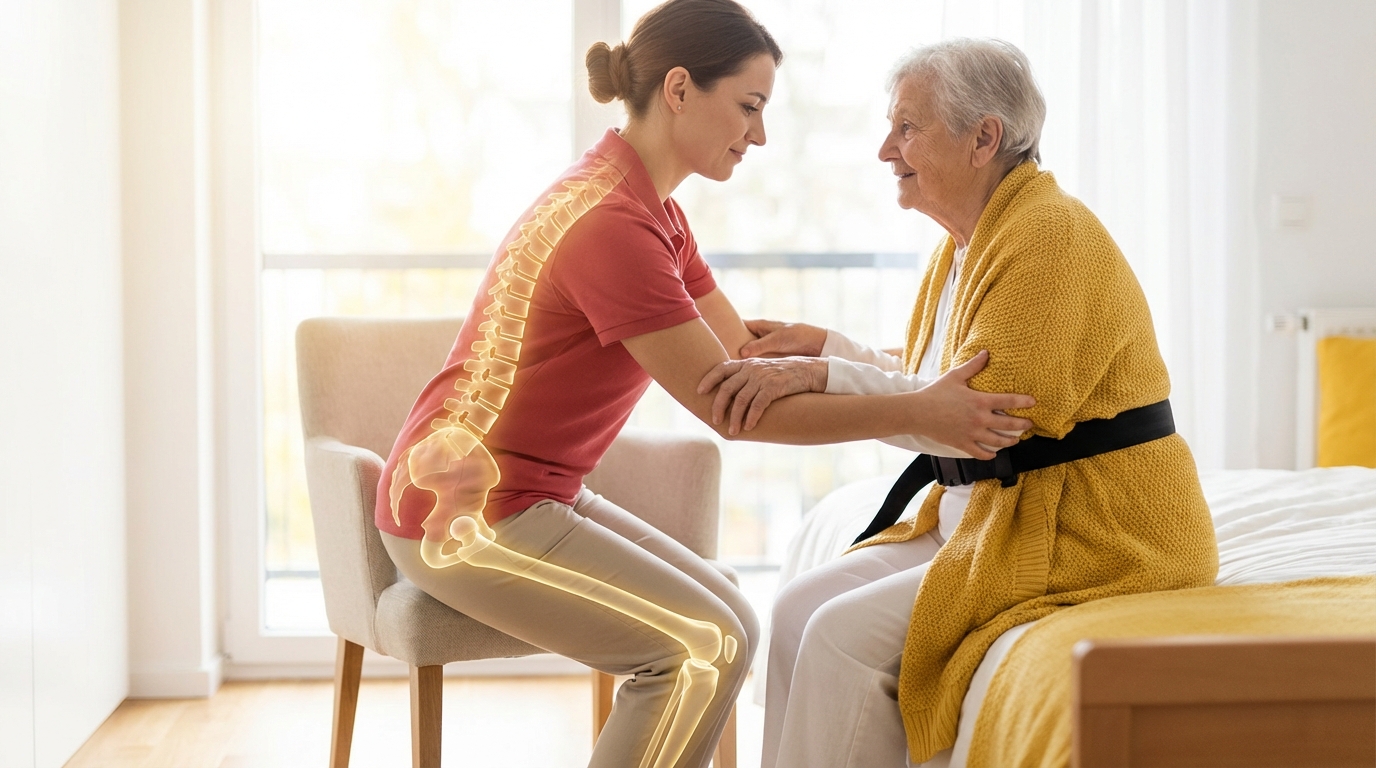
It is not easy to care for someone when your own back, shoulders, or knees ache every day. Many of us quietly push through the pain, telling ourselves that the person we care for needs us, and we can rest later. Over time, though, those little twinges can grow into injuries that make it harder to keep caring at all.
The short answer is that safer lifting comes from slowing down, planning every move, keeping the person you support as involved and active as possible, and protecting your own posture. That means staying close to their body, bending at your hips and knees instead of your back, keeping your shoulders relaxed, and using any equipment available, like slide sheets or hoists, whenever a move feels heavy or awkward. If a lift feels unsafe, it probably is, and it is kinder to everyone to stop and change the plan.
Safe lifting is not about being strong enough. It is about being kind enough to your own body so you can keep caring for the long term.
Why carers are at such high risk of injury
Caring is physical work. We reach, pull, twist, catch, and steady. Often we do this in small spaces, when we are tired, worried, or in a hurry. Many of us are not given full training, or we had it once, years ago, and our daily habits have slipped.
Common reasons carers get hurt include:
- Trying to prevent a fall by grabbing or catching the person suddenly
- Lifting more of the person’s weight than our body can safely handle
- Twisting while we lift or lower, especially around beds and chairs
- Working in cramped bathrooms, cars, and narrow hallways
- Feeling rushed and skipping aids like hoists or slide sheets
- Carrying the emotional load of caring, which makes us ignore our own pain
Many carers blame themselves when they get injured. In truth, injury is a sign that the routines and supports around us need to change, not that we have failed.
If we want to protect our bodies, we have to look at ergonomics: how our body, the person we care for, and the environment around us fit together during each movement.
Understanding the basics of ergonomics for carers
Ergonomics for carers is about arranging tasks, equipment, and spaces so our bodies work in their strongest, safest positions. When we move someone, it involves three parts:
- You: your posture, strength, fatigue, and any existing injuries
- The person you care for: their weight, mobility, pain, fear, and cooperation
- The environment: the bed height, chair type, clutter, floor surfaces, and available equipment
The aim is to bring these three parts into better balance so that no one part carries too much strain.
Here is a simple way to think of it:
| Part | Question to ask | What might help |
|---|---|---|
| You | “Can I do this safely without strain or twisting?” | Adjust your stance, ask for help, rest more often, seek training |
| Person | “How much can they safely do on their own?” | Encourage small movements, use simple cues, respect pain and fear |
| Environment | “What around us makes this harder than it needs to be?” | Raise or lower bed, move furniture, use aids, clear clutter |
Every safe lift starts before you touch the person. It begins in your mind, with a quiet moment of planning.
General principles for safer lifting
1. Think ‘no lift’ first
In many care settings, policies discourage lifting most or all of a person’s body weight without equipment. At home, we often break this rule because we feel we have no other choice. Over time, that choice can cost us our health.
You might find it helpful to adopt a simple personal rule:
“If I have to lift more than I comfortably would at the grocery store, then I need help from equipment or another person.”
That might sound strict, but our spines do not know the difference between a person and a heavy box. They only know strain.
Ways to reduce full lifting:
- Encourage the person to push through their legs, use rails, or support their own trunk
- Use transfer boards, slide sheets, and height-adjustable beds
- Use a standing hoist or full hoist when a transfer feels heavy, rushed, or unsafe
- Split tasks into smaller steps rather than one big move
2. Keep the person close to your body
The farther away the weight is from your body, the harder your back has to work. Holding someone at arm’s length might feel polite, but it is very hard on your spine.
Safer habits include:
- Stand close so that your hips are near their hips or shoulders
- Bring them toward the edge of the bed or chair before trying to stand or turn
- Keep your elbows by your sides, not stretched forward
- Hug-style support (with consent) is often kinder to your back than holding hands and pulling
3. Bend at hips and knees, not at your waist
When you bend from the waist with straight legs, your lower spine bears a large share of the weight. When you bend your knees and hinge at your hips, your big leg and buttock muscles share that work.
When you need to reach lower:
- Keep your feet apart, one slightly in front of the other
- Squat or lunge gently, keeping your back as upright as feels comfortable
- Draw your belly in slightly to support your spine
- Avoid locking your knees
You do not need to sink into a deep squat. A small bend often helps a lot.
4. Avoid twisting while lifting
Twisting while you lift is one of the quickest paths to back injury. This often happens around beds, when we reach across someone and then twist to pull them toward us.
Safer alternatives:
- Move your feet to turn your whole body, instead of twisting your spine
- Take small side steps or a gentle pivot, keeping your hips and shoulders facing the same direction
- Reposition furniture or adjust the bed so you can face the person directly
- Use slide sheets so you push or pull with less effort and less twisting
5. Use gentle rocking and weight shift
Instead of one big heave, our bodies work better with gentle, rhythmic movements.
You might find it useful to:
- Count “1, 2, 3” together before moving, so you both work at the same time
- Shift your weight from your back leg to your front leg, letting your legs do the work
- Use small rocking motions to help someone go from sitting to standing
This approach is usually more comfortable for the person you are moving as well, especially if they live with pain or stiffness.
6. Plan your moves and clear the space
Rushing is the enemy of safe lifting. Many of us are juggling medications, meals, appointments, and our own families, so it feels natural to hurry. Hurrying increases mistakes and strain.
Before a transfer or lift, take a quick pause to check:
- Is the floor clear of rugs, cables, or spills?
- Is the bed or chair at a height that suits your hips, not just theirs?
- Is any needed equipment (walker, hoist, slide sheet) close at hand and in good condition?
- Does the person understand what you are about to do?
A 10-second pause to plan can save you months of recovery from a back injury.
Protecting your own body: posture, stance, and breath
Neutral spine: what it means in daily care
You may have heard of keeping a “neutral spine.” In simple terms, that means your back keeps its natural gentle curves, instead of rounding forward or arching sharply.
While caring, neutral spine might look like:
- Your ears over your shoulders, not jutting forward
- Your shoulders soft and relaxed, not lifted toward your ears
- Your chest open, not caved in
- Your lower back gently curved, not forced flat or overly arched
You cannot hold perfect posture all day. No one can. The aim is to return to a more neutral position whenever you can, especially during heavier tasks.
Stable foot placement
Your feet are your base. A narrow stance makes you less stable and forces your back and shoulders to work harder.
Safer positioning includes:
- Keep your feet at least hip-width apart
- Place one foot a little ahead of the other when you expect to push, pull, or support weight
- Point both feet in the direction you want to move, to reduce twisting
- Shift your weight between your legs instead of bending at your spine
Using your breath
Many carers hold their breath during hard efforts. This creates tension in the neck, shoulders, and back.
You might try:
- Breathing out gently during the “effort” part of the movement, such as the moment someone stands
- Taking one slow breath in and out before starting each heavier task
- Noticing any jaw clenching and letting your mouth soften
This does not just protect your muscles. It also soothes your nervous system, which is often on high alert when you care for someone day and night.
Working with the person you care for, not against them
Encouraging independence, even in small ways
Every bit of movement that the person can do for themselves reduces the load on your body and supports their dignity.
Ways to involve them:
- Ask them to push with their legs when standing up, even if it is only a small effort
- Guide their hands to use the armrests, bed rails, or grab bars
- Encourage them to turn their own shoulders or hips when rolling in bed, with your support as needed
- Give clear, simple directions one step at a time
For example, instead of saying “Let us get you up,” you might say:
- “Scoot your bottom toward the edge of the bed.”
- “Now bring your nose over your toes.”
- “Push through your feet when I count to three.”
Managing fear, confusion, and fatigue
Fear and confusion can make someone stiff, resistive, or unpredictable during transfers. That increases the risk for both of you.
You might find it supportive to:
- Explain gently what you are doing before you start: “I am going to help you sit up now.”
- Use the same words and routine each time to create a sense of safety
- Check if pain is making movement harder and speak to a professional if needed
- Choose quieter moments of the day for bigger moves when possible, like baths or longer walks
When the person feels safer, they move more smoothly, and your body does not need to fight against their fear.
Common caring tasks and safer techniques
Helping someone sit up in bed
Sitting someone up in bed can strain your shoulders and back, especially if they are far from you or you try to pull them by their arms.
A safer pattern might look like this (only as much as is safe for your situation):
- Raise the head of the bed slightly if you can, so you are not working fully against gravity.
- Ask the person to bend their knees if possible, which gives them more power to help.
- Stand close to the bed, feet apart, near their upper body.
- Use a draw sheet or slide sheet under their shoulders and hips, holding it close to their body.
- On a count of three, shift your weight from your back leg to your front leg, guiding them up rather than pulling with your arms alone.
Try to avoid:
- Pulling on their arms or shoulders directly
- Bending over the bed with straight legs
- Twisting as you pull
Rolling someone in bed
Rolling is easier on your body than lifting if done well, especially with slide sheets.
Safer rolling:
- Stand on the side you want them to roll toward.
- Bend the knee on the far side over the other leg, if they can tolerate it.
- Place one hand on their far shoulder blade and one on their far hip, not on the spine.
- Guide them to roll toward you using a gentle rocking motion, shifting your weight back as they come toward you.
- Keep them close to your body; do not lean far over the bed.
If they are very heavy or unable to help, using slide sheets and having a second person present is safer for both of you.
Helping someone from bed to chair
Bed to chair transfers often involve turning and stepping in a small space, which can strain the back.
General steps that protect your body:
- Place the chair close to the bed on their stronger side if they have one.
- Angle the chair slightly toward the bed so you do not need to twist much.
- Bring the bed to a height where the person’s feet can reach the floor, but you can still work without bending sharply.
- Help them sit up and scoot to the edge of the bed first, with their feet flat on the floor.
- Use a gait belt if taught and safe, so you can support their trunk without pulling on arms.
- Ask them to lean forward (“nose over toes”), and push through their feet as you shift your weight and guide them up.
- Turn your whole body with small steps, staying close to them, rather than twisting your spine.
If they bear very little weight or the transfer feels heavy, a stand aid or hoist is safer than your back alone.
Helping someone stand from a chair or toilet
Toilets and low, soft chairs are hard places for safe standing.
To make it easier:
- Raise the chair height with firm cushions or use a raised toilet seat.
- Position their feet under their knees, not too far forward.
- Encourage them to bring their nose over their toes and push through the armrests or grab bars.
- Stand close, slightly to one side, with a stable stance.
- Support them at their trunk or gait belt area, not by pulling on their hands or under their armpits.
- Exhale together as you stand, timing your weight shift with their push.
Try to avoid pulling them up by their hands or yanking from above, which strains both your shoulders and theirs.
Helping with washing and dressing
Washing, dressing, and personal care can involve repeated small twists and reaches, which build up over a day.
To reduce strain:
- Adjust bed or chair height so you are not bent low for long periods.
- Sit on a stool yourself when washing legs or feet to avoid prolonged bending.
- Bring supplies within arm’s reach before you start.
- Ask the person to lift or move limbs as they are able while you guide gently.
- Use long-handled sponges, sock aids, or dressing sticks if they are available.
| Task | Common strain | Safer habit |
|---|---|---|
| Washing feet | Bending low, rounded back | Sit on a stool, bring foot to a higher surface if safe |
| Putting on socks | Twisting and bending | Use a sock aid or ask the person to cross one leg over the other |
| Changing shirts | Reaching behind the person | Support their trunk with your body close, avoid long reaches around them |
Working safely with hoists and other equipment
Why equipment is an act of care, not a failure
Many family carers feel guilty about using hoists or standing aids, as if they are giving up on hands-on care. In truth, equipment protects both of you and often makes movements smoother and less frightening for the person you support.
Using equipment is not a sign of weakness. It is a sign that you respect your own body and the person you care for.
Types of common aids
- Slide sheets: Slippery sheets used to move someone up or across the bed with less friction and effort.
- Transfer boards: Boards that bridge between bed and chair or chair and wheelchair so the person can slide rather than be lifted.
- Standing aids / sit-to-stand hoists: Devices that support someone as they move from sitting to standing when they can bear some weight.
- Full hoists: Lifting equipment with slings used when someone cannot stand or assist much.
- Grab rails and bed rails: Fixed supports that help the person move themselves more safely.
Safer habits when using equipment
- Ask a nurse, therapist, or equipment provider to show you several times, and take notes or videos if allowed.
- Check weight limits and sling types match the person you care for.
- Always lock brakes when required, such as with wheelchairs, before starting a transfer.
- Keep the person calm and informed about each step so they do not suddenly stiffen or grab you.
- Use slow, smooth movements rather than sudden jerks.
- If the equipment feels awkward, squeaks, or is hard to push, ask for maintenance or review rather than forcing it.
Adapting the home to support safer lifting
Small changes that protect your body
Not every home can be fully adapted, and money is often tight. Even so, small changes can make a large difference for your back and joints.
Areas to look at:
- Bed height: A bed that is too low forces you to bend; one that is adjustable lets you work at a better height.
- Chair height and firmness: Firmer, higher chairs are easier for standing transfers than soft, low sofas.
- Toilet height: Raised seats and grab rails reduce the help needed for standing and sitting.
- Bathroom safety: Non-slip mats, shower chairs, and grab bars reduce sudden slips that lead to emergency lifting.
- Clutter and rugs: Clear paths make it easier to position hoists, walkers, and yourself safely.
You might find it useful to ask an occupational therapist or community nurse to review the home. They often see hazards and possibilities that we miss.
Using furniture layout to your advantage
The position of beds, chairs, and tables affects how much you twist and reach.
Some ideas:
- Place the bed so you can access both sides if possible.
- Leave enough space beside the bed for a hoist or standing aid.
- Angle chairs slightly toward where the person usually transfers from, so you can turn with fewer steps.
- Keep commonly used items at waist height to avoid frequent bending or reaching overhead.
Listening to your body and knowing your limits
Warning signs that your lifting habits need to change
It is common for carers to ignore their own discomfort. Our bodies, however, keep sending messages.
Signals to pay attention to:
- Back or neck pain that worsens after transfers or lifting
- Sharp pain or weakness in the legs, arms, or shoulders
- Tingling or numbness in your hands, feet, or down your legs
- Needing more and more pain relief just to get through basic tasks
- Feeling anxious every time you need to help with a transfer
If you notice these signs, it is not a personal failure. It is a sign that you need more support, training, or equipment. Speaking up early can prevent long-term damage.
When to say “I cannot safely do this alone”
Many carers feel they must say yes to every task, regardless of pain or risk. This is understandable, but it is not sustainable.
There are moments when the safest, kindest response is to say:
“I want to help, but I cannot safely do this transfer on my own. We need extra help or equipment.”
Times when this might apply:
- The person has fallen and cannot get up, and you would need to lift most of their weight
- You are recovering from your own surgery or injury
- The person has become heavier or weaker and your usual method now feels unsafe
- You are too exhausted or in too much pain to maintain safe posture
In these cases, calling for professional help, such as community support, ambulance services for non-injury lifts (where available), or extra family support, protects both of you.
Building your strength and resilience as a carer
Gentle exercises that can help
You do not need a gym program to support your body for caring. Short, gentle exercises can help your muscles cope with lifting and transfers.
You might find it supportive to:
- Practice gentle stretches for your hamstrings, hips, and chest to reduce tightness.
- Do simple leg strengthening exercises such as sit-to-stand from a chair several times a day.
- Strengthen your core with easy movements like pelvic tilts or marching in place while seated.
- Take short walks when possible to keep your circulation and stamina up.
Before starting new exercises, especially if you have pain or other health conditions, speak with a physiotherapist, doctor, or other health professional.
Rest and emotional care
Safe lifting is not only about muscles and joints. It is also about whether your mind is rested enough to plan, to move slowly, and to notice your own limits.
Helpful habits might include:
- Brief rest breaks where you sit down, breathe slowly, and notice where your body feels tight
- Asking family, friends, or community services for short periods of respite
- Talking with other carers, in person or online, about the strain and the small victories
- Seeking support for anxiety, grief, or burnout if they start to overwhelm you
You are not just a pair of strong hands. You are a whole person, and you deserve care as much as the person you look after.
When to seek professional guidance
Getting an ergonomic or moving-and-handling assessment
If you are often lifting or supporting someone, a professional assessment can make a large difference. This might be done by an occupational therapist, physiotherapist, or moving-and-handling specialist, depending on your area.
They can:
- Watch how you currently move and suggest safer alternatives
- Recommend equipment like hoists, rails, or slide sheets
- Advise on bed and chair heights and furniture placement
- Teach the person you care for ways to help more during transfers
Do not wait until you are badly injured to ask for this help. If your back aches regularly or transfers feel like a struggle, that is already a good time.
Talking honestly with health professionals
Sometimes carers feel they must appear strong and capable, so they tell doctors and therapists that everything is “fine.” This can lead to care plans that assume you can safely lift more than you actually can.
When you speak with professionals, you might try saying:
- “I am struggling with the transfers. My back hurts most days.”
- “Our home is small, and I cannot get the hoist in there easily.”
- “I cannot safely catch them if they start to fall.”
Clear, honest information helps them design a support plan that keeps you safer.
Bringing it all together in daily caring
Safe lifting for carers is not one big technique; it is a series of small, kinder choices throughout the day:
- Pausing for a few seconds before each transfer to plan your steps
- Keeping the person as close to your body as possible
- Bending at your hips and knees, not your waist
- Avoiding twisting by moving your feet and turning your whole body
- Using equipment and support whenever a lift feels heavy or awkward
- Listening to your own pain and fatigue as signals that something needs to change
You are not alone in trying to balance safety and care. Many of us are learning, adjusting, and sometimes struggling with the same questions in our own homes and communities. By protecting your own body, you protect your ability to keep showing up with the steady presence and kindness that matter most.