It is not easy to face the fact that getting in and out of the tub or shower has started to feel risky. Many of us quietly hold our breath every time we step over that tub wall or reach for a towel while balancing on one leg, hoping our knees do not give out or that we do not slip on a wet floor. If you are reading this, you are probably trying to make bathing safer for yourself or for someone you love, and that can stir up a mix of worry, relief, and even grief for the changes that aging or disability brings.
The short answer is this: walk-in tubs usually suit people who want or need to sit and soak, have significant mobility issues, chronic pain, or a strong fall risk, while curbless showers often suit people who can still stand (with or without support), want easier wheelchair access, and prefer a more open, modern bathroom. Both can be safe and comfortable if they are installed correctly, but they solve slightly different problems. The best choice comes from looking honestly at current abilities, how those may change, and how many people share the bathroom.
The “right” choice is the one that keeps the person safe, preserves dignity, and fits the bathroom, not the one that looks trendiest or is pushed hardest in advertisements.
How Walk-In Tubs and Curbless Showers Work
Before we weigh pros and cons, it helps to slow down and picture what each option really looks like in daily life, especially on a tired evening or a rushed morning.
What is a walk-in tub?
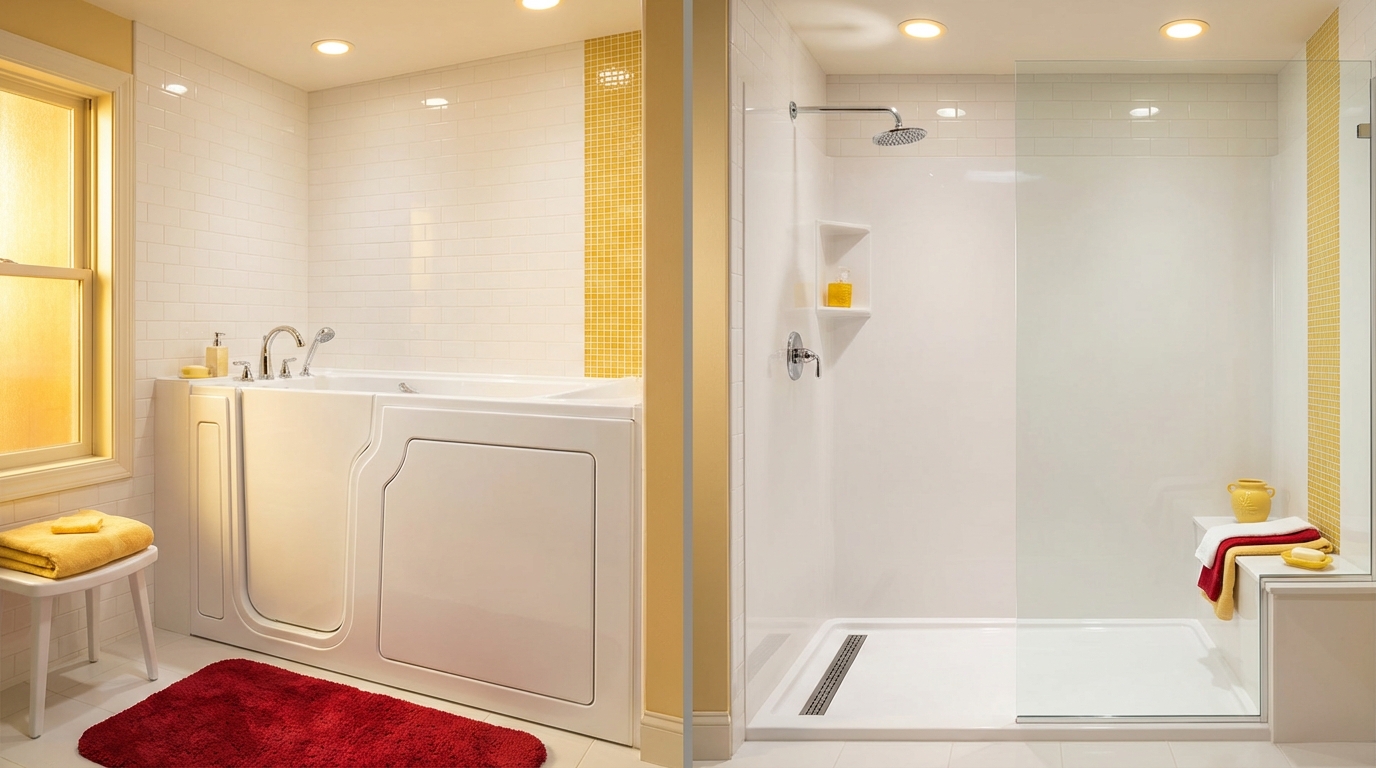
A walk-in tub is a bathtub with a low step-in threshold and a watertight door on the side. The person walks into the tub through the open door, sits on a built-in seat, closes the door, and then fills the tub with water. Many walk-in tubs also have:
- Grab bars
- Handheld shower wands
- Non-slip flooring
- Heated seats or neck rests
- Air or water jets for hydrotherapy
The key point is that you enter the tub without climbing over a high wall. Once inside, you are seated, not standing.
What is a curbless shower?
A curbless shower (also called a zero-threshold or barrier-free shower) is a shower that has no raised edge to step over. The floor slopes very slightly toward a drain, and the transition from bathroom floor to shower floor is smooth. Often there is:
- A wide opening with no door or a wide, easy-to-open door
- A handheld shower head on a slide bar
- A built-in bench or a sturdy, movable shower chair
- Grab bars and non-slip flooring
This design is usually more open and easier for wheelchairs, walkers, and people who shuffle their feet or struggle to lift their legs.
The biggest difference is simple: walk-in tubs are about sitting and soaking behind a closed door, while curbless showers are about rolling or walking into an open, level space to wash.
Who Usually Does Better With Each Option?
Our needs are personal, and they change. Still, some patterns can help guide us.
When a walk-in tub might fit better
Walk-in tubs tend to match people who:
- Love soaking in warm water for pain relief or comfort
- Have arthritis, fibromyalgia, or chronic pain that eases in a bath
- Can sit comfortably for the entire time it takes to fill and drain the tub
- Have enough strength and balance to stand briefly and turn to sit on the built-in seat
- Do not use a wheelchair full time, or can transfer safely with help if they do
- Share the bathroom with others who also want a tub
Walk-in tubs are often helpful for:
| Condition / Situation | Why a walk-in tub can help |
|---|---|
| Arthritis or joint stiffness | Warm soaking can ease pain and loosen joints before bed. |
| Chronic pain (back, hips, legs) | Jets and buoyancy lessen pressure on painful areas. |
| History of falls in a standard tub | Lower step-in and built-in seat reduce risky movements. |
| Cognitive changes but strong bath preference | Set routine with seated bathing feels familiar and soothing, if supervised. |
When a curbless shower might fit better
Curbless showers often match people who:
- Use a wheelchair or walker and need true level access
- Have trouble sitting in one place for long (restless legs, back spasm, breathing issues)
- Prefer quick showers instead of long baths
- Share a bathroom with family who prefer standing showers
- Want the bathroom to look less medical and more like a standard, open shower
Curbless showers are often a better fit when:
| Condition / Situation | Why a curbless shower can help |
|---|---|
| Wheelchair use | Roll in without a step; transfers can be safer and simpler. |
| Progressive conditions (MS, Parkinson’s, ALS) | Space and access adapt better as mobility changes. |
| Serious heart or breathing problems | Person can exit faster if they feel short of breath or dizzy. |
| Multiple users, one bathroom | Works well for both disabled and non-disabled users. |
If a person will likely need a wheelchair or more hands-on help within a few years, a curbless shower often offers fewer barriers and more flexibility over time.
Walk-In Tubs: Pros and Cons
Let us look more closely at what walk-in tubs bring to daily life, both the comforts and the frustrations that families often do not hear about until after installation.
Pros of walk-in tubs
-
Lower step-in height
Many walk-in tubs have a 3 to 7 inch threshold, which is much lower than the wall of a traditional tub. This can feel far safer to someone with weak hips, knees, or poor balance. -
Built-in seat and handholds
The person enters, turns, and sits in a molded seat, often at chair height. This reduces the need to lower the body to the floor of a tub and then stand up again, which is where many falls happen. Grab bars and the tub edge give extra points of support. -
Comforting soaking experience
For many older adults, a warm bath is not just about hygiene. It is about comfort, ritual, and even emotional peace. Warm water can:- Ease muscle tightness
- Reduce joint pain
- Help with sleep
- Lower anxiety and restlessness in the evening
-
Hydrotherapy features
Some walk-in tubs come with air or water jets, chromotherapy lights, or heated surfaces. For those with chronic pain, neuropathy, or circulation problems, these features can give real relief, although not everyone likes the strong sensation. -
Safer than a standard tub for many users
When installed properly with non-slip surfaces and grab bars, and when used with good habits (slow entry, no rushing), walk-in tubs can lower fall risk compared with climbing over a regular tub wall. -
Familiarity for people who “grew up with baths”
Some elders resist showers strongly but feel calm and cooperative when offered a tub bath. Preserving that sense of normal routine can reduce conflict and distress during personal care.
Cons of walk-in tubs
Walk-in tubs are often marketed as if they solve every bathing struggle. In real homes, there are tradeoffs.
-
You must enter and exit with the tub empty
The door seals only when the tub is closed and empty at entry and drained at exit. This means:- You walk in, sit down, close the door, then wait while the tub fills.
- At the end, you wait inside while the water drains before you can open the door and get out.
Sitting wet and cooling down can be uncomfortable, especially for people who get chilled easily or who have poor circulation.
-
Fill and drain time
Depending on the plumbing, water heater, and tub design, filling can take 5 to 10 minutes, and draining another 2 to 6 minutes. During that time, the person is seated and cannot leave.For someone with:
- Bladder urgency or incontinence
- Restless legs
- Shortness of breath
- Anxiety or agitation
this wait can feel long and stressful.
-
Risk if a medical issue occurs while seated inside
If the person feels faint, has chest pain, or panics while the tub is full, they have to wait for enough water to drain before the door can open. Even with a “fast drain” model, this can feel like a very long time when someone is in distress. -
Not ideal for many wheelchair users
A person who cannot stand at all will need to:- Transfer from wheelchair to seat (often across a distance and over a sill)
- Or have a caregiver provide a lift or full support
This can be done, but it is not usually as simple as a roll-in or side transfer to a shower bench.
-
Space needs and door swing
Walk-in tubs are bulky. They may not fit well in very small bathrooms. The door also needs space to open, and some doors open inward, which can make rescue harder if someone collapses inside. -
Higher water use
Many walk-in tubs are deeper than standard tubs. They may need 50 to 80 gallons or more to fill, compared with roughly 30 to 40 gallons for a typical bath. This can:- Strain older water heaters that cannot keep up
- Raise water and heating costs
-
Cost and sales pressure
Walk-in tubs are often sold through high-pressure home visits. Families are sometimes told they must sign contracts on the spot to receive a discount. It is very reasonable to slow down, compare brands, and check independent reviews. Expect the installed cost to be several thousand dollars, sometimes more than ten thousand, depending on plumbing changes and electrical needs for jets or heaters. -
Resale and flexibility
Some future buyers do not like walk-in tubs and will plan to remove them. If the home will be sold in a few years, this can matter. A walk-in tub also cannot easily convert into a standard, open shower for someone who later uses a wheelchair full time.
For many families, the biggest hidden downside of a walk-in tub is not the step-in height, but the “wait time” while seated inside, wet, and unable to get out quickly.
Curbless Showers: Pros and Cons
Curbless showers are often praised for looks and accessibility, but they have their own details that can surprise people.
Pros of curbless showers
-
No step to trip over
Removing the curb removes a common source of falls. For someone who shuffles, drags a foot, or uses a walker, this can make a daily difference. There is no need to swing a leg over anything. -
Best choice for wheelchair and walker access
With the correct slope and drain design, a wheelchair or rollator can enter smoothly. Transfers from a wheelchair to a shower chair or bench can happen right next to the user, which can be safer and less straining for caregivers. -
Faster entry and exit
A person can step in, sit on a bench (or stand, if safe), wash, and then step or roll out as soon as they feel the need. There is no wait for a tub to fill or drain.This matters a lot if someone:
- Has bladder urgency
- Gets dizzy standing too long
- Feels anxious in enclosed spaces
-
Flexible seating options
You can use:- A fold-down wall bench
- A freestanding shower chair
- A transfer bench that straddles the outside and inside
This makes it easier to adjust as needs change instead of being locked into one seat shape.
-
Less water use and less waiting
Showers generally use less water than filling a deep walk-in tub, especially if you keep showers fairly short. There is no long fill time and usually no drain wait that keeps someone stuck in one place. -
Often easier for caregivers
A caregiver can stand beside or just outside the shower, with more room to move. It is easier to reach the person from multiple angles. This can reduce back strain and make assisting with washing more comfortable. -
Can look like a normal, modern shower
Many curbless designs look stylish and not “medical,” which can help with pride and dignity. Family members who do not have mobility issues often like them too, especially if there is a hand shower and a good shelf or niche for products. -
Flexible for future changes
If the person needs more equipment later, such as a larger shower chair or a mobile shower commode chair, a curbless shower is usually easier to adapt than a tub.
Cons of curbless showers
While curbless showers can be life-changing in a good way, they are not perfect.
-
Floor slope and drainage must be done correctly
The shower floor needs a gentle, consistent slope so that water flows to the drain instead of out into the bathroom. If the work is not done well:- Water may pool and cause slips
- Water may spread onto the main floor, leading to wet socks, damp rugs, or even damage
Good planning and experienced installers matter here.
-
Possible splash and spray outside the shower area
An open, doorless design can let more water spray out. To manage this, families often use:- A curtain that hangs to the floor
- A partial glass panel
- Careful placement of the shower head and drain
-
Standing can still be risky for some
A curbless shower does not automatically remove fall risk. The floor can still be slippery when wet, and standing to turn, reach, or bend can be dangerous without:- Grab bars at the correct heights
- Non-slip flooring
- A stable seat
People who are used to quick showers often try to keep standing when they really would be safer sitting.
-
No deep soaking option
For those who truly rely on soaking for comfort or pain relief, a shower cannot replace that feeling. A long, warm shower can help somewhat, but it is different from being supported by water. -
Construction can be complex in some homes
To create a level, curbless entry, the floor sometimes needs to be lowered or reframed. This can raise costs and make the project more invasive, especially in older houses or on concrete slabs. Many people are not warned about this upfront. -
Cold drafts if the space is very open
Some open showers feel chilly for people who are thin, frail, or sensitive to cold. Thoughtful placement of a curtain, glass panel, or heat lamp can help make the space warmer.
A curbless shower can be very safe, but it is only as safe as its details: floor texture, grab bar placement, seating, and drainage design.
Comparing Walk-In Tubs vs. Curbless Showers Side by Side
Sometimes it helps to see how the two options match up on the questions that really matter day to day.
Safety and fall risk
| Factor | Walk-In Tub | Curbless Shower |
|---|---|---|
| Step to enter | Low step (3 to 7 inches), still needs leg lift | No step, level entry |
| Position while bathing | Seated, supported by high walls; less risk of falling while washing | Can be seated or standing; standing carries more fall risk |
| Risk when exiting | Must stand from seat, step out after water drains; floor may be wet, person may be chilled | Can exit as soon as washing is done; floor can be designed to be less slippery |
| Emergency exit | Slower; must drain below door height before opening | Faster; can exit quickly or be assisted out |
Accessibility and caregiver support
| Factor | Walk-In Tub | Curbless Shower |
|---|---|---|
| Wheelchair access | Challenging; usually requires transfer or lift | Good; can roll in or transfer with minimal barriers |
| Caregiver space | Caregiver often stands outside tub; leaning over can strain back | Caregiver can stand beside user, easier to move around them |
| Future changes in mobility | Less flexible if person becomes non-ambulatory | More flexible; can adapt with chairs, benches, or commode chairs |
Comfort, dignity, and personal preference
| Factor | Walk-In Tub | Curbless Shower |
|---|---|---|
| “Feel” of bathing | Soaking, enclosed, spa-like for some | Open, quick, more like a standard shower |
| Temperature comfort | Can cool down during fill/drain; heated seats help | Less waiting while wet; drafts possible if very open |
| Privacy | High walls offer a sense of enclosure | More open; curtains or glass provide some privacy |
| Emotional comfort | Can feel nurturing, like long-time tub baths | Can feel more “normal” for those used to showers |
Cost, installation, and home impact
| Factor | Walk-In Tub | Curbless Shower |
|---|---|---|
| Typical installed cost range | Often higher; can be $5,000 to $15,000 or more depending on features and plumbing | Varies widely with tile and structural changes; simple conversions and prefab pans can be more moderate |
| Construction complexity | May need plumbing upgrades and electrical for jets | May need floor reframing and careful waterproofing |
| Water use | Higher, deep volumes each bath | Lower for most shower routines |
| Effect on resale | Some prospective buyers dislike walk-in tubs | Curbless showers often seen as a plus |
Questions To Ask Before You Decide
This choice affects not just money, but safety and daily stress. It is healthy to pause and ask some honest questions.
About the person who will use it
- Can they safely stand for at least 5 to 10 minutes, or would sitting be safer for nearly the entire bath?
- Do they strongly prefer baths, showers, or are they open to either?
- Do they have conditions that may worsen, such as Parkinson’s, MS, or heart failure, that could limit standing or walking in the near future?
- Are they sensitive to cold or prone to chills?
- Do they have severe arthritis or pain that makes transferring in and out very difficult?
- Is bladder urgency or incontinence a frequent struggle that would make waiting in a tub very stressful?
About caregivers and support
- Will a family member or aide usually be present to help, or will the person bathe alone most of the time?
- Is the caregiver strong enough to help with transfers into a tub, or would a roll-in option protect their back better?
- Will the caregiver need easy access from both sides of the person to wash, rinse, and help with clothing?
About the bathroom itself
- How wide is the bathroom door, and can a walker or wheelchair fit through it?
- Is there enough space for a larger tub, or would that make movement too tight?
- Can the floor structure support changes needed for a curbless shower?
- Where will grab bars go, and are there studs or proper backing in those walls?
- Is there a suitable place for a shower chair or bench that does not block the way?
About long-term planning
- Is this the “forever” home where the person hopes to age in place, or might they move in a few years?
- Is there a chance that two people with different needs will share the bathroom later (for example, an aging couple, or grandparent and family)?
- Could the person need full wheelchair access or a mechanical lift within the next 3 to 5 years?
When we plan for the body the person has today and the one they are likely to have in a few years, we give ourselves fewer crises and fewer rushed, expensive remodels later.
Practical Pros and Cons List
To gather everything in one place, here is a clear list of common pros and cons that caregivers and older adults often report after living with each option.
Walk-in tub: quick pros and cons
- Pros
- Lower step-in height than a standard tub
- Seated bathing with built-in support
- Soaking and hydrotherapy can ease pain and stiffness
- Familiar bath experience for those who prefer tubs
- High sides can feel private and secure
- Cons
- Must sit and wait while the tub fills and drains
- Harder to exit quickly in a medical emergency
- Challenging for full-time wheelchair users and some caregivers
- Higher water use and demand on water heater
- Can be expensive and sold with pressure tactics
- May not appeal to future home buyers
Curbless shower: quick pros and cons
- Pros
- No step, true level access
- Best match for walkers, wheelchairs, and changing mobility
- Faster entry and exit, including during emergencies
- Flexible seating and easier caregiver access
- Usually uses less water
- Often seen as attractive and modern
- Cons
- Requires careful design for slope and drainage
- More splash and possible water on bathroom floor if not planned well
- Standing can still be risky if seating and grab bars are not used
- No deep soak option for those who rely on baths
- Construction can be more complex in some homes
Common Mistakes To Avoid
There are patterns we see again and again when families look back and say, “I wish we had known that earlier.”
Choosing only based on advertising or appearance
Glossy ads can make any option look perfect. Some families choose a walk-in tub because the brochure shows a relaxed, smiling older adult, without thinking about the fill and drain wait times or how hard it might be to help someone transfer into the seat.
On the other side, some families choose a curbless shower only for its clean, modern look, without adding proper grab bars or seating, which leaves a very slippery, open space that is not truly safer.
Not involving the person who will use it
When decisions are made without the input of the actual bather, resistance often follows. For example:
- A person who has always loved evening baths might resent having only a shower, even a safe one.
- Someone with dementia might be frightened by a big, echoing shower but feel calmer in a more enclosed tub.
Whenever possible, it helps to show pictures, visit showrooms, or try out sample tubs or showers to see how the person feels and moves.
Underestimating future decline
Families sometimes think, “She still walks fine, so we do not need to plan for a wheelchair.” Then, within a couple of years, a stroke or progression of illness changes everything, and the bathroom no longer fits.
Planning only for the next six months is a common trap. We serve ourselves better when we also imagine what life might look like in three to five years.
Overestimating caregiver strength
Caregivers, especially spouses, often say, “I can lift him” or “I can always help her in and out of the tub.” Over time, backs wear down, arthritis worsens, and what was barely manageable becomes risky.
If the only way to use a walk-in tub is for someone to pull another adult over a threshold and into a seat, that may not be safe in the long run.
How To Talk With Contractors and Salespeople
This decision is not just about what you want; it is also about the quality of the installation. A good product installed poorly can still be unsafe.
Questions to ask about walk-in tubs
- What is the exact step-in height of the model you are recommending?
- How long does it usually take to fill and drain in a typical home like ours?
- Does our current water heater need an upgrade to support this tub?
- Can we see written reviews from customers who have used this tub for more than one year?
- What is the warranty on the door seal and mechanical parts?
- Can we have time to think and compare without losing the quoted price?
Questions to ask about curbless showers
- How will you slope the floor, and where exactly will the drain be?
- What type of non-slip floor surface will you use?
- Where will grab bars be placed, and how will you reinforce the walls for them?
- Can a shower bench or chair fit comfortably without blocking the entrance?
- How will you contain spray so the bathroom floor does not get soaked?
- Do you have experience with accessible showers or just standard ones?
If a salesperson rushes you, brushes off safety questions, or cannot answer clearly, that is a sign to pause and seek other bids or advice.
When You Might Choose One Over the Other
Sometimes the choice, while hard, becomes clearer when you think about everyday scenarios.
When a walk-in tub may be the better choice
You might lean toward a walk-in tub if:
- The person can walk with or without a cane but struggles to lower themselves into and out of a standard tub.
- They find soaking in warm water deeply soothing for pain, stiffness, or sleep.
- They do not have severe urgency or incontinence that makes long waits very stressful.
- They are not likely to need a wheelchair full time in the near future.
- They have a strong emotional attachment to baths rather than showers.
In these cases, a walk-in tub can preserve a sense of comfort and normalcy while still cutting down on major fall risks.
When a curbless shower may be the better choice
You might lean toward a curbless shower if:
- The person already uses, or is likely to use, a wheelchair or walker.
- They or their caregiver are worried about quick exit in case of dizziness, chest pain, or panic.
- Bathing often needs hands-on help from a caregiver who has back or joint issues.
- Multiple people with different abilities share the bathroom.
- There is limited space, and an open shower offers more room to move.
Here, a curbless shower often supports both safety and long-term independence more effectively.
Small Upgrades That Help Either Choice
No matter which path you choose, some simple, thoughtful additions make a big difference.
Shared supports for both walk-in tubs and curbless showers
- Grab bars in the right places
At entry, near the seat or bench, and near the controls. These should be anchored into studs or backing, not just tile. - Non-slip flooring
Inside the tub or shower and on the bathroom floor where wet feet will step. Textured tile, safety coatings, or non-slip mats can help, but loose mats can trip people if they are not secured. - Good lighting
Bright, glare-free light helps with depth perception, especially for those with vision changes. A night light or motion-activated light can make night-time bathroom visits safer. - Handheld shower head on a slide bar
This works for seated or standing users and lets caregivers help without drenching themselves. - Comfortable room temperature
A small, safe space heater outside the wet area, a heated towel rack, or a bathroom heat lamp can help keep chills away, which can reduce shivering and the muscle tension that can trigger falls.
Sometimes, even while saving for a larger project, these smaller changes can make the current bath or shower much safer for now.
Accepting That Needs Change
One of the hardest parts of making a decision like this is acknowledging that a body, or a loved one’s body, is changing. Choosing between a walk-in tub and a curbless shower is not just about fixtures; it is about grieving losses, protecting dignity, and adjusting to new realities.
It is natural to feel unsure, to change your mind a few times, or to worry about making a mistake. No solution will feel perfect in every way. What we can do is focus on real daily safety, emotional comfort, and long-term adaptability, instead of on slogans or trends.
If you still feel stuck between the two choices, it can help to:
- Ask the primary care doctor or physical therapist what they expect mobility to look like in a few years.
- Speak with an occupational therapist who can assess the home and suggest specific features.
- Visit a local showroom where the person can actually sit in a walk-in tub or on a shower bench.
Taking these steps can bring the decision out of the world of glossy photos and into the more grounded space of how it feels to move, sit, stand, and breathe in real time.