The phone goes at ten past seven. Your mum says she’s fine, then mentions she’s had her coat on indoors since yesterday and the radiators feel lukewarm. You’re a long way from her front door, and you have a meeting at nine.
A heating fault is an annoyance for most of us and a safety problem for someone frail, so it pays to sort the basics before the cold arrives. If you need a company to look at, one place to start is https://garnettair.com/, and the checks below will help you ask sensible questions of any firm you call. I test home-safety kit for a living, and the dull items on this list matter more than the clever ones.
Find out how warm the house really is
Your mum will tell you she’s warm enough. She’s also the person wearing a coat in the lounge, so trust a thermometer over a conversation. A cheap room thermometer in the living room and another in the bedroom shows what the house is doing at three in the morning, when nobody is watching the dial.
The high-tech version is a wireless sensor that sends the reading to your phone. It’s good when it works, but it needs the home Wi-Fi to reach the room, and a bedroom at the far end of the house is a classic dead spot. When the signal drops, the sensor goes quiet, and quiet looks exactly like “all fine”. My verdict: start with the plain thermometer, and add the connected sensor only if you will genuinely look at the app.
Then walk the house once. A sofa against a radiator, long curtains hanging over it and a gap under the front door all quietly steal warmth, and moving a chair costs nothing.
Carer’s checklist
- Put a room thermometer, ideally one with a memory for the lowest reading, in the living room and the bedroom.
- Check that furniture and curtains aren’t blocking the radiators.
- Feel for draughts around the front door and the bedroom window.
- If you use a wireless sensor, test the Wi-Fi signal in that room before you rely on it.
Book the service before the cold does it for you
Heating systems tend to fail when they’re working hardest, which is also when every engineer in the area is busiest. A service in early autumn costs you a little planning and saves you a cold week.
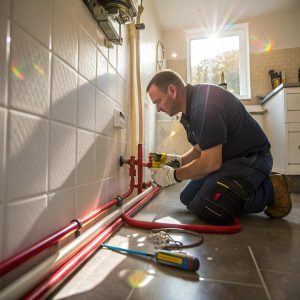
A service is a job for a registered professional, not for you, and not for a handy neighbour. Ask to see their registration before they start, and ask for a written record afterwards. What you’re paying for is a check that the system runs safely and efficiently, and that small faults are caught before they become a breakdown.
If your relative lives some distance away, the booking is the part you can do from your desk. Have a look at a company’s own website first to see what it offers and whether it covers your relative’s address at all.
Carer’s checklist
- Book the annual service now, not in the first cold week.
- Ask the engineer to show proof of registration, and keep the written record.
- Put the date of the next service in your phone calendar.
- Decide who will let the engineer in, and warn your mum the day before.
Fit the alarms, then test them on a schedule
Any heating that burns fuel can, if it’s faulty, give off carbon monoxide, which you can’t see or smell. A carbon monoxide alarm is inexpensive, and it’s the one piece of kit I’d call non-negotiable in a home with a fuel-burning boiler, fire or cooker. Fit it as the instructions say, and ask the engineer at the service whether it’s in a sensible spot.
Alarms fail in dull ways. The battery dies and the chirp gets ignored, the unit has passed the replacement date printed on it, or it’s stuck on a shelf nobody can reach. Press the test button each time you visit, and put every replacement date in your phone.
Low-tech or high-tech? A plain battery alarm is loud and doesn’t need Wi-Fi. A connected one can send a message to your phone, which helps when you live far away, but it’s only as dependable as the router it relies on. If your mum is hard of hearing, ask about alarms with a flashing light or a vibrating pad for the bedside, because a sound she can’t hear protects nobody.
Carer’s checklist
- Check there’s a working carbon monoxide alarm and a working smoke alarm, and read where the instructions say to place them.
- Press every test button whenever you visit.
- Note each replacement date in your phone.
- If hearing is poor, ask about flashing-light or vibrating alerts.
Choose controls your mum can actually use
The cleverest thermostat in the world is no use if she can’t read it. Look at what she can manage: small print, a touchscreen, a menu five levels deep. If she has started leaving the heating on one setting because she’s afraid of undoing it, the controls are the problem, not her.
| Option | Cost band | Suits | What to watch |
|---|---|---|---|
| Simple dial thermostat | Low | Someone who wants one clear control | Easy to leave too low, and it won’t follow a routine |
| Programmable timer | Low to moderate | A steady daily routine | Tiny buttons, and the clock needs resetting after a power cut |
| Smart thermostat with an app | Moderate | A carer who wants to see and adjust things from afar | Needs working Wi-Fi and a phone; your mum may never touch it |
Fitting or swapping a thermostat or timer that is wired into the boiler is a job for a qualified heating or electrical professional. Please don’t try it yourself. Ask them to show your mum the new controls and to leave a one-page instruction card in large print.
If you can change the settings remotely, tell her first. A house that warms up by itself is unsettling for anyone who lives alone.
Carer’s checklist
- Check she can read and reach the controls without a stool or a search for her glasses.
- Choose the simplest control that does the job.
- Leave anything wired in to a professional, and ask for a large-print instruction card.
- Agree with your mum before you change settings from a distance.
Plan for the day the heating breaks
Every system breaks eventually, and for someone frail the first few hours matter most. Decide now where she would go to keep warm: one room with the door shut, a neighbour’s front room, or a few nights with you.
If you keep a portable electric heater as a backup, check its plug and lead for damage, stand it clear of curtains and bedding, and never use it to dry washing. Anything that looks worn should be checked by a professional or replaced.
Write the key numbers on a card by the phone: the heating company, the energy supplier, a neighbour with a spare key, and you. Ask the heating company before you need it what happens if the system fails in the middle of winter, and how it handles urgent calls from older or unwell customers. Ask her energy supplier, too, whether it keeps extra support for customers who need it. Some do, and it’s a ten-minute phone call.
Carer’s checklist
- Pick the warm fallback room, and tell her which one it is.
- Check any portable heater for damage and keep it clear of fabric.
- Write the heating company, supplier, neighbour and your own number on a card by the phone.
- Ask the heating company what its out-of-hours arrangements are.
- Ask her energy supplier about extra support for customers who need it.
If you only do one thing this week
Book the service. Ring the company that looks after her heating, or look up one that might, give them a date before the cold sets in, and put it in both your diaries.
You can’t warm a house from a distance, but you can make sure the right people and the right kit are in place, and that’s a good week’s work.